
By Bernard Hickey
Do you think the money you have in a bank term deposit is government guaranteed?
If you think it is then you're not alone.
You're wrong, but you're not alone.
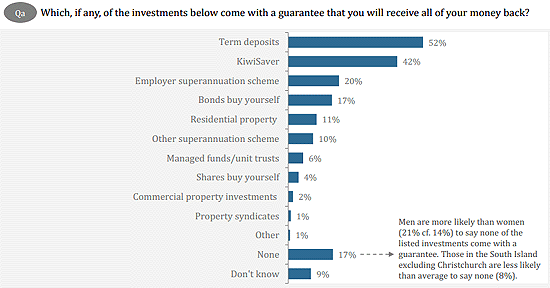
A survey conducted for the Financial Markets Authority by Colmar Brunton and published during Money Week found 52% believed the money in a bank term deposit was guaranteed.
To be fair, there was a period during the Global Financial Crisis from October 2008 to December 2011 when these deposits were guaranteed. Banks paid a fee for the privilege, but that scheme is over now.
Those term deposits are 'naked'.
So what would happen if a bank fell over?
Would you get all your money back and would the taxpayers of New Zealand step into to make sure you got all your money back?
The simple answer is we don't know for sure.
The Reserve Bank has created a system that would allow a bank to be shut down over a weekend and reopen after a restructure that could see those deposits given a 'hair-cut'.
This means the Reserve Bank would arbitrarily freeze a portion of the deposit to ensure the bank can open again on a Monday. You might eventually get all your money back. You might not.
This system is called Open Bank Resolution (OBR) and is designed as another option for the Government, if it chooses not to bail out a bank.
That's all fine and in line with what many central banks are doing overseas to solve the problem of moral hazard. That's the problem of where savers, shareholders and bankers bet they can take lots of extra risk because taxpayers will always bail them out.
Essentially these type of OBR or 'living will' systems being adopted around the world mean regulators and politicians are saying to these bankers and savers that they must understand there's a risk they could lose their money.
The idea is those savers and bankers will take that risk into account and demand an appropriate and probably higher return for that risk.
But this big bargain, which is designed to reduce the problem of 'Too Big To Fail' banks, all depends on savers and bankers actually knowing there is that risk of failure and loss. Those expectations need to be changed for the system to work.
New Zealand's bankers and regulators are well aware of OBR, but this survey shows that at least 52% of New Zealanders are not and that's a dangerous situation.
It means at least half of these depositors would expect the Prime Minister to force taxpayers in general to stump up to pay them out in full. That's a big expectation for any politician to stare down and even less likely when taxpayers have no idea they don't have to be on the hook.
It means that, essentially, there is currently an implicit government guarantee.
Hundreds of thousands of New Zealanders have over NZ$127 billion in bank accounts, yet they are effectively guaranteed for free by their fellow four million taxpayers. That's simply not fair on taxpayers in general who are in effect providing a guarantee they don't known about to a much smaller group of savers.
Bankers are also getting something of a free ride. It is an implicit guarantee without the deposit insurance fees they had to pay from 2008 to 2011.
The way to solve this problem of the implicit and unspoken guarantee that encourages yet more moral hazard is to inform the public.
The Reserve Bank is very good at public information campaigns and does a great job explaining how it operates monetary policy and manages our currency and payments systems. Shouldn't it also be explaining to those 52% of term depositors about how OBR works and the risks of a haircut?
It's true those risks are very small, but they are there and should be taken into account when savers accept a return for that risk.
It may mean savers demand a slightly higher interest rate, which would be the cost that bank shareholders would either have to bear or choose to pass on to borrowers in marginally higher rates.
Either way, it would be a better informed and less risky market for everyone - bankers, savers, regulators and politicians alike.
Now is a good time to have this type of public education campaign when financial markets are stable and our banking systems are seen as very strong and reliable. There is little risk of 'scaring the horses' at the moment. That would be a big risk if savers and voters were suddenly to find out all about the chances of an OBR haircut or a bailout on some nervous Friday night.
A frenzied press conference is the wrong way to explain this stuff.
This is increasingly relevant and pressing for Prime Minister John Key as he prepares for the G20 Leaders meeting in Brisbane in November. The Bank of England Governor Mark Carney explained this week that the leaders would agree at that meeting to global standards to ensure banks could be restructured without taxpayer bailouts - effectively a set of global OBRs.
The best type of public education campaign would be an explanation from the Reserve Bank and the Government together about what OBR means for savers and taxpayers.
A good system has been built. It works best when we all know about it and can use it.
-------------------------------------------------
A version of this article was first published in the Herald on Sunday. It is here with permission.
We welcome your comments below. If you are not already registered, please register to comment
Remember we welcome robust, respectful and insightful debate. We don't welcome abusive or defamatory comments and will de-register those repeatedly making such comments. Our current comment policy is here.