

By Bernard Hickey
Do we really need to be spending so much on motorways that may not be needed as much in 30 or 40 years?
Do we really think cars and trucks will be the same or use the roads in the same way in 30 or 40 years time?
We're certainly investing as if they will be, but it's worth questioning that assumption.
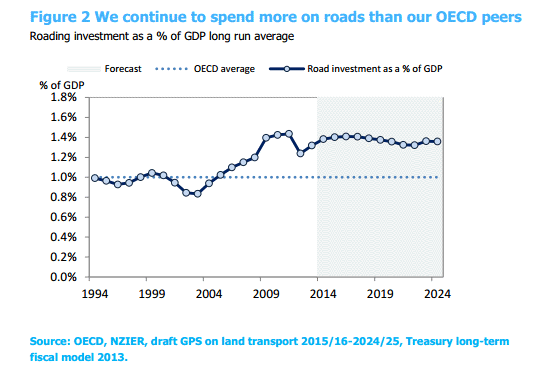
In contrast with our record on research and development spending, New Zealand is certainly investing much more heavily in roads and motorways than others in the OECD.
NZIER published a paper this week by Nick Allison showing New Zealand has been spending 20-40% more than the OECD average since 2008 as the Government has pushed ahead with its Roads of National Significance.
These included big projects in Auckland such as the Waterview connection and Victoria Park Tunnel, as well as Wellington's Transmission Gully and Kapiti Expressway projects.
The spending is expected to ramp up from NZ$3.4 billion next year to NZ$4.4 billion a year by 2024/25. For a Government that prides itself on its frugality and caution when spending money, it is much more aggressive with road investment.
But will we need all these motorways come 2065?
They will still be there and the money will be well and truly sunk, but will the cars and trucks need them?
NZIER questions this given the rapid development of new technologies for driverless cars, collision avoidance, assisted braking and car-to-car communication. The rapid adoption of electric cars could also short circuit the Government's big spending plans.
Firstly, tests are already being done with 'platooning' of cars that can drive closely together in lines in a managed way that reduces congestion.
Driverless cars also open up the option of travellers buying a car service rather than a car itself, reducing the number of cars sitting idly in car parks and driveways - or on motorways.
Adaptive Cruise Control used with smart navigation could significantly reduce congestion.
NZIER pointed to estimates that such technologies could add 43% to 250% to existing road capacity.
There is also the potential for Uber-style services that allow car park and car pooling in a way that reduces car and motorway use.
Do we need to be building big new concrete capacity when a new vehicle fleet packed with a plethora of chips could do the trick much more simply and cheaply?
Secondly, these new technologies hold out the hope of much better road safety through fewer collisions and fewer accidents as predictive technologies brake, decelerate and swerve to avoid accidents. Assisted braking and electronic stability control are just a taster of things to come.
New Zealand already spends NZ$650 million a year on making existing roads safer and promoting road safety. These are technologies that are being much more rapidly adopted than previous new technologies, raising the risk that by the time the motorways are fully built and paid for the use of cars will have changed dramatically.
Anyone watching the development and adoption of smart phones over the last seven years will realise how quickly the landscape could change.
The third spanner in the works for the heavy motorway spending is how it is currently funded.
At the moment motorists pay a levy when they buy fuel, which is then redirected into road maintenance, new roads and road safety campaigns. But the rapid adoption of more efficient hybrid and plug-in electric cars could blow a hole in that revenue base.
Surely it's time for the Government to look at taking a smarter approach to road investment that involves using a lighter and cheaper touch that looks over the horizon at the coming benefits of new technologies.
-------------------------------------------
A version of this article was first published in the Herald on Sunday. It is here with permission.
We welcome your comments below. If you are not already registered, please register to comment
Remember we welcome robust, respectful and insightful debate. We don't welcome abusive or defamatory comments and will de-register those repeatedly making such comments. Our current comment policy is here.