
I love it when a client asks me something that really makes me think, I had one of those questions last week and it’s been sitting with me ever since. Joanne (not her real name) wanted to know how to talk to her parents about their spending. How do you even start that conversation with someone who's retired, set in their ways, and, as she put it, "just not going to change now"?
My first thought, and maybe yours too, was the obvious one: change is hard at any age, and harder still when a habit's had fifty years or more to settle in. But my second thought surprised me. I found myself assuming Joanne’s parents, like most people who grew up on cash and cheque books, long before a credit card lived inside a phone, would probably be good with money. No debt they couldn't see. No invisible spending. Cash has a way of making itself felt on the way out of your hand.
Then I thought about Mum.
She won't put her credit card number into Mr Google (as she likes to call it). Wouldn't dream of it. But she'll happily transfer money, check balances and pay bills through her banking app without a second thought. For a while I read that as a contradiction, comfortable with technology here, wary of it there. It isn't a contradiction at all. It's discernment.
Her banking app is a relationship she, rightly or wrongly already trusts, it’s just wearing a new outfit. A browser checkout is a stranger asking for her card number with no one vouching for them. Looked at that way, hers is a more considered call than a lot of the impulse-buying the rest of us do without thinking twice. I will put myself in that category too. But Jett (the labrador) does love his paddling pool that I bought online with no thought whatsoever.
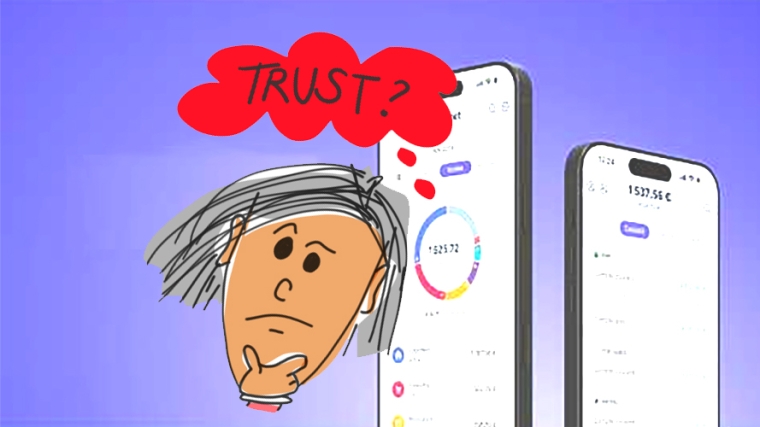
And that's really what I want to explore: the generation who grew up without credit cards didn't just learn to handle money differently; they learned to trust differently. Trust, more than tech skill, might be the real thing shaping how well someone adjusts as money keeps changing shape around them. How does that sit with you?
Because the difficulty is rarely arithmetic. Anyone who's balanced a chequebook for forty years can manage a budget app. What's harder to shift is the identity underneath the habit of "I pay cash," "I don't owe anyone," "I don't buy what I can't picture paying for." Ask someone to change how they spend, and you're not really asking them to update a system. You're asking them to renegotiate who they are with money, at a stage of life when most people feel they've already settled that question.
It's worth remembering, too, that this generation has weathered plenty of monetary upheaval already, sky-high interest rates, banks merging and rebranding, the slow march from passbooks to eftpos to apps all while raising families and running businesses. Adapting isn't new to them. What's new is the pace, and the fact that so much of it now happens invisibly, behind a screen, without the cues cash used to give. That's not a failure to keep up. It's a sensible response to a system that keeps taking away the signals people learned to rely on.
Which is why I'd rather ask a different question than the usual "how do we get them to change?" namely, what would make the new way feel as trustworthy as the old one did? Sometimes that's a person, not a feature: a bank teller who walks them through the app once, patiently, in person. Sometimes it's just permission to keep doing what still works, cash at the market, card everywhere else, instead of an all-or-nothing switch.
I have a friend the same age as me, who still draws cash out of their account every week, not because they don’t like using cards, it’s more of an experiment to see what happens when they want to pay cash for something. They have stopped frequenting some businesses who simply won’t take cash. Over the course of a year, this adds up to a significant amount of money that is going to that business’s competitor.
So, if you're having this conversation with a parent, or on the receiving end of it yourself, I don't think the goal is to modernise anyone. It's to notice where the caution is wisdom in disguise, and where it's quietly costing something, a missed discount, an unnecessary errand, a reluctance to ask for help that would make life easier. Two different conversations. One deserves respect. The other, a bit of gentle, practical support.
I'd love to hear how this shows up in your own family. If there's a version of "the banking app but not Google" happening in your house, I'd be curious to know what it is.
*Lynda Moore is a Money Mentalist coach and New Zealand’s only certified New Money Story® mentor. Lynda helps you understand why you do the things you do with your money, when we all know we should spend less than we earn. You can contact her here.
We welcome your comments below. If you are not already registered, please register to comment
Remember we welcome robust, respectful and insightful debate. We don't welcome abusive or defamatory comments and will de-register those repeatedly making such comments. Our current comment policy is here.