
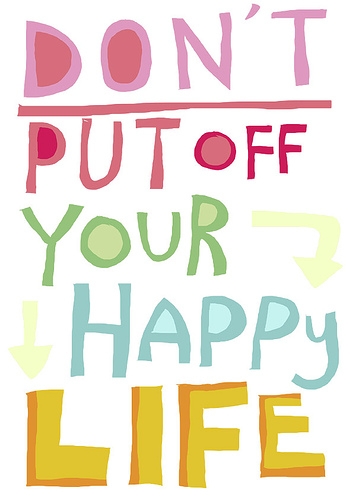
1) Buy later be happy now
I linked yesterday to an article by one of my favourite writer's, Globe and Mail columnist Margaret Wente, writing about the consumer predilection for always wanting more.
In a similar vein, this piece from The Daily Ticker, explores the underlying psychological issues and behaviours driving debt. The heart of the problem, according to Jim Roberts, author of Shiny Objects: Why We Spend Money We Don't Have in Search of Happiness We Can't Buy is that humans are looking for fulfillment in all the wrong places.
The video is worth watching. Roberts doesn't minimise the importance of money rather he cautions against over-valuing money at the expense of the things, or rather people, that provide more sustainable happiness.
I particularly liked this line: "Money is good up to a point as long as the value you place on money and material possessions doesn't supersede the value you place on your personal growth, your relationships and community activity.''
I couldn't agree more. I was reminded of the just how badly our core values have been displaced by our consumer driven culture when I was shown a photograph recently of a traditional Mongolian family standing outside their very modest yurt, which they all shared. I asked my friend whether the family, given their proximity and very basic existence, exhibited any of the usual family dysfunction common in today's Western societies. His observation was that they were on the whole quite a happy bunch in their simplicity with more respect and sensitivity to their environment than most of us will ever know.
2) It's a long life
I marvel quite often at the speed of time, particularly in adulthood. I tend to think this is a short-life. One of my colleagues maintains otherwise and groans about what a long life it is.
Regardless of one's optics, when it comes to financial planning it is better by far to take the latter view as short-term thinking won't leave you well placed in retirement.
Life expectation figures published by Vanguard here show why:
Here's the likelihood of 65-year-olds living to certain ages, according to figures from the Society of Actuaries:
- Male. A 65-year-old man has a 41% chance of living to age 85 and a 20% chance of living to age 90.
- Female. A 65-year-old woman has a 53% chance of living to age 85 and a 32% chance of living to age 90.
- Couple. If the man and woman are married, the chance that at least one of them will live to any given age is increased. There's a 72% chance that one of them will live to age 85 and a 45% chance that one will live to age 90. There's even an 18% chance that one of them will live to age 95, as shown below.
My personal belief is that the Malthusian effect will radically shrink the projected population explosion of oldsters however counting on that as an exit strategy isn't such a hot idea. Plan for a long journey.
3) Ethical investing
A few years back, I naively subscribed my two children into what I believed to be an ethical KiwiSaver fund. I later discovered that in the investment world, what constitutes ethical is very much subjective. Here's a piece I wrote earlier on How to be Good in KiwiSaver.
Similarly, Chris Douglas, co-head of research for Morningstar writes here about how to balance his "hippy wife's'' ethical nature with investment strategies that tend to overlook such matters.
4) Cash for x-mas
Cash in an envelope may be unsentimental but it is proving an increasingly popular gift for kids.
According to this article by Roy Morgan, the percentage of Australian children aged 6-13 who receive money as a gift has increased 10% from 2007 to 2011.
In terms of how they choose to spend that money, it's a close tie between banking it and blowing it on toys. I try to encourage my kids to bank it and sell their older toys on Trade-Me and use that money in turn for used toys. Sometimes they listen to me.
5) 33 side jobs
Sidelines are great for the bank account. The extra revenue can be used to top up savings, reduce debt or buffer against a holiday blow-out, or unexpected repair bill. There's not many people I know who don't have a special skill set that can be translated into profit; be it a knack for baking, making furniture, clothes, tutoring, writing or even mowing lawns.
Here's 33 side jobs for possibilities.
To read other Take Fives by Amanda click here. You can also follow Amanda on Twitter @amandamorrall
We welcome your comments below. If you are not already registered, please register to comment
Remember we welcome robust, respectful and insightful debate. We don't welcome abusive or defamatory comments and will de-register those repeatedly making such comments. Our current comment policy is here.