
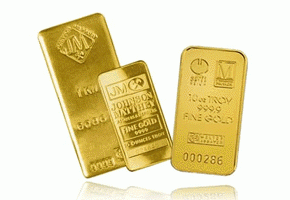
Don't worry if you don't understand the movements in the gold price.
Fed Chairman Bernanke told the US Senate Banking Committee in July that "nobody really understands gold prices and I don’t pretend to really understand them either".
His country is headed for a debt default, its government unable to agree on a Budget, and its debt limit is approaching fast.
You would think the traditional response to this impending crisis would be that gold would reassert itself as a store of value.
But almost the opposite is happening.
Some of the world's central bankers - especially those in emerging economies - seem to be stocking up on the precious metal.
But in doing so they are taking horrendous losses.
Since mid 2011, they have 'lost' US$545 billion in value on their holdings.
Private investors have lost another US$60 billion.
Many 'smart' big money investors like George Soros have quit their holdings entirely. Others, like John Paulson have given up after taking a pounding in value.
Even others, like Warren Buffett, steadfastly refused to get involved in the first place.
Miners have a self interest in talking up its value; and that usually means talking up its scarcity - which is real.
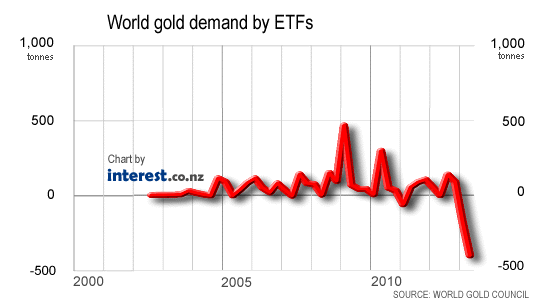
But you need willing buyers who want more than willing sellers are ready to sell for 'supply-and-demand' forces to move the price up.
We are not seeing that.
We are seeing demand from the 'small fry' - the traditional Indian and Chinese buyers, and the apocalyptic Western 'investor'.
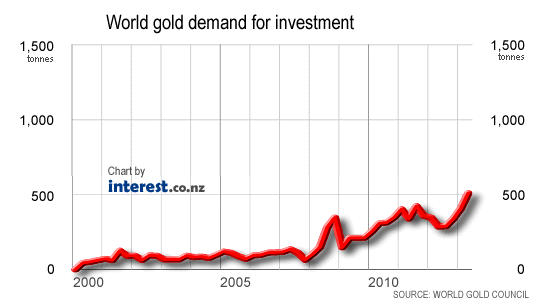
But none of that is enough to push the price higher, even when supported by the Russian and Venezuelan central bank buying.
Or a potential shutdown of the US Government, it seems.
Investors forget that Venezuela has more unmined gold reserves than just about any country. Of course they value it as a resource. But why would they continue to raise their holdings?
If I recall, large gold reserves didn't help the Libyan dictator in a time of severe crisis.
It didn't pan out for John Paulson either.
Like art, and other non-traditional investment assets, there may be a place for it in your investment portfolio. But it will cost you to hold it, and it may decline in 'value' (meaning you may only be able to buy fewer goods and services with it in the future than you could have when you bought it). And if things turn really bad, you can't eat it (but then again, you can't eat any other investment either). In a calamity, would you take gold for food? I suspect you would want to barter for more useful stuff.
The future may work out for investors holding gold, but it is hard to see a rational reason why that would be the case.
Investing in gold is pure speculation.
As per usual, be very wary of those that are certain what the future holds.
(If the embeded video below isn't showing, you can see it here.)
We welcome your comments below. If you are not already registered, please register to comment
Remember we welcome robust, respectful and insightful debate. We don't welcome abusive or defamatory comments and will de-register those repeatedly making such comments. Our current comment policy is here.