

New Zealand average house values have risen by 0.5% over the past three months - the first such rise since the current downturn began in late 2021. And it has Quotable Value tentatively asking the question: "Has the real estate recovery begun?"
QV operations manager James Wilson said "things are beginning to look a little healthier now".
"For the first time in a while we are seeing value increases in some areas of Aotearoa – especially in places where there is strong demand for entry level housing.
"Real estate agencies are beginning to report growing interest for a reduced number of new properties coming onto the market, with buyers having to compete for the best ones. This is pushing up values once again," Wilson said.
QV said the "modest amount of home value growth" in the latest three months had been driven primarily by first-home buyers outside of the country's main urban areas.
The national average is, however still down -8.2% compared with 12 months ago.
"Generally speaking, it’s a case of the more affordable end propping up the market overall, with areas coming off low value bases continuing to be among the strongest performers," Wilson said.
"The obvious exceptions among the main urban areas we monitor are Tauranga and Queenstown, but in both of these places values at the lower end of the market are growing while values at the upper end are still soft."
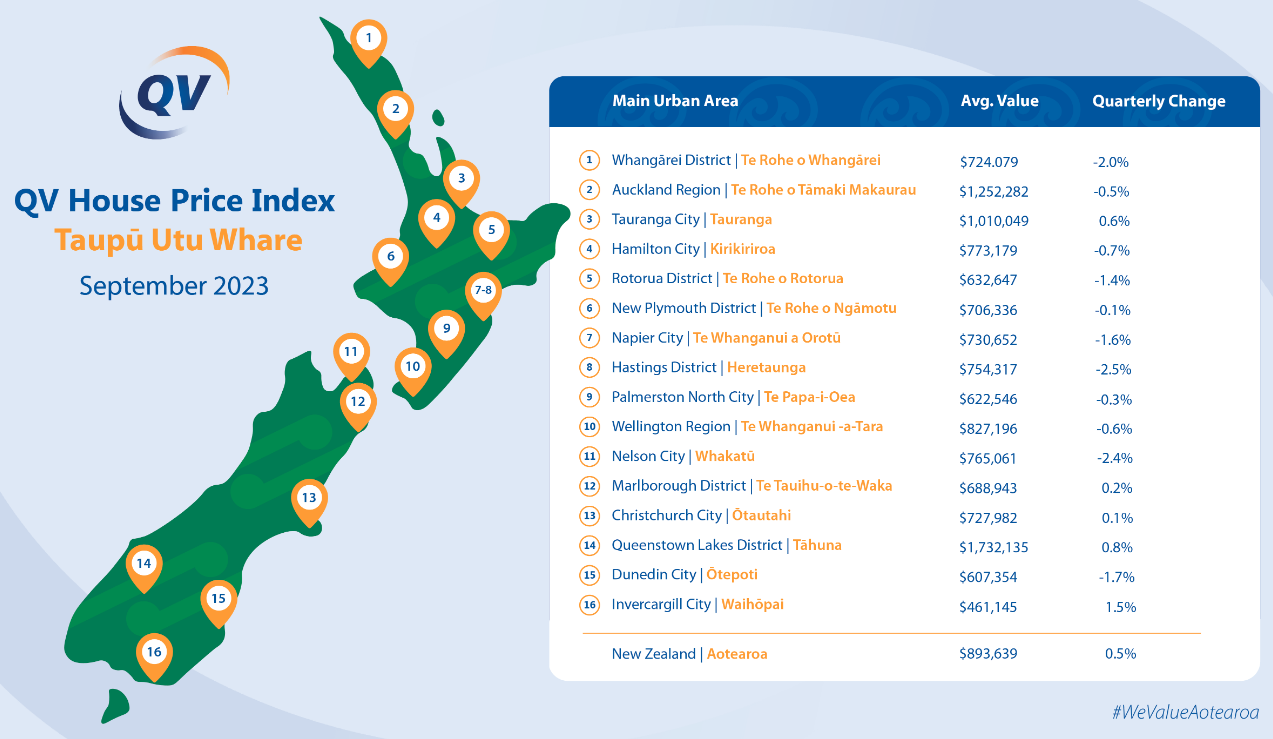
The rolling three-month average nationally rose to $893,639 as of the end of August and it is up from $888,999 in July. The rise in national average in the three months ended August followed a value decline of -1.5% over the three months to the end of July, -1.8% over the three months to end of June and -3.5% for the three months to the end of May.
Regionally, the picture is still patchy. In terms of the three-month rolling averages, just five areas rose, while 11 fell. Those rising were: Tauranga (0.6%), Marlborough (0.2%), Christchurch (0.1%), Queenstown (0.8%), and Invercargill (1.5%).
Among the regions seeing declines, the latest QV House Price Index shows the rolling three-monthly rate of reduction has slowed in Auckland (-0.5%), Wellington (-0.6%) and Palmerston North (-0.3%), and increased by less than a percentage point in Whangārei (-2%), Hamilton (-0.7%), Rotorua (-1.4%), New Plymouth (-0.1%), Napier (-1.6%), Hastings (-2.5%), and Dunedin (-1.7%). The rate of decline in Nelson (-2.4%), stayed the same.
However, in terms of just the last month, there were seven regional increases in price in August against nine decreases, with the prices in Auckland, Tauranga, Wellington, Marlborough, Christchurch, Queenstown and Invercargill all rising when compared with July.
And while the country's largest market Auckland was still down overall on a rolling three-month average, the $1,252,282 figure at the end of August was up some $8672 (0.7%) from the end of July. And this followed a very slight increase between June and July. Going back three months, the rate of decline in Auckland values was running at -2.3%. In the past year values are down -9.5%.
Local Auckland QV valuer Hugh Robson said there has been a moderate increase in the volume of sales and fewer properties listed for sale, "which means there’s currently a shortage of stock on the market. Hopefully the normal ‘spring surge’ in listings will restore some equilibrium to this situation".
In the meantime, he said first home buyers remained the most active group in the market.
“There has been a slight increase in activity from owner-occupiers, and agents are reporting some increased activity from investors, but first home buyers are the main group looking and buying right now. The North Shore, Papakura, and Manukau are the areas that have shown the most value movement in recent times."
In the capital, Wellington, the rolling three-monthly rate of home value reduction has eased for the fifth straight month – with the region even posting a $3096 (0.4%) average home value increase in the month of August to $827,196, although this is still down -0.6% over the past three months. However, going back three months, Wellington's rate of decline was running at -2.6%.
Local Wellington QV senior consultant Blake Ngarimu said home values across the Wellington region had experienced "another month of minimal value movement, with Hutt City and Upper Hutt experiencing small reductions, and Kapiti, Porirua, and Wellington City recording small gains".
In Tauranga, while the three-month average rise was just 0.6%, the average price as at August of $1,010,049 was up some $15,258 (1.5%) on July.
But that figure is still -8.1% less than at the same time last year, including -6.2% lower than at the start of 2023.
QV property consultant Derek Turnwald said Tauranga had experienced a quarterly increase in residential values "for the first time in well over a year, with the average residential value rising to above $1,000,000 again".
"First-home buyers remain the most active group in the market despite high interest rates and tight lending conditions. There is even the beginnings of FOMO amongst first-home buyers now, with a shift toward more of a seller’s market becoming evident," he said.
Home values in Christchurch have experienced what QV described as "a modest increase once more" in its rolling three-monthly rate of home value growth – up 0.1% to $727,982. But it’s a smaller average increase than the 0.8% reported last month.
Local Christchurch QV registered valuer Olivia Brownie said while "the cycle appears to be turning" she expected to see some months positive and some negative throughout the remainder of 2023.
"Economic pressures are still having a firm impact on the Canterbury property market, but the downturn does appear to be over now, with a subdued market expected over the coming months," she said.
Meanwhile QV said the "highly volatile" residential property values continue to "zig and zag" in Queenstown.
The average home value in Queenstown has increased by 0.8% this quarter to $1,732,135 – an improvement on the -1.3% quarterly decline reported in last month’s QV House Price Index. And the latest figure is 2.4% higher than the same time last year.
Back on the nationwide picture, QV operations manager James Wilson said though sales volumes have increased from month to month, new listing numbers continue to soften overall.
“It seems market confidence is increasing, but the upcoming election has also encouraged many buyers and sellers to adopt more of a ‘wait and see’ mindset. It’s also important to remember that strong economic headwinds are still blowing, with many households still re-fixing their mortgages at significantly higher interest rates. It’s likely this will continue to restrict investors in particular."
Wilson said as all eyes now looked toward next month’s general election, the housing market would continue to vary considerably from region to region.
"While values begin to strengthen in some areas, the rate of growth is not expected to bounce back at a significant rate. More likely, we’ll continue to witness flat or gently rising value levels in many areas, while other areas continue to bottom out," he said.
"We’ll have a clearer view of what’s next for the housing market after October 14. By that time, we’ll also have some indication of whether or not we’ll see the usual spring surge in listings that we typically experience around this time of year."
We welcome your comments below. If you are not already registered, please register to comment
Remember we welcome robust, respectful and insightful debate. We don't welcome abusive or defamatory comments and will de-register those repeatedly making such comments. Our current comment policy is here.