
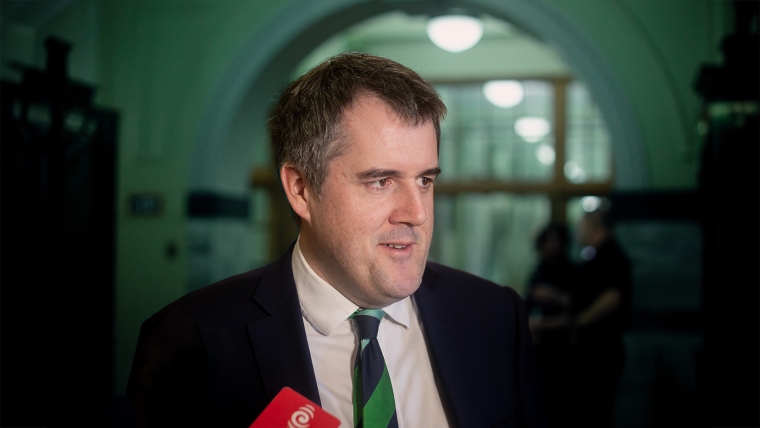
Minister of Housing Chris Bishop says his ambition for New Zealand’s social housing system is to create a level playing field between community housing providers (CHPs) and Kāinga Ora.
“I don't care who builds social houses as long as they are built,” Chris Bishop said during a speech at Auckland’s Community Housing Aotearoa Conference on Tuesday.
“I am agnostic as to whether those houses are delivered by CHPs or the Government. The simple truth is this, we will not solve our housing crisis by the Government alone.”
CHPs offer long-term social housing via private housing providers. Bishop said CHPs currently operate 13,700 social homes across the country.
In May Bishop revealed Budget 2024 had allocated $140 million to fund 1,500 new social housing places provided by CHPs. This will start from July 2025 as the previous government’s social housing funding finishes in June 2025.
On Tuesday, Bishop said as of October, around 100 social housing places for June 2025 onwards have either been approved or are in the final stages of consideration.
Three new changes to barriers faced by CHPs in the community housing sector were also announced on Tuesday. The changes will help CHPs compete with government housing agency Kāinga Ora for social housing funding.
The changes include making the operating supplement of $70 million, a funding subsidy given to CHPs for new housing developments, available upfront when contracts for new social housing are agreed upon rather than paid out to CHPs over the course of the contract.
According to Bishop, this will mean more community housing projects meeting financing criteria and lead to those projects being done more quickly.
“There is significant interest from private developers and investors in partnering with CHPs to help them deliver and operate social housing,” Bishop said.
The Ministry of Housing and Urban Development has been directed to review the use of leasing to provide social housing in cases where it provides value for money. This will only be available for newly built homes that haven’t been occupied.
The Government will also be looking at changes to contracts for new housing supply to make the revenue stream of Income-Related Rent Subsidies (IRRS) “more attractive” for investors. This includes “exploring” the removal of termination for convenience clauses and extending compensation terms.
Bishop said these new changes would help bring about “competitive neutrality” although it could take some time to implement them.
“I’m being realistic about timelines as politicians always over promise,” he said.
The Treasury and the Ministry of Housing and Urban Development will be providing advice on the changes in the new year, but no time has been set for when the changes will be rolled out.
‘Overcooked’
Bishop said the Government broadly agrees with CHPs on their issues with the Reserve Bank’s risk weight rules for social housing.
Due to banks viewing CHPs as investors, banks tend to lend to CHPs via commercial lending requirements instead of residential. Business lending carries higher risk weights and capital requirements compared to residential lending, meaning higher interest rates.
“Broadly, we agree with you and think the risk weights may be overcooked for lending for social housing,” Bishop said.
He said Minister of Finance Nicola Willis will be requesting the Reserve Bank undertake a review of standardised risk weights, including prioritising work on lending for social housing. (This follows the Commerce Commission's banking market study).
“Over time, and as the social housing sector grows, there is the potential for changes through that review to increase competition and place pressure on the cost and terms of debt financing,” he said, adding banks are not the only source of debt financing for CHPs or their partners.
“In other jurisdictions, financing for the operating phase tends to come from lenders that can be more flexible to meet the needs of the sector, such as capital markets. This is an area where I am seeing a lot of opportunities and potential for innovation.”
‘All talk’
Following Bishop’s announcement, Labour Housing spokesperson Kieran McAnulty said Bishop was “all talk when it comes to housing”.
He said there had been no commitment to build any more public homes, no further support for CHPs and no increases to Income-Related Rent Subsidies (IRRS).
The Ministry of Housing and Urban Development pays IRRS to public housing landlords to cover the financial gap between the market rent for the property and what a public housing tenant pays in rent.
“Everyone was hoping the Government would at least announce it would guarantee loans for the newly established community housing funding agency to make them cheaper. But again, no commitment from the Minister,” McAnulty said.
According to McAnulty, Labour delivered more than 14,000 public homes over the six years it was in Government from 2017-23, alongside the community housing sector.
We welcome your comments below. If you are not already registered, please register to comment
Remember we welcome robust, respectful and insightful debate. We don't welcome abusive or defamatory comments and will de-register those repeatedly making such comments. Our current comment policy is here.