
sign up log in
Want to go ad-free? Find out how, here.

QV says average NZ residential property values down 1.5% over the three months to the end of July

Property / news
QV says average NZ residential property values down 1.5% over the three months to the end of July
House in storm

Winter has deepened the chill across the country's housing market with average residential property values declining in most parts of New Zealand, according to Quotable Value's (QVs) report for July.

NZ's average dwelling value was $898,799 at the end of July having fallen 1.5% over the three months to the end of July, according to QV's House Price Index.

The biggest declines in average values over that period were in Gisborne -6.4%, Greymouth -5.0%, Wellington City -3.2%, Marlborough and Hastings both -2.3%, Auckland -2.2%, followed by Hamilton and Whanganui, both -1.7%.

The only regions to post an increase in average values over the three months to July were Tauranga +0.7%, Christchurch +0.3%, Timaru +0.6%, Queenstown +0.2% and Invercargill +0.1%. The average value in Rotorua was unchanged.

The report said the modest upward momentum in values at the start of the year continued to fade, with the winter slowdown becoming more widespread as buyers grew increasingly cautious.

"The regional divide we highlighted last month [between the mid-lower South Island and the rest of the country] is still evident, but there are fewer bright spots now," QV spokesperson Simon Petersen said.

"Winter has put a further chill through the market, while the prospect of higher borrowing costs and ongoing economic uncertainty have given buyers even less reason to rush," he said.

"This isn't another sudden correction. It's an already subdued market losing what little momentum it had built earlier in the year," Petersen said.

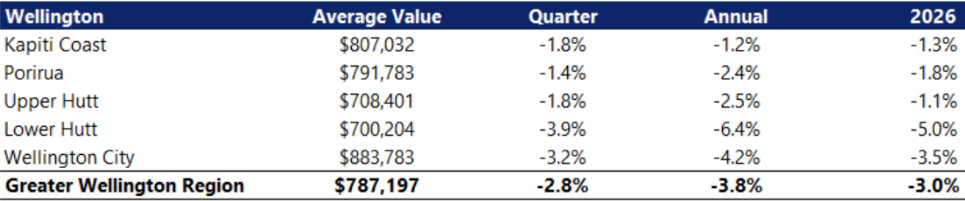
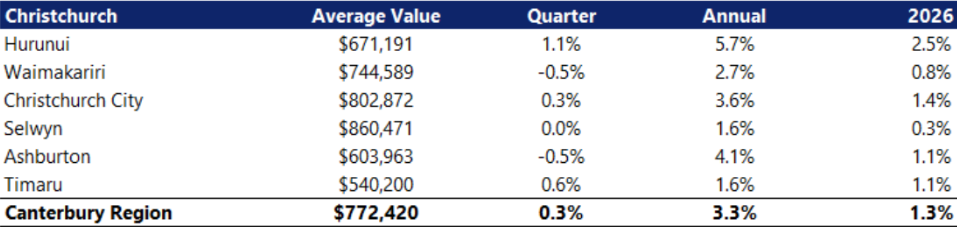
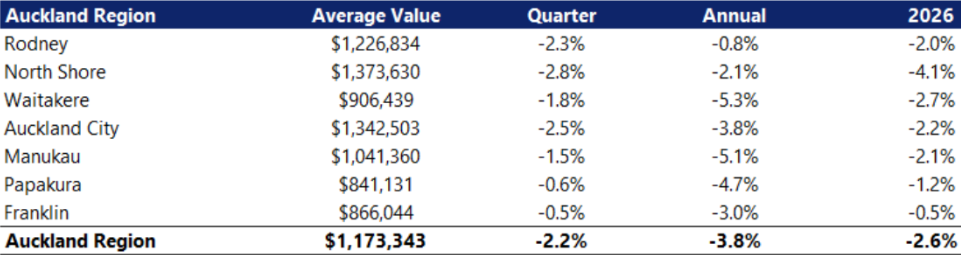
The tables below show the average residential value movements in the main urban districts throughout the country.

The comment stream on this article is now closed.
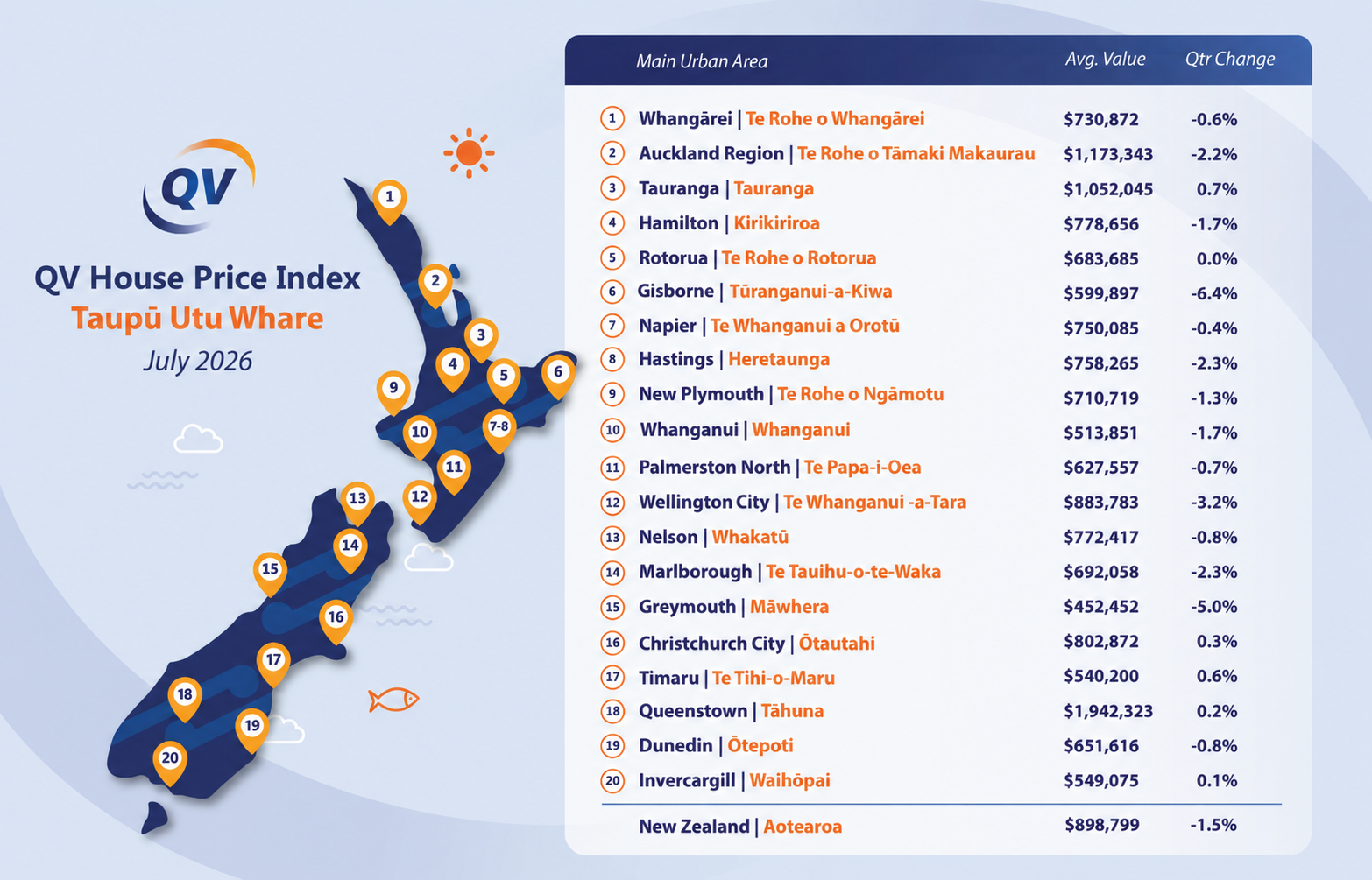
QV House Price Index Movements - July 2026 - Auckland, Wellington Region, Canterbury 

We welcome your comments below. If you are not already registered, please register to comment

Remember we welcome robust, respectful and insightful debate. We don't welcome abusive or defamatory comments and will de-register those repeatedly making such comments. Our current comment policy is here.

25 Comments

Looks like the areas that didnt tripple down on greed fueled speculative overshoot are doing ok, aka Chch and deep south. Wellington and Awkland are still free fall.

Higher rates, insurance, even Luxy is talking a bed tax for BnB crowd, and noise that inflation is on the rise. Add in a more normal cost of debt (higher) how's that negative leverage is going...?

🍿 

Up
7

Not sure about Wellington but in Auckland the added supply must be a huge factor. The unitary plan was like an on switch for development and there are townhouses going up everywhere. 

Up
2

Agreed. No wonder old rot box squatters are finding tenants hard to come by.

Up
1

Excellent. Median house price needs to fall to three years' median household income.

Up
6

Yes, and pigs might fly too.

Up
3

Pigs may not fly, but according to you it’s justifiable to put a bit of lipstick on them and try to deceive people about their true nature. 


(ie spending your time (for your own financial gain) talking up what is the worst housing market we’ve seen in the past 40 years). 

Up
10

Median house price needs to fall to three years' median household income.

That would be the equivalent of economic Armageddon. 

Assuming it could happen, it would rip the capital base out of many SME businesses and indirectly the whole banking system.

But it does have an important underlying idea: developed economies should be deflationary. I used to think this should only apply to the lowest rung on the hierarchy of needs, but I now believe it should apply further up the ladder.    

Up
4

Not sure we will be that happy with our yearly pay cut...

Up
1

We have built our non-housing economy on credit from a house of cards.

You are right, and the central bank has to do everything it can to stop it happening, hence lost decades ahead.

As we have concentrated wealth in housing not equities, we are very sensitive to falling prices/equity.

we urgently need better super policy,  most countries have salary sacrifice, seems not here


Up
2

Scott Pape from The Barefoot Investor on the psychology and attitudes surrounding the Ponzi:

House prices are falling, and that’s a good thing.

For anyone under 40 who’s given up on ever owning a home, this is the best news since your dad stopped emailing you the auction results with “food for thought” in the subject line.

Yet for a real estate agent with an Audi lease, it’s the end of the world.

Heck, if you listen to the property industry you’d think the sky was falling.

Over the June quarter, prices across the combined capitals slipped by just 2.5 per cent. Over the past year they’re still up 3.9 per cent, according to Cotality.

What is true is that at the moment, the market is colder than a mother-in-law’s kiss.

And if prices were to fall 10 per cent 
 they’d still only be back to where they were in late 2024.

Some perspective you don’t get from the outrage:

Average house prices have increased by more than 400 per cent since 2000, partly on the back of taxpayer-funded landlord welfare. They’ve grown much faster than workers wages. Which is why we’re in this pickle.

Up
2

Don't forget that Japan suffered a prolonged period of deflation following a 1980s housing/property bubble, and Japan is rather vibrant an economy compared to us Anglo Saxon Western nations.

I think these things are often slow burn.  In the UK property revivals have been forecast for a few years now (since 2022), never to transpire, and so while two years ago that house that 'is certainly worth ÂŁ900k', is now 'well, we have to be realistic and if we sell for ÂŁ775, hey, we have made a stack'.   

I guess there are many questions to ask: what would drive a housing market recovery?  In the UK it would be 2-3% mortgage rates.  Is that likely to occur?  No.

I remember driving from your West Coast way back in 2008 and reading various articles, noting - what the West must learn from is Japan, we must not repeat their mistake of failing to accept that property prices can fall, we must restructure away from property speculation, and we will!  Did that happen? No.

As a friend notes, the problem with inflated house prices is, they suck money out of the productive economy. In the UK banks used to lend to small businesses, now the majority of lending goes to, or pre 2020 went into, property, as in housing.


Up
0

Approximately 60% or more of bank lending is tied up in property now in NZ Marcus so same issue. Banks want the least risk and highest returning loans so they've followed the capital gains and ever growing mortgage values.


The sharemarket crash of the late 80's drove people to property after seeing friends, colleagues, family lose their homes and life savings. 35 years of real interest dropping + high population growth leading to abnormal increases in property values. That, and you used to be able to offset your persona. income tax from running a rental at a loss which was the best possible way to minimise tax at the time until the govt finally put a stop to that.

Up
0

JohnTrz,

I was able to borrow no more than 3 times my income for my first house in 1969-in Scotland-but I think it was the same here. I doubt whether it will ever go back there, but I would like to see it reach a ratio of no more than 5. That, with some help, would give my grandchildren a decent shot at owning a property, though a partner's income would still be needed.

All too many of my demographic-the long since retired- seem to want their homes to keep increasing in value, while at the same time, moaning about how hard it is for their grandkids to get into the market and don't seem to grasp the incompatibility of the two forces.

Up
4

Good post - yes I’ve had many conversations with those in the 65+ age bracket and you say ‘wouldn’t it be good for future buyers if they had smaller mortgages as a result from lower prices relative to incomes’. 

The general response is ‘why would I want my house price to drop in price?’

You then say ‘well you purchased the house you live in in 1975 for $50,000 and it’s now valued at $1.5 million - that means it’s gone up 30x in the time you’ve purchased it - and you haven’t renovated or done anything to the place - do you think you deserve this windfall in capital gains for doing nothing to it?’

Response is generally ‘I’ve worked hard so I deserve everything I have and to hell with everyone else’. 


I say - ‘well would it be reasonable then for a current FHB buyer to expect a 30x return on their homes over the next 3-4 decades? Ie they buy the average house like yours for $1.5 million and expect it to be worth $45 million when they reach 65? Do you see how completely ridiculous this position is to take?’


It’s usually complete silence after this and the +65 wants nothing further to do with me. 

The conclusion I’ve drawn from this over the past decade or more with those in the 65+ group is many (not all) are a bunch of self serving fools who have been deluded by their own good fortune with little care for the overall financial and social well being of the country/economy. If I were in their position I’d be completely ashamed of what has happened but then again something strange seemed to happen to those who were adolescents in the 1960’s period. Self entitlement is greater than moral/social righteousness and common good . As you point out, there is some severe cognitive dissonance going on with this group of people.

Up
3

Response is generally ‘I’ve worked hard so I deserve everything I have and to hell with everyone else’. 

In some ways, they're behaving rationally. Aotearoans believe that paying down a mortgage is a proxy for savings. They seem to consider less that paying down a mortgage is also consumption. 

And among the entitlement, they can't fathom why they should have to pay increased local govt rates. That particularly outrages them. 

Up
0

Target the entitlement directly. Vote the Land Tax for the win. Anyone under 40 with one house or renting will be better off. If you dont vote you endorse the status quo.

All those land banker squatter and speculators types... not so much.

đŸ”„ 

Up
1

Then you try telling them the point of having an asset at retirement is to be able to use it to enjoy retirement by downsizing, reverse mortgage or otherwise, yet many live in the cold saying they will be carried out of their 4-bedroom house in a box, and demand better rates rebates, more form their super gold card and a better pension, wilfuly dismissing the logical aformentioned options as heresy. An interesting bunch indeed.

Up
2

I agree. 5 x income would be good, and several parts of NZ are already (pretty much) at that level. The big cities may struggle to get to that multiple though.

Up
1

When you have so much of the economy riding on rising prices 


Up
0

Not long ago we’re celebrating the ‘good problem to have’ of house prices rising for decades at 7x incomes and incomes only rising a third of that value  - pretending it was sustainable - and being completely delusional that mathematically this was going to end in severe economic pain - and calling anyone who pointed out this issue as a ‘doom gloom merchant’. 


House price = Cash flow / mortgage rate. 


It is impossible for the house price to go up at 7% if the cash flow is only going up at 2% (rents or income growth or even GDP as a proxy for these values), unless the mortgage rate is always dropping. Which it did from 1980’s - 2020. But now that pattern has ended - the 7% thing dies as soon as mortgage rates go flat - if they go up then you should be more worried about negative 7% growth in house prices while GDP/rents and income growth are so low. But some people are still in 1980’s - 2020 thinking - they haven’t got the memo yet that the party is over. 

Up
2

Even Real Estate NZ is trying to tell people the market has moved.....

But people really believe you do not lose until you sell at a lower price, so they won't

Summer is going to be painful as a % start to sell and set a -10% market


Up
3

It is impossible for the house price to go up at 7% if the cash flow is only going up at 2% (rents or income growth or even GDP as a proxy for these values), unless the mortgage rate is always dropping.

Not sure I agree entirely. House prices can theoretically go up 7% if credit keeps expanding at a requisite rate. But the money supply can't really grow if the punters are not stumping up for mortgages - the primary driver of money supply growth. 

BTW, Smart NZ Property ETF is down 30% over the past 5 years. The dividend yield is 5.77%. 

https://www.tradingview.com/symbols/NZX-NPF/?timeframe=60M

Up
0

Yup - head in the sand. Vote the land tax. Single house owners will be offset with their basic income. Specu stackers... will be paying tax, a lot of tax.

Up
0

why would a farmer need to pay 0.5% when they run a business and council would never let them subdivide?

seems like a tax grab vs a move to open up more land

if ToP wanted cheaper land then they could just allow anyone to carve off 1000 sq m and sell it?

but to put a tax on people as they own land but council does not allow them to disperse it does not seem a fair policy?


Up
0

Thats a council and infrastructure problem. Lets face it, 1000sq dection sounds residential, so clips 1.75%? Alternatively is a development so sale should be taxed at business rate. No one "accidently" develops and titles a subdivision. Requires premeditated action.

End of the day all designed to stop or retard land banking speculation. 

Up
0