
“All the way with LBJ”.
Those were the words that Australian Prime Minister Harold Holt used in 1966 to express his total loyalty to Lyndon Baines Johnson, the US president. Holt was a steadfast supporter of Australia’s alliance with the US, and of the war in Vietnam.
War has been a big part of the US/Australian relationship. The two countries have fought together in every major war since 2018. In the Second World War many Australians saw the US as their saviour in the South Pacific.
The relationship was cemented with the ANZUS Treaty in 1951 in the shadow of the Cold War. That treaty has only been invoked once, by Prime Minister John Howard in support of America several days after the September 11 attacks. Howard was sometimes referred to as George W. Bush’s ‘deputy sheriff’ in the wars in Iraq and Afghanistan.
Fast forward to 2022 and not much has changed. The current Australian Prime Minister Scott Morrison may not be quite as chummy with President Biden as Holt was with LBJ, and Howard with Bush, but he is a staunch advocate of very close ties between the two countries.
Indeed, Morrison has arguably strengthened those ties with the recent ramping up of US troops based in Australia, the AUKUS security pact, and QUAD, the Quadrilateral Security Dialogue. Morrison has also been vociferous in his criticism of China on everything from its attitude to an international investigation into the cause of the Covid-19 outbreak to its failure to rebuke Russia for the invasion of Ukraine.
A major rivalry has emerged in the Indo-Pacific between China and the US, and Morrison is making sure that there is no doubt where Australia stands.
Australia’s clear objective is to operate in lockstep with the US and other allies in the containment of a rising China. However, there has been a price to pay. Sino-Australian relations have collapsed, and China has waged a trade war against Australia (although it still spent $150bn on Australian iron ore in 2021).
The contrast between the Australian and New Zealand approaches to the US is stark.
For years Wellington has maintained an independent foreign policy. Not an overt independence like Switzerland but rather a neutrality-lite with kiwi characteristics.
The origin of the current policy lies in the mid-1980s when New Zealand declared itself a ‘nuclear-free zone’ and rejected US nuclear deterrence. America responded by suspending its commitments to New Zealand under ANZUS
New Zealand’s anti-nuclear stance was morally admirable and politically popular. It was also very well timed.
The country chose to loosen its ties with America and strike out for independence just before the Cold War ended and the world entered a period of relative peace. The collapse of the Soviet Union brought a unipolar world; a ‘Pax Americana’ with no strategic threats for a small liberal democracy at the bottom of the South Pacific.
If history was not at an end, it had certainly taken a holiday. Crucially for New Zealand, in this environment an independent foreign policy was both virtuous and safe.
To date at least, that policy has been successful. It has given the country the ability to trade and talk with all comers; to pursue multilateralism and avoid taking sides. A middle ground for Middle Earth.
Unfortunately, history has now returned with a vengeance. The world confronts two powerful authoritarian regimes with expansionist ambitions – Russia and China.
Having come close to economic collapse after the end of the USSR, Russia has spent years rebuilding its economy and its military. Armed with thousands of nuclear weapons, it now appears bent on reestablishing dominance on its western border by seizing or neutralising former Soviet republics.
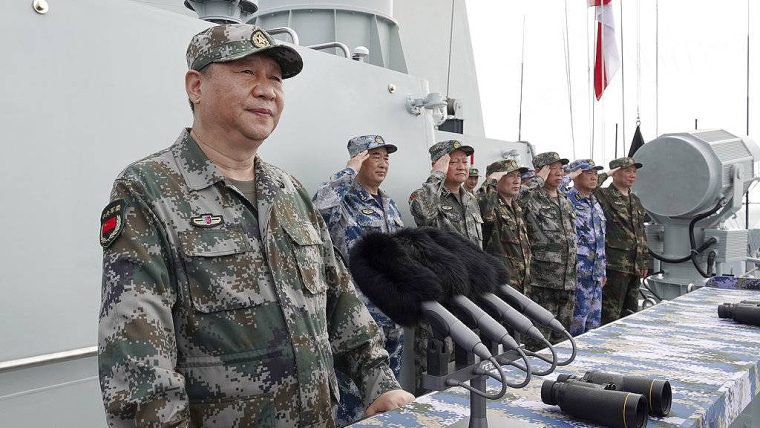
China has become a new superpower to rival the US. Its rising self-confidence is backed by a massive expansion of The People’s Liberation Army. The result is increasing assertiveness in its territorial claims in the South China Sea and a determination to ‘reunify’ with Taiwan sooner rather than later.
Great power politics is back.
That spells danger for small states. Two thousand years ago, the Greek historian Thucydides described the harsh reality of the international system – ‘the strong do what they can, the weak suffer what they must’.
He might have added that in turbulent times, weak states would do well to get themselves strong friends. And with a major geopolitical division now emerging between liberal democracies and illiberal authoritarian regimes, that may necessitate taking sides and cementing alliances.
Wellington enjoys much warmer relations with Beijing than Canberra. New Zealand was the first western country to enter into a free trade agreement with China and the first to join China’s ‘Belt and Road Initiative’. Last year New Zealand sent a third of its exports to China.
The current dilemma of Finland and Sweden is fascinating. Close neighbours of Russia, those countries have maintained independence for decades and have not been part of the NATO security treaty. Unsurprisingly their attitude to independence has changed dramatically with the invasion of Ukraine. Both are now looking at joining NATO.
But as Wieslander and Skaluba point out in Atlantic Council, “it is not easy to take out insurance when the house is already on fire”.
It’s not too late to strengthen strategic ties … until it is.
NZ’s participation in international and regional organisations and its focus on trade has served the country well. But Russia’s invasion of Ukraine and its new ‘no limits’ partnership with China may be a tipping point.
There was a thawing in US/New Zealand relations in the 2010s but New Zealand’s status in ANZUS remains unclear. Is it time for New Zealand to consider fully recommitting to the treaty and the American relationship?
Would that provide greater protection in an increasingly hostile world? Or would it damage Chinese trade and entangle New Zealand in potential conflicts it might otherwise avoid?
Views will differ. One person’s rational self-preservation is another person’s warmongering.
Australia provides a useful case study. Some think it has been reckless in its antagonism of China. Others think there is no alternative but to challenge what they see as a rising threat and to balance against that threat with likeminded allies.
One thing is certain. New Zealand cannot ignore the rapidly changing geostrategic environment. The crucial issue of the country’s foreign policy must not be neglected in the chaos of short-term domestic concerns with Covid and the cost of living.
Ross Stitt is a freelance writer and tax lawyer with a PhD in political science. He is a New Zealander based in Sydney. His articles are part of our 'Understanding Australia' series.
We welcome your comments below. If you are not already registered, please register to comment
Remember we welcome robust, respectful and insightful debate. We don't welcome abusive or defamatory comments and will de-register those repeatedly making such comments. Our current comment policy is here.