
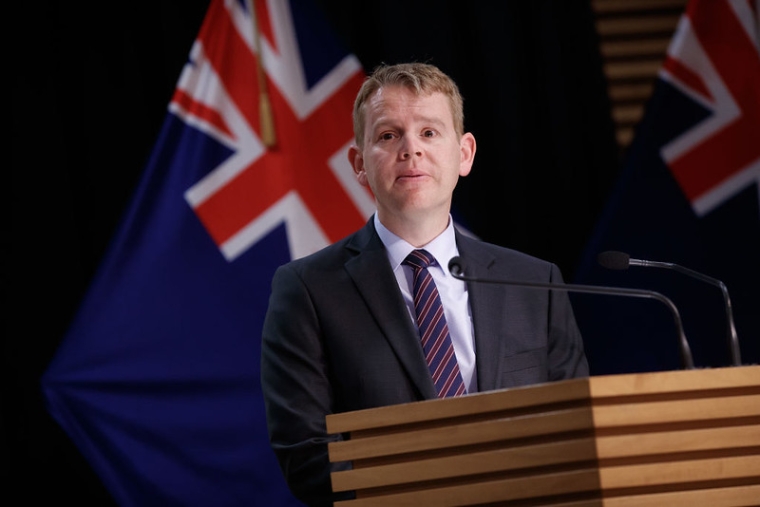
New PM Chris Hipkins is set to use a cabinet reshuffle this week and a series of policy tweaks to try to distance Labour from Jacinda Ardern and catch up to National, but he may struggle to convince voters that much has changed.
The Government had already started and previewed the migration and spending tweaks under Ardern. Many of the changes will be presentational and in tone, rather than substance, with Hipkins doing his best to highlight how different his 'boy from the Hutt' style of eating sausage roll birthday cakes and cycling to work is from Ardern's high-flying Grey Lynn smile and talk of co-goverance and nuclear free moments. He has emphasised his focus on 'bread and butter' issues and clearing the decks of unnecessary spending and catchphrases such as 'co-governance' and transformation.
He indicated in his first week in the job he was set to loosen migration settings to buy the Government a surge of cheap economic growth that keeps interest rates and inflation low and tries to restart house price growth, along with winning Labour re-election. Median voters love this kind of growth, as do businesses and Treasury.
For 20 years, both main parties have used this tactic of accidentally-on-purpose pulling the cheap migration lever to buy fast growth without the necessary infrastructure investment. In the end, it simply increases the ‘churn’ rate where young New Zealanders have to leave for Australia to be able to afford their own homes, and are replaced by temporary workers who see life here as preferable to life in China, India, the Philippines or South Africa.
At what point does the ‘churn’ rate become unacceptable to the median voters who decide election results? We’re not there yet, and won’t be until older home owners in the suburbs and provinces get sick of having to help their kids with deposits and/or have to watch their grandkids grow up in Australia via Whatsapp.
Australia’s imminent opening up of a fast pathway to ‘first-class’ Australian residency for New Zealand residents (including the recent arrivals) could be that moment of truth. It would be a moment when the ‘escape valve’ for the pressures in our political economy of residents emigrating starts blowing so loud that everyone hears it whistling. Right now, it can’t be heard over the immediate noise of calls from median voters for lower inflation, lower mortgage rates and higher house prices.
What happened in the first week
Hipkins was open in his first meeting on Thursday to calls from business leaders for an urgent opening of the low-wage migration tap, while he was also cautious about committing to another significant hike in the minimum wage.
Hipkins will decide in the coming days how his new Cabinet will fire up economic growth without high inflation and try to win a third term on October 14. He looks set to opt for the cheapest and fastest way to win back the confidence of small-to-medium business owners, which is to enable them to grow by adding cheap labour that resumes downward pressure on wages.
It is the simplest way in the short run to reassure median voters the Government is focused on what they and Treasury officials want: a faster return to Budget surplus through extra GST and income tax receipts from population and employment growth; the flow-on short-term benefits of lower Government debt to take pressure off interest rates and mortgage rates in particular; and, the resumption of a strangling of infrastructure spending to ensure the return of low mortgage rates and population growth combines with residential land shortages to generate another surge in untaxed and leveraged capital gains on land values.
The new PM, who said yesterday he agreed with businesses that the ‘rising tide of economic growth lifts all boats,’ looks set to opt for the usual bi-partisan approach of fueling nominal GDP and land price growth through high population growth that is not debated or agreed to by the public, not planned for or invested in by councils and infrastructure operators and, does not have the permission or endorsement by future voters
Hipkins used his first news conference to also talk about ‘reining-in’ non-essential spending, which could include delays in housing and public transport investment.
The churn economy
Choosing the low-wage, high nominal GDP growth, high population growth, low interest rate and low investment option is consistent with the approach of Governments of both the centre-left and centre-right in the last 20 years. It’s what median voters want, but the pressure on the disposable incomes and wellbeing measures of those in the renting class of families is showing through the ‘escape valves’ of surging health, housing subsidy and justice costs for the Government, along with an escalation in emigration by those locked out of home ownership.
It’s sustainable as long as the ‘churn’ rate of cheap migrants replacing exiting residents can be held high and those residents left here are comfortable commuting to and from Australia for family events and crises. A loosening of migration settings and a tightening of investment spending is the Government’s likely tactic for the next six months, largely because it fears median voters will prefer the even louder calls for a bigger use of the churn lever by the Opposition.
Hipkins' first meeting as PM was in in Auckland with a tightly-packed group of small and large business leaders in the Auckland Business Chamber (formerly known as the Chamber of Commerce). It was carefully choreographed and designed to send a signal that Hipkins went first to business leaders and was open to their suggestions. The first order of business for new PM Hipkins was meeting Bridges and the Auckland Business Chamber.
Hipkins and Auckland Business Chamber CEO Simon Bridges reported after the meeting that it had focused on calls for looser migration settings for lower-wage workers.
“He got it, and got it straight between the eyes. There's a real sense that this isn't just about skilled work. It's not just about rocket scientists or surgeons or anything like that. It's also workers at the bottom of the rung," Bridges said.
“If we're not competitive against in Australia or Canada or something, we're not really in the game. He got that message, and he was listening," he said.
Hipkins made clear he wanted to work closely with businesses.
“I think the relationship between business and government is a really important one. It is integral to the economy. We have shared interests here and making sure that we create a good well paid jobs for New Zealanders because that's how Kiwi families are going to be getting ahead," Hipkins said.
"We all want to see the economy continue to grow. The rising tide will lift all boats. And that's that's actually the spirit in the business community as well. So I think we've got a real interest in working together," he said.
He confirmed the Government was considering further loosening migration settings. There have been at least three rounds of loosening since mid-2022 under new Immigration and Workplace Relations Minister Michael Wood.
“We have always kept immigration on the table as an issue that we'll continue to reconsider as the pressure that we face as a country changes. We've had significant population growth in recent years, and that has created a set of pressures. We've had to catch up in terms of extra housing in terms of extra infrastructure and so on," Hipkins said.
"And so that has been one of the factors that we weighed when we've made decisions around immigration. We also acknowledged that there's a significant skilled labor shortage. There's a significant labor shortage that we're dealing with across the country," he said.
A short-lived tightening
Earlier last year the Government tried to restrict population growth by restricting migration growth in the hope of squaring the population growth-infrastructure deficit circle. That lasted about three months before the pressure from employers forced the various loosenings, including the reopening of the skilled migrant and parental residency categories; an historic increase in the Registered Seasonal Employer scheme quota; and, increases in backpacker and student work rights.
Another big decision in front of Cabinet in the next couple of weeks will be what the minimum wage will be increased to from April 1. Since 2017, the current Government has lifted the minimum wage by 39% or an average of 6.5% per year to $21.20/hour.
Employers and the Opposition have called for slower increases, arguing that would allow more people to be employed and avoid the wage increases being passed on as price increases in a new ‘wage-price spiral’. Recent research globally has shown such minimum wage increases have barely slowed jobs growth and have not been as big a factor in inflation as profit margin expansion.
Hipkins was cagey about whether the next increase in the minimum wage would be as fast as the ones seen since Labour’s election in 2017. Unions have called for an increase of 11.5% to the current living wage of $23.65/hour.
“We've got to acknowledge that our lowest paid workers, minimum wage workers, are really feeling the acute pressure from the rising cost of living. With all of these things, there's a balance to make sure that we're supporting people whose budgets are squeezed, to make sure that their incomes are rising so that they can keep up with the rising cost of living," Hipkins said.
We welcome your comments below. If you are not already registered, please register to comment
Remember we welcome robust, respectful and insightful debate. We don't welcome abusive or defamatory comments and will de-register those repeatedly making such comments. Our current comment policy is here.