
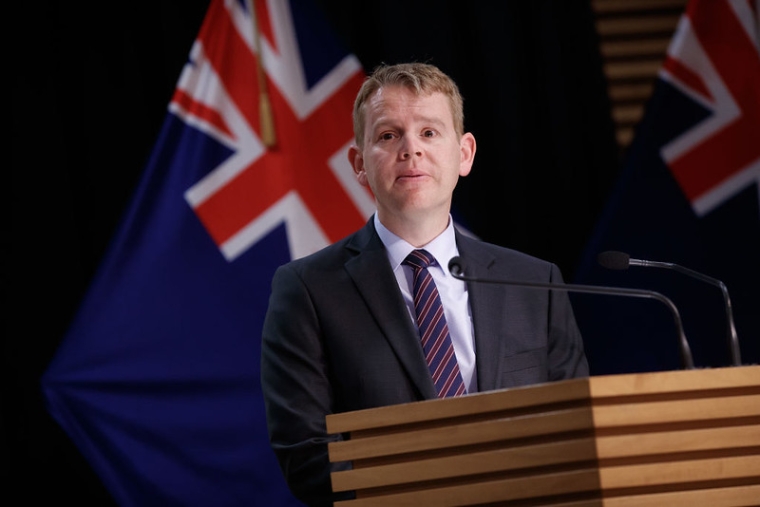
Prime Minister Chris Hipkins’ claim that repeated failures by staff to flag the email that led to Stuart Nash’s sacking was a mistake doesn’t have any credibility, the Opportunities Party leader Raf Manji says.
On Friday the Ombudsman said he would reopen an investigation into a complaint over former minister Nash's email to his political donors and friends Troy Bowker and Greg Loveridge. This email detailed a confidential Cabinet decision not to extend rent relief to large commercial property operators during the covid lockdowns. Both have significant rental interests.
In Auckland on Friday Hipkins told media there was no cover up in former prime minister Jacinda Ardern's office to hide the existence of the email Nash sent in 2020.
An Official Information Act (OIA) request was lodged by Newsroom freelance journalist Pete McKenzie in 2021 which asked for correspondence between Nash and his donors. This was when the two staffers in the former prime minister’s office, which included deputy chief of staff Holly Donald, were made aware of the email by Nash’s office.
Nash's office referred the emails to Ardern's office three separate times.
The email was not released as it was ruled out of scope, with Nash arguing it was sent by him as a Labour Party MP rather than in his capacity as a minister - although it pertained to a cabinet discussion where he attended by virtue of being a cabinet minister.
Despite these repeated contacts between the two offices and staff about the rejected OIA request Hipkins said on Friday that “somebody made a mistake” and “I don’t think there was any ill intent there”.
He denied there was a culture of misusing the Official Information Act. He has said Nash must take responsibility for the email.
TOP leader Manji said; “No-one is going to believe that.”
He has called for the establishment of an anti-corruption commission, and said public trust in New Zealand’s democratic institutions including Parliament and its MPs needed to be restored.
Manji said the public deserved transparency and accountability from elected officials, and Nash’s actions must be investigated thoroughly to ensure there was no corruption or misuse of power taking place behind closed doors.
Hipkins has triggered an investigation, asking the Cabinet Secretary to explore if there were any other times where Nash shared private Cabinet discussions.
Manji said NZ has a Serious Fraud Office for criminal prosecutions but ethical behaviour of our members of parliament also needed to be scrutinised, much like security services are by the Inspector-General.
“... No one bats an eyelid about that, and that’s someone inspecting our security services whenever they feel like it.”
Manji said New Zealand had a lackadaisical approach to buying influence and lobbying of its politicians.
He is also concerned about political staff and MPs going back-and-forth from the Beehive or Parliament to lobbying their old offices without pause. Manji said the prime minister's chief of staff Andrew Kirton joining his office straight from a lobbying firm was "unbelievable".
Former Labour Party minister Kris Faafoi left parliament and is now heading up a lobbying firm.
Australia is setting up an anti-corruption commission. Watchdog Transparency International New Zealand (TINZ) said in November 2022 that an anti-corruption commission should be discussed in New Zealand.
It said New Zealand had not seen public sector or political corruption similar to Australia, but did face private sector corruption cases and gaps in political integrity oversight remained, with examples being issues around Parliament and political party funding and elections.
In October 2022 three people were found guilty of using sham donors to make political donations and concealing the identity of the true donor from the public.
Transparency International said anti-corruption commissions usually investigate alleged political and public sector corruption.
It said New Zealand did not yet have a national anti-corruption strategy, despite it being promised for many years.
"New Zealand’s corruption prevention mechanisms need to be independent, comprehensive, future looking and well funded. We can do this either through an anti-corruption agency or by further funding and empowering existing agencies," TINZ said.
New Zealand always ranks highly in global surveys for low corruption, with Transparency International noting in November that "New Zealand remains solidly at the top of the Corruption Perceptions Index (CPI) and has not seen major corruption incidents similar to those of Australia".
However, the appearance of the handling of this email to political donors is causing concern that this may indicate how ministers and offices might work to thwart the OIA, and how some get exclusive access to ministers and information.
Political commentator Bryce Edwards has also called for an anti-corruption commission. He said the planned investigation didn't go far enough. Edwards said sharing the information to donors as Nash had was "basically insider trading".
Manji said the corruption ranking was "BS".
"That's kind of self reporting, because we don't actually have any checks and balances so nobody can see anything."
The prime minister's office was approached for comment.
119 Comments
I quite like their "Teal Card" policy:
https://www.top.org.nz/tealcard
...and the fact they've ditched that cringeworthy branding from their previous campaign.
TOPs policy is to steal from people who worked all their lives to provide a home for their families and handout as a UBI to people who can't be bothered getting out of bed.
This sounds very much like the Green Party's policies. The difference is maybe that the Green Party hacks add a good dose of plain racism to their policy mix.
There's a whole lot of emotive language in that comment, and not much in the way of facts.
Unfortunately it's emotion which drives some people.
... I think that many people disparage the idea of a UBI without bothering to do a little study of the matter ; which would reveal an amazing array of benefits to individuals & to society , and with a much lower cost base than you'd initially believe ...
Took me awhile to get on board with it ... but , got there now ...
My wife had a UBI once, but a course of antibiotics fixed it right up.
Front to back, ladies.
What you are talking about is a UTI urinary tract infection :)
You do understand what the U stands for?
I notice that with these arguments that it is always "worked" in the past tense. TOP's policy aims to shift the tax burden from income to idle capital. This means those that have significant capital but may not be working or contributing to the economy actively, will pay more taxes to fund the UBI program. This approach ensures that the burden of funding social programs is shared more equitably and not solely placed on those who work hard for their incomes.
With our demographics shaping up the way they are I can't really see any other way to fund what New Zealand needs without shifting this tax burden around. How is it fair that the people who earn an income and are currently working hard to keep this country running end up with significantly higher tax rates than those who are simply sitting on land and extracting rent and gaining capital from the hard work of the community around them.
Agreed - not taxing idle capital is stupid and unfair.
replace "taxing idle capital" with "raiding people's life savings" and you get a different conclusion.
Taxing income is arguably worse. At least if we reduced tax on income people would then be incentvised to work as people could keep more of their paychecks.
The unfortunate reality is to have a functioning economy we need to raise revenue from somewhere. It's difficult to justify why taxing land is morally wrong when we already impose significant taxes on people's incomes which costs them significantly more of their time and labour compared to capital gains derived from increasing land value.
IF we were designing a tax system from scratch it could be arguable that taxing income is "worse" - although it is far from obvious.
We are not starting afresh though. TOP proposal is essentially to change the rules in the middle of the game .
People worked and saved all their lives , paying income tax. To raid their life savings , accumulated from tax paid income is confiscation , pure and simple.
I can understand this perspective. I think for any successful implementation of a land value tax it needs to be implemented over a relatively long time scale slowly shifting the tax burden from one source to another, allowing people to plan in advance and allocate their resources accordingly.
What I don't agree that we have to keep everything exactly as it is and changing anything is unfair, we could go backward and forwards about what is and isn't fair but the reality is life is not fair. It's about structuring a tax system that is more equitable and more efficient for both current and future generations.
I agree with what you say here . I do not believe that TOP proposals come anywhere near it though.
I guess one thing people may not think about is if TOP end up in parliament then it’s likely to be with only 1 person, so voting for them isn’t going to result in all their policies being enacted. But it would hopefully result in more conversations/compromises being had around a tax system revamp. And bring more awareness to other tax alternatives for people to learn about and vote on.
Unlikely to end up with 1. They either win an electorate and coat tail another few MPs (3 at current polling), or get to 5% and get 6+
Yep was going for an electorate win rather than 5% but didn’t realise there’d be a couple others brought in with him. Still not enough to have a major impact straight away.
I really wish we would lower that threshold. I think it would do the country a world of good to get more diverse voices into parliament. Or perhaps bring in some kind of transferable vote system so people can vote for who they want and if they don't get in transfer that vote to their second choice. As it is people are forced into voting strategically for the larger parties and having to settle for the "least worst" option.
More diverse voices? Like Shaneel the trans advocate for the Herald? Or far right supporters like myself? Nah, stick with middle of the road mainstream. Hopefully the Greens and Māori party get sidelined in October.
In a democracy, it's important to respect the diversity of thought and allow for all voices to be heard. This includes the possibility of far-right or far-left parties gaining representation in parliament if they receive sufficient support from voters. Imposing low thresholds to exclude these parties undermines the democratic process and limits the ability of citizens to fully engage politically. We should be upholding the principles of democracy by ensuring that all political perspectives are given a fair chance to be represented, even if I or anyone else might disagree with those views.
Our MMP system is already pretty good at moderating coalitions to not be too extreme in either direction so I think allowing more voices to have a say wouldn't be a bad thing. It would certainly be better than another Lab/Nat MP number 50 getting in.
I think land here is a red hearing, and intellectual property is a much higher impact, I had an idea once, based on other peoples ideas now I can profit without doing anything. Once large companies own all the ideas we are all screwed.
Like most things its about scale, if you have a house and its paper value increases, its irrelevant you still only have a house. It when you start playing the market, buying houses for the only purpose of making money on buying houses, producing nothing and becoming rich doing it that you have a problem. That is actually how our tax system is. If you are buying houses for the purpose of making a profit on the sale then you should be paying tax on that, under the current tax system. However its hard to prove that is what someone is doing, so if you are dishonest to the IRD you get away with it. There is nothing special about houses, it works the same for shares, cars, items on Trademe. As soon as you are buying and selling things for the purpose of making a profit you should be paying tax on it.
By the way there is a tax on owning a property, its called rates.
I'd disagree with that. Intellectual property is something that can be created and is typically not perpetually granted. New ideas can and will continue to be created, and old ideas will have their intellectual property lapse.
A capital gains tax is pretty typical around the world, it is a bit weird that we don't have but all the developed countries we compared ourselves to do. One negative is a capital gains tax doesn't bring as stable of a revenue stream as something like income tax or an LVT.
A land value tax would differ from rates by only being applied to the land value rather than the property value which includes any improvements that have been made to the property, which is something we should be encouraging rather than discouraging. Rates themselves would probably be a lot more equitable if they applied to land value rather than property values and encourage more development in areas with higher LVT rates.
It's not your capital to tax. So, it's theft.
You could say this about literally any tax.
.. exactly ... the tax man raids my earnings weekly ... I'm a " rich prick " in Labour's eyes ... yet I labour Monday to Friday 48 weeks out of 52 ...
The idle wealthy mega millionaires , sitting on their enormous fat property acreages pay ... 0 % ... nada , zilch ... nothing ...
There's the mother-of-all gold mines in this nation , a $ trillion of untaxed land ... zero tax ...
Agree. I always appreciated the below quote from Milton Friedman.
"There's a sense in which all taxes are antagonistic to free enterprise – and yet we need taxes. ... So the question is, which are the least bad taxes? In my opinion the least bad tax is the property tax on the unimproved value of land"
I think we can all agree that paying taxes kinda sucks. But the reality is we do need to pay into the system we all benefit from and how it is structured at the moment is both holding us back economically and burdening the people who actually do the work that keeps the economic engine running.
Land that was purchased from after tax income.
You pay rates currently. It's really not that different or unprecedented. Until 1992 we had a land value tax in place. And since then we have seen capital flow into property and profit wildly at the expense of the wider economy.
You are mixing arguments.
Rates are collected to cover providing services directly related to the property rated - and not in order to reduce taxation elsewhere . It is no more a general tax than a purchase of any other service - like water for instance ; this is why GST applies to it.
Any link between abolition of land tax and capital flow into property is unproven. A much more obvious explanation is sustained artificially low interest rates over the same period.
Providing services like gigantic yellow signs on the waterfront :) (Wellington lol). Perhaps the scope of councils has crept up since their implementation but a lot of modern councils seem to act more like governments than direct service providers. We can see overseas many places that use property taxes rather than income and it seems to work just as well (or poorly) as governments funded by income tax. E.g Singapore, Denmark, Estonia, and State governments in the United States.
It could be argued that land value tax is providing services directly related to the property as well. Due to the nature of land, we all use it and either directly or indirectly pay for it.
I'd agree the low-interest rate environment is most likely the bigger factor than the removal of a land value tax, I was going to mention that in the above comment but didn't want to go off on another big tangent. I think the removal of it would have been a small contributing factor but it likely pales in comparison to the last 10 years o ZIRP/LIRP in skyrocketing housing costs.
Speculative take here, but what it could have potentially done if we kept it in place is incetivize people to put all that cheap capital into actual productive businesses and infrastructure and we would have had a lot more to show for the billions and billions of dollars worth of personal debt the country has collectively taken on.
A bit confused over what you are arguing in connection to rates. Are they :
a) a precedent to follow
b) something that is misused and wasted ?
As to "It could be argued that land value tax is providing services directly related to the property as well." :
Seems a stretch to me ..please explain how taxing land in Auckland for the purpose of paying domestic purpose benefit in in Invercargill fits into it.
Regarding rates: I would lean towards it being an example of precedent to follow, that rates are a form of property tax that local governments use to fund public services and infrastructure and are just as valid as any other tax we currently pay.
My personal view of local councils generally being pretty wasteful might be creeping into my previous reply.
In terms of land value tax, my argument is that it can be seen as providing services directly related to the property because the tax is based on the value of the land itself, which is generally determined by its location and proximity to public amenities and services. Therefore, it can be argued that the tax is a way of funding the provision of those services. Ideally, these would be paid for by rates but in practice, it seems like central government revenue is used to pay for most larger projects in Auckland.
So rates are both misused/wasted AND a precedent to follow. I rest my case on that .
WRT Land tax I note that you studiously avoided addressing my specific question :
Please explain how taxing land in Auckland for the purpose of paying domestic purpose benefit in in Invercargill fits into the model of providing services directly related to the land taxed.
The government wastes a lot of tax on stupid stuff, it doesn't undermine the need for us to pay taxes in order to fund services we do need. The fact they are misused is a completely different argument altogether to how the revenue is raised in the first place.
I avoided addressing the specific question because I am not entirely sure what you're asking there.
People in Invercargill would still be paying tax on the value of their own land would they not? You would certainly get taxed more on land in central Auckland, but this land is generally benefitting from central government-funded services to a much greater degree than anyone in Invercargill gets.
Obviously, we can't rapidly shift from taxing incomes to suddenly taxing only land, but I think incorporating it into the mix and shifting some burden off incomes would be a lot better than what we currently have where we are relying far too much on workers incomes to generate government revenue
"The government wastes a lot of tax on stupid stuff, it doesn't undermine the need for us to pay taxes in order to fund services we do need .. The fact they are misused is a completely different argument altogether to how the revenue is raised in the first place."
I disagree. They can only waste what they raise. We need to pay less tax - to encourage the governments to cut the said stupid stuff. LVT would inevitably encourage policies leading to further growth in land values - like restrictive planning laws and/or negative interest rates ( we need that like a hole in the head - something I think we agree on ).- as it leads to more revenue.
WRT Auckland LVT to pay for Invercargill DPB - I raised that in response to you stating that
"It could be argued that land value tax is providing services directly related to the property as well"
- are you still arguing that , in the context of my example ?
A land value tax could incentivize voters to vote for policies that moderate land values, like less restrictive planning and zoning laws and encourage more housing to be built since they would now bear some of the negative externalities coming from rising land value costs.
Agree with you on the interest rates, I think a lot of our current problems are stemming from those decisions.
The latter point there seems more of an argument of how the money is spent as opposed to how it is raised which seems like a different argument altogether. You could just as easily say why should someone paying income tax in Invercargill have to pay for someone on the benefit in Auckland. 🤷
Hang on there! Don’t overlook that the calculation for rates is in itself a quasi wealth tax. That is because it is mostly based on property values. Resultantly the more your property is worth the more rates you pay. Supposedly it’s a goods and service charge. But a household of say two, that may use only a fraction of those services compared to a household of say six, can end up paying much more than twice the amount of rates. Then the government collects 15% GST on top of that, which is never ever seen as being returned to the respective communities.
Income tax doesn't provide services related to income, it just goes to the general pool. GST doesn't provide services to sales, it goes in the general pool.
Why are you setting the bar differently for other hypothetical taxes?
Because the collection of rates is now so distorted an inequitable that it can hardly be described as a charge on services. For example two neighbouring houses, same sized section and street frontage, same sized house structures, same number of occupants. One pays $8900.00 pa rates the other $4850.00. The difference being the former is a new house ex the EQs. If it was a charge for only services used per household then logically there would be no difference. As such then it is then an extra levy based on wealth rather than the cost of services that do attract GST, and central government has no right to impose a tax on a tax.
I think it would be more equitable if rates were done on Land Value rather than property value. The system as it discourages construction, maintenance, and repair because rates typically increase with improvement.
All rates in chch are very high compared to other cities.
I did not know that chch residents are a lot wealthier than aucklanders and their property values a lot higher too. Wait a minute.
A little morning study would be interesting
Probably because the Christchurch council are better even than Auckland’s, at spending other people’s money on the things that other people neither need nor want.
... like , a cycle way down Harewood Road to the airport ... as if people lug their bags on a bike , before heading overseas ...
Perhaps it’s just forward planning as connection to their other airport 4 hours away in Central Otago.
Rubbish if I own a 3 bedroom property and its valued $100,000 or $1,000,000 the services for that property are the same. If that was the case we should be paying rates on the number of people living there not the value of the property. Its a tax on the value of the property. Also if you are a tenant you use those services so why are you not paying directly.
I understand your point, but the value of the property does have an impact on the services provided by the local government. For instance, a more valuable property might have better access to council services, have more waste management needs, or have more demand for infrastructure like roads, sidewalks, and public transportation.
Additionally, property value is used as a basis for property taxes because it's a relatively stable and objective measure of an individual's ability to pay. Property owners who own higher-value properties generally have greater financial resources to pay taxes than those who own lower-value properties.
As for tenants, they indirectly pay property taxes through their rent. Landlords typically factor in the cost of property taxes when determining the rent for a property.
It might seem unfair to pay taxes based on the value of a property, it's actually a reasonable system that helps ensure that those who can afford to pay more do so, and that services are provided in a fair and equitable manner. I personally think it would be better if they were rated on Land Value rather than property value in order to incetivise improvments and development but it is what it is.
The old envy tax. You worked and paid off an asset. Now we’d like to tax you on that asset. I spend a lot of time in Euro (currently there now). Switzerland has a housing tax based on equity/value but offers tax relief on the mortgage hence many friends who are financially secure still rent or maintain mortgages whilst having significant investment portfolios. Can’t see TOP or any other party following suit.
Is the top income tax bracket not an envy tax as well then? I would rather we reward people who are actively working than those who have "worked". Economic growth and prosperity aren't driven by being static, we need to shift our tax system and encourage productivity rather than rent-seeking.
Switzerland is a well-run country, I think we could learn a lot from them.
You mean like taxing land bankers?
TOP has the fairest tax and welfare policy of all parties.
... " Chris ! " ...
" Yeah , what ? "
... " ... should we give Raf Manji a free run in the Ilam electorate ... or , just a brown envelope full of $ 100's ? ... anything to shut him up " ...
" We've still got some envelopes left ? .... wow .. "
PM Ardern sure as hell knew when to bail out! If there was any backbone or integrity there she would take some responsibility, address parliament in the next 14 days while still the member for Mt Albert, put the record straight and relieve her successor of the barrow load of s**t that has been dumped on him, from out of her prime ministership.
.... she will front up at some stage to give her valedictory speech ... and no doubt , will use that as a platform to laud herself and her transformational government for the fantastic strides and initiatives they've made ... and exhort Hipkins to continue her good work ...
Then , she'll be off to Womans Weekly for another photo shoot , coffee later with Tova and Jessica ...
Ardern and Tova both on the dole
5 April is the day
The correct benefit. To which they are entitled.
Well, Ardern wont be entitled to it straight away. She quit, so will need to go through the requisite stand down.
Commissions of Inquiry Act 1908. Same powers as the District Court. Witnesses can be summoned to testify under oath. Set this up and let the two PMO staff members in question, or possibly more of them, give their evidence and defend themselves. After all Minister Robertson loudly, stridently protested in parliament, that they had been denied this ability.
PM Ardern sure as hell knew when to bail out! If there was any backbone or integrity there she would take some responsibility, address parliament in the next 14 days while still the member for Mt Albert, put the record straight and relieve her successor of the barrow load of s**t that has been dumped on him, from out of her prime ministership
She could, But she won't. Princess Cindy is all about Princess Cindy. The idea that she was ever there for 'the people' should be dead and buried by now. That was clearly obvious before she got out of the kitchen.
IMO a big part of why she resigned is because she new that hiding Nash's corruption was going to blow up in her face! Better to let someone else take the heat, Not that I have any sympathy for Hipkins as he has told bare faced lies his whole political career. This whole debacle shows Ardern's true character.
This OIA funny business lends weight to Gaurav Sharmas claims of the Labour Party running all day long OIA workshops of avoiding releasing information. Sharma published a screenshot of a message sent by Minister of Conservation Kiri Allan to the caucus reminding them all written correspondence was subject to the OIA, and "if we are being lobbied on issues by colleagues, especially where we haven't had a yarn, things unfolding through OIA process less than desirable".
I think that Ardern was vehemently denying that at the time
PM's Office responds to accusations over Official Information Act | RNZ News
https://www.rnz.co.nz/news/political/473343/pm-s-office-responds-to-acc…
Simon Bridges insinuated that it’s endemic in his old party by saying Nash was an idiot for puting it into writing.
Yes they probably do. Though the Gnats did not come in with bold claims of open, honest and transparent when they anything but. Grinning from ear to ear and looking all innocent sucked in a lot of voters and supporters
Followed by strong denials of wrongdoing when caught red-handed.
Wow red-handed, that fits
It’s a problem alright and an unsavoury one at that. MPs are lawmakers, it’s a serious responsibility, and this includes the very important issue of political donations being monitored and disclosed. Yet they themselves, too often it seems, set about to defeat that law. And now quite obviously that same sort of attitude and methodology is being employed re the OIA. Don’t overlook either the calculated clandestine attempt to undermine parliamentary protocols, and entrench the Three Waters legislation.
The token efforts from central and local government to get voters to engage won't be helped by this.
Essentially, pay up your rates, pay your tax and just trust us.
Don't question us or put us under the microscope and ask for accountability on how or where we spend your money.
Democracy continues to be weakened further.
Yip. Labour's. mandate ...
" We know what's best for you"!...
...Here's some more money to keep you quite.
We know, we say, you do! You sure do get sick of it. This lot just picked up and carried on from the Clark/Cullen lot.
Like it or not but the most up front politician right now is Wayne Brown. He calls it like he sees it, which MSM doesn't like but sure as hell gets what bothers most ratepayers.
Specsavers might help him.
Probably not though .
Ratepayers simply don't like paying to maintain their cities despite being the economic beneficiaries of those cities. I don't think Wayne Brown has impressed anyone except yourself.
- Greens - Penalising the Rich and Middle, to give to the Poor.
- Labour - Penalise everyone except Labour MPs.
- TOP - Penalise the Middle, to give to the Rich and Poor.
- TPM - Make rich Maori richer, and poor Maori poorer. Penalise everyone else.
- NZ First - Make rich Winston richer. Penalise everyone else.
- National - Penalise the middle and Poor, to give to the Rich.
- ACT - Penalise everybody, without realising it.
Great election ahead. So many parties - so little choice.
Um, TOP's land tax policy will see the top 20% pay more tax and everyone else get a tax cut or benefit debt wiped.
By definition, the top 20% are not the middle.
So a correct summation is, penalise the wealthy to give to the poor and middle. Pretty much what everyone - except the wealthy - would probably think is a good idea.
of course 80% of the people think it is great idea. This is why TOP got 2% of the vote last time round.
The rough number of 80% is for those that would be better off with TOP's taxation reform (tax free threshold for the first 15k earnings to be replaced with the Land Value Tax). It honestly wouldn't surprise me if 80% of voters don't know that TOP's is a political party let alone what their policy is. This has been one of my criticisms of TOP, they should focus on getting a few headline (LVT/taxation reform would be one) policies out there into that 80% instead of trying to have a policy on everything which leaves voters confused as to what they stand for.
Fortunately, we have commenters like E46 doing an excellent job explaining how the LVT policy would benefit people. If TOP manage to get into parliament then I would expect a large increase in votes due to increased awareness of how good their taxation reform policy is in addition to those that are 'too scared to waste their vote on a minor party' no longer being afraid.
You might think so but I doubt it will happen, the thing about being rich, and by that I don't mean owning a property or 2. Is that you have the power to move your wealth and structure it in a way as to avoid taxes.
If you introduce a land tax then people living in their own home will be forced to pay. Landlords will put up their rent and the cost will be eventually passed on to the tenants. Really rich just move their ownership of companies offshore.
If you believe that rental prices are related to the marginal cost of building the next rental (which seems like a reasonable assumption) then LVT does not increase rent prices because it does not tax improvements such as constructing larger buildings with greater rental capacity.
Under the LVT scenario if landlord-A increases the rent above marginal build cost then landlord-B (or C, D, E...) can build a larger rental and undercut landlord-A.
Owning 2 properties would make you much wealthier than the majority of kiwis. The benefit of taxing land compared to other forms of wealth is it cannot be removed from the country so you don't see the issues that you would with a straight-up wealth tax. A land value tax would not disincentivize capital inflows into the country and incentivize investment into more productive enterprises. Ideally, the LVT rate is bought in over a long period of time and at a rate to minimise the effect on individual owners, the majority of which should be better off it they are working for a living and earning an income.
I have no issue with people earning high incomes or having equity in productive businesses. The goal of a land value tax is to minimise rent-seeking behaviours which are economically inefficient and hurting our countries productivity.
Chippie is looking like he needs a crap. The strain is showing
Crap in crap out!
This is the tip of the " labours hides everything/ most transparent, lie fest ever seen in NZ politics" tail
Ardern could not be trusted with many things thus the media control she dictated to us all via the Tova and Jessica puppet show .
Karma will expose thier mantra!
A bad week for Hipkins for sure. Let's see what the future weeks bring!
2023 is labours anus horriblis.
. . oh dear ... how terribly sad for them ( teeee heeee ) ... and guess what , we've got another 6 months of watching them burn & implode .... Joy upon joy !
... it is autumn ... perhaps he needs a prune ...
Has anyone else worked out the additional tax one would pay for the Land Tax over and above the $15000 tax free structure. As a retired couple with a mortgage free home, no other properties, we would be $3000 worse off each and every year. Our income is the super and interest.
... the theory is that monies collected annually from a land tax are directly targeted at tax cuts for workers & business , and a boost to NZ superannuation ...
Not according to Raf Manji when I last spoke with him 2 weeks ago. They would like to reduce taxes but that will be further down the track, and IF they get Ilam.
For an excellent history & understanding of land taxes , try Fred Harrison's (UK) books ... " Wheels of Change " is a good primer ...
... land taxes need to be phased in over several years , and the cuts to income tax etc , similarly staggered ...
A $15,000 tax free threshold is "reducing taxes" and it is their 2023 policy.
True, but needs to be $20,000
Interesting. $1500 each is less than I would have thought.
I looked up their policy it states the below:
- Superannuants could opt to defer payment until there is a change in ownership of the property.
So for most superannuants they would end up better off.
It would encourage older people to stay in houses too large for their needs - while perhaps taking out a reverse mortgage to supplement their income. I fail to see how it helps younger people to solve their housing problems.
Or they could sell a larger home that's too big for their needs earlier to get capital out of it and move into a property that attracts less LVT.
An LVT isn't going to be a silver bullet that immediately fixes all of our housing problems, we have decades worth of damage there, but it might be a start in encouraging investment away from land and into productive applications.
There's an apparent internal logical fallacy in your statement "...they would end up better off"
Better off than pay no land tax at all ?
If they were unfortunate enough to be renting they would certainly be better off. Or if they have downsized into a smaller property after selling a larger property they would most likely be better off as well. I can't give any concrete answers as everyone's situation will be different.
Individuals above 65+ benefit from one of the world's most generous superannuation schemes which is paid for primarily from income tax revenue. Unless we want to start means testing super, having to pay a bit more tax upon selling a property that has likely appreciated significantly over their ownership is probably a fair trade.
65+ benefit from one of the world's most generous superannuation schemes
NZ is not wealthy enough for this. Dumb pollies vote grab by offering us freebies. This year will be no different, probably worse with all the hangers on minor parties
Yeah I don't disagree with you there. We have designed a system that is effectively a Ponzi scheme and isn't funded by people paying their way into it but funded by the people coming up behind them. I fully expect at this point that younger generations are now basically paying for older generations' retirement as well as having to self-fund their own, and pay exorbitant housing costs off of those who bought in for a pittance.
Something like Australia's superannuation scheme would be massively better but I don't see any political party having the fortitude to make any change in this department.
Aussie seems no better for housing, the median Sydney home is a smidge under 1.5m. I know that they dont all have seaviews
But the country has its massive resources that pays the bills. We however have been cajoled into believing we shouldn't mine. All the while making use of mining in everyday products
That's true, but if you defer the tax, are they not going to charge you interest at higher rates than a bank. So then defer the next year, and the year after, tax on interest on tax on interest. A very large bill is possible.
Are you going to leave that for your kids, be reasonable and realistic. What happens in a housing downturn, and the bill owed exceeds the house price??? Your wife going to agree to that, assuming you are married, or still married.
deleted
I imagine it would similarly to how rates postponement works currently?
I don't think a land value tax is perfect, no form of tax is and you have raised some valid issues that could arrise from a blanket LVT policy if it were to be implemented like that today. Ideally it would be phased in over a longer period of time so people can plan ahead and build it into their plans.
The proposed LVT rate would be unlikely to exceed the value of the property. If you had a property with a land value of 300,000, the proposed rate of 0.75 percent would be $2250, for that yearly cost to add up to the value of the property it would take 133 years. If your land value was to somehow drop 50 percent your it would still take nearly 67 years of stacked-up payments to exceed the value of the property, not even taking into account the fact that your LVT rate would of halved as well. And since it is only on the land value, not the entire property value the owner would still have some equity left if the total LVT bill came out to more than what the property is worth in this scenario.
Let me know if my maths is wrong there since I have never been great at it but I think its right.
And how would a land tax work with Māori land? Currently I believe this land is not subject to rates. Also, before we start raising taxes how much income tax do iwis pay? Once you have answered these questions we can move on to the utter waste that occurs in the public sector. To a certain extent increasing tax is straight out theft……and I am not wealthy!
I was at the TOP AGM and from memory Maori, government and rural land was excluded. Personally, I'm not sure I would have any exclusions (if say Maori land cannot be sold, then get the council valuation changed to reflect that, maybe zero is appropriate in that case). I don't have any say or connections to formulation of TOP's policy but am a huge fan of LVT.
I believe the total GDP for New Zealand is currently about 400 billion, and government taxes total 37billion. Say 40 billion to round it up and make the maths simple. That to me equates to a 10% tax grab. Now this is on total revenue of NZ. Salary and wage earners pay tax on total gross income, why not all tax entities pay 10% tax on total gross income, including religious organisation's and iwi, and any others who get a tax break. Especially the overseas based organisations.
Just a thought, simple, no provisional tax probably many other benefits as well.
What say all of you???
Taxing revenue on all businesses like that would have a lot of unintended consequences. How would it work in industries that have huge revenues but low margins, how would it work on a startup that's trying to achieve growth? We would overnight make New Zealand a less attractive place for investment and put more burden on already struggling businesses. Why even start a business at that point. Is that a tax system that has actually ever been implemented anywhere before?
The benefit of a LVT is that it is economically efficient and does not deter production, distort markets, or otherwise create deadweight loss.
Good points, but an organisation with large revenue and low margins, ie a supermarket, would only be paying 10% on the revenue. If an organisation can't survive on 90% of its revenue, should it be in operation amyway, have reduced staff as less accountancy or office staff required, so there are savings to be made. I am thinking that this style of taxation be introduced over a period of time, say 10 years for business owners, so changes can be implemented.
This needs a lot more work, but the simplicity looks good, so reduced tax avoidance and evasion. I also believe most salary and wages earners would like the concept.
Any other thoughts??
If you tax a corporation on income alone, I don't see how any startup company would ever really succeed without massive investment to pay for the tax on income. Most startups don't make profit for years.
Many commodities work on high-revenue but low-margin models. Farmers would be one example, another would be supermarkets (in most countries, they're taking the piss a bit over here with their margins) and startups like Xero would of operated in the same way. We would end up crushing companies that are trying to be competitive and benefit companies that have the fattest margins and are reaming us. What if a business owner had a bad year as many did during COVID, now they would not only of made zero profits they would be liable for a massive tax bill?
I'm trying to find an example of a country that uses a system like this and I am coming up short as it seems like it fundamentally doesn't mesh in with the capitalistic systems that underpin the wider economy.
Currently we are getting reamed by the likes of Visa and Mastercard earning billions and paying no tax on it.
The small margins and start ups is a problem but surely surmountable. No more of a problem than a minimum income individual paying 15% on everything they purchase surerly.
Ok E46, I hear we're you are coming from. I have started up 3 businesses, and just looking briefly at the first few years, all would have been more successful, and intact one would have been extremely successful, and I should not have sold it when I did. However, I will look closer at the figures and we can continue this thread on another interest.co.nz posting. I do think you are being overly negative anout the obstacles but more feedback from different individuals with alternative experiences would be of interest.
I think it's an interesting idea. I can certainly see the appeal especially if it's applied to big multinationals that are utilizing tax havens and other stuff like that. It's not really something I have ever looked into so my critiques are just what I see as potential issues, but other people might have some ways to make it work.
As an individual I pay tax on revenue not on income, I can't deduct basic living expenses that are necessary to work from my expenses. All revenue from my salary is instantly taxed. Plus any purchases I make have a 15% tax on them as well
This is exactly my point, all salary and wage earners pay tax on Gross (income or revenue) and the reason I think we should start the discussion on re-writing our tax laws and structures. There has to be a better way, but what is it. This is just an alternative idea, needs fleshing out and expanding.
With regard to investment, I think many companies would love to start up a business here knowing they have only 10% tax to pay, as it is so simple. But I could be wrong. Its easy to say it won't work, but maybe it could.
More thoughts, perhaps we can also reduce GST to 10%, and make tax paymentson Gross income (revenue) and GST to be paid every 2 months, but at different monthly intervals.
Reducing GST would help low and middle income earners as not so much of their take home pay goes to tax.
Perhaps also incorporate $20,000 tax free threashold, now that would reduce tax at the low end, and reduce the need to social welfare, and reduce poverty at the bottom.
Just ideas, so any other negatives or positives???
I've thought along the lines of a tax on gross income rather than profit. As a business, to be tax neutral my personal rate of 20% would drop to 6% if I remember correctly. To me that seems about right and would be a effective way to stop the rampant profit shifting and loop holes while simplifying accounting. Of course that would make a number of accountants redundant meaning the lobbying against it from them would be ferocious.
Interesting Redcows, there are so many taxes on companies and individuals, that many I feel could be eliminated or reduced. Too many politicians have been making an absolute dog's breakfast of this issue for many many decades, and my apologies too all dogs.
Many accounts would welcome a simple tax structure so they can spend more time making the organisation more profitable, and control overheads more closely
How do we charge costs incl insurance to body corporates at present.
Umm corporately
Why are any private owners exempt and getting a free ride from the rest of society.
I think Murray answered the question about Māori land to an extent. I suppose it might be similar to how Native American reservations are taxed in the United States as a precedent.
I'm not advocating about raising taxes, it is about shifting how that revenue is gathered in the first place by shifting some of it off of income earners and onto capital.
How is income tax any less theft than a land value tax? If anything it's worse since income is the product of an individual's time and labour and we then go and take away up to 39 percent of that. Meanwhile, someone who has inherited property and potentially never worked who is living off of inheritance would pay zero tax whilst benefitting from the collective effort of the community around them without ever contributing themselves.
My understanding is only Maori land not being used in any way is not subject to rates. This was to stop the utterly rediculous situation of rates on land with no access no residents or council services which lead to penalties on penalties on rates often with owners having no idea it was even happening.
I work for a land owning Maori trust and believe me the rates bill is enormous and is on every damn square inch of owned leased or otherwise land.
Here is my speculation on what happened. The prime minister was informed but that was done verbally and not written down to bypass the official information act. Remember a while back when it became public that is what they where being trained to do.
We welcome your comments below. If you are not already registered, please register to comment
Remember we welcome robust, respectful and insightful debate. We don't welcome abusive or defamatory comments and will de-register those repeatedly making such comments. Our current comment policy is here.