
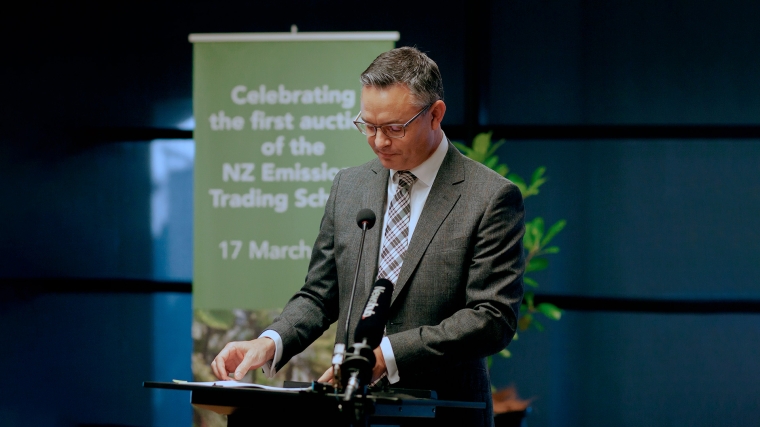
The spot price for carbon units has fallen to its lowest level in almost two years as uncertainty over the future role of forestry in the Emissions Trading Scheme (ETS) has scared investors off the market.
New Zealand ETS units traded at $53.25 on the secondary market this week, down 40% from a peak of $88.50 and at the lowest price since September 2021.
While prices have not fallen below $53.25 on the secondary market, an auction monitoring report by the Ministry for the Environment used a hypothetical clearing price of just $43 when presenting data from the failed March auction.
The Ministry said this was the bid at which units would have sold if the confidential reserve price had been met. That would’ve been the lowest price for units since the second-ever auction in June 2021.
One commodity trader told Interest.co.nz that the uncertainty of future ETS settings was depressing the unit price and discouraging investment.
The Ministry for the Environment has been tasked with a review of the scheme to determine what balance of gross and net emissions should be incentivized.
Currently, the ETS has been functioning primarily as an offset scheme with large amounts of pine forests being planted for sequestration, but little being done by businesses to lower their gross emissions.
The forest for the trees
The Climate Change Commission is concerned that NZ has become overly reliant on forestry to achieve its carbon emissions targets and the ETS will cause extensive afforestation.
Establishing and growing a forest can remove carbon from the atmosphere at a cost of between $25 and $50 per tonne. Removing remissions at their source can often cost upwards of $100 per tonne.
There are four million hectares of land that could be profitably converted into forestry at $50 per tonne, according to the Ministry for the Environment.
This could act as a cap on the carbon price and reduce the incentive for actual gross emissions reductions.
And so the Commission has suggested creating new rules to either limit the amount of forestry in the scheme, impose a minimum price, or even set up a separate forestry scheme.
This advice was what the Environment Ministry was exploring in its review, which was supposed to be reported back to Cabinet in the first quarter of this year.
All the suggestions are aimed at lifting the carbon price and incentivising emitters to make gross reductions, rather than relying on cheap offsets.
However, the uncertainty hanging over the ETS has deterred participants from bidding for units and put extra pressure on already falling prices.
Markets hate uncertainty
Susan Kilsby, an economist at ANZ who watches the carbon market, said it was too difficult for investors to predict what impact the review would have on prices.
“On the face of it, if ETS changes occur that restrict the use of forestry — and therefore reduces supply of units — you would expect to see carbon prices lift,” she said in an email.
“However if the rule changes focus more on reducing gross emissions (rather than offsetting emissions) then the demand for units would potentially fall, putting downward pressure on prices”.
Unit prices peaked in November 2022, despite asset price declines in other markets, but took a tumble that December after the Government rejected Climate Change Commission advice to tighten the number of units made available in future auctions.
Prime Minister Chris Hipkins' so-called ‘policy bonfire’ in March further undermined market confidence in the government’s commitment to cutting emissions, and resulted in the first failed auction.
Unit prices have fallen more than 30% this year and are down almost 40% from their peak.
Earlier this week, Finance Minister Grant Robertson said the Government was still committed to making the emissions trading scheme work.
There had been a number of reasons for the fall in unit prices and it wasn’t solely due to government decisions.
When asked by reporters, Robertson wouldn’t say whether Cabinet would implement the Climate Change Commission’s latest recommendations for ETS settings.
“The challenge here is making sure we make the transition we need to make in a way that is fair and just, that requires a balance of timing, investment, and bringing people with us,” he said.
We welcome your comments below. If you are not already registered, please register to comment
Remember we welcome robust, respectful and insightful debate. We don't welcome abusive or defamatory comments and will de-register those repeatedly making such comments. Our current comment policy is here.