
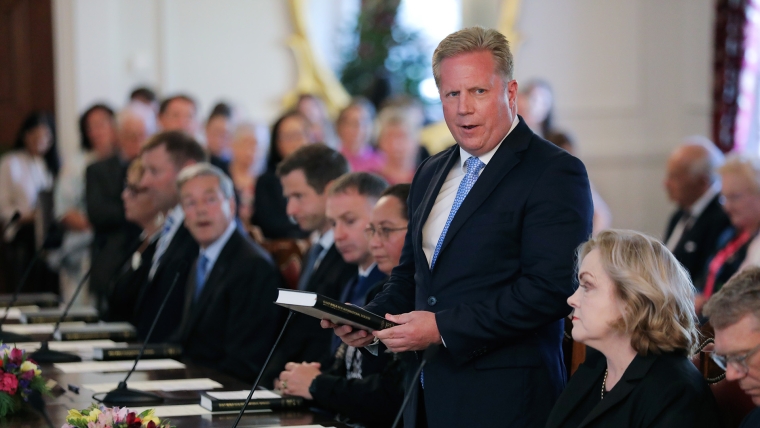
Agriculture Minister Todd McClay says he will accept the advice of a panel established to set softer methane emission reduction targets for farmers and the waste sector.
Five scientists have been appointed to review methane science and the 2050 climate targets to give advice on a new target that would not worsen global warming relative to 2017.
Because methane only stays in the atmosphere for 12 years, agricultural emissions only have to hold steady to stop adding to the greenhouse gases warming the planet.
However, a build up of methane over previous decades has helped to create the greenhouse effect that is causing global warming. Current targets aim to eat away at this build-up.
New Zealand law requires annual gross biogenic methane emissions be reduced by between 24% and 47% of 2017 levels by the year 2050. This would mean the amount of methane in the atmosphere would decrease and weaken the greenhouse gas effect.
But the Coalition Government has worried asking farmers to reduce their emissions over the next 25 years will cause some farms to close and push food production overseas.
And so, it has asked this panel to come up with a target which would allow the agriculture and waste industries to lock in the methane levels that were in the atmosphere in 2017.
Simon Upton, the Parliamentary Commissioner for the Environment, has previously said this approach would allow the agricultural sector to “claim a right to a certain level of warming … indefinitely”.
Research done in 2018 found methane emissions would only need to be reduced between 14% and 27% to halt warming at 2016 levels — instead of the up to 47% legislated today.
Advice will be accepted
McClay said he believed New Zealand’s targets should be consistent with this “no additional warming” principle and that the panel’s recommendations would be adopted.
“We've worked very, very hard to ensure that everybody on the panel has the scientific expertise they need and that they are completely independent,” he told reporters.
“And so, whether it's good news or not for farmers will depend on what they find, but the science will be the science, if you will”.
It is highly unlikely the panel will find similar or stronger reduction targets are consistent with the softer "no additional warming" concept.
This would mean rejecting the advice of another independent advisor, the Climate Change Commission, which said in April there was no evidence to support weakening the target.
Adopting a no additional warming approach for methane would require the Government to strengthen targets in other sectors or tolerate more warming, it said.
The terms of reference given to the panel specifically barred the scientists from providing advice on what choosing a new methane target might mean for NZ’s broader climate strategy.
They will also not be allowed to make any judgments about how the burden of limiting global warming should be shared across different sectors and countries.
McClay’s promise to accept the advice clashed with simultaneous comments made by Climate Change Minister, Simon Watts, who said the review’s findings wouldn’t necessarily be adopted.
“That review is going to feedback policy recommendations by the end of the year, and that'll inform us in terms of our position around the re-setting of those targets, or not,” Watts said.
Whether the advice would contradict the Climate Change Commission was a “hypothetical” question and would be resolved “if, and when” it happened.
Doves and hawks
The panel will be chaired by Nicola Shadbolt, a professor of Farm & AgriBusiness Management at Massey University, who has previously been employed as a Fonterra board member.
It will include Dave Frame, a physics professor at the University of Canterbury who has advocated for lower methane targets, but also others with opposing views.
Bill Collins, a Professor of Climate Processes at the University of Reading, co-authored a 2018 study which concluded reducing methane emissions would be “crucial” to keeping warming below 1.5 degrees as agreed in the Paris Agreement.
Sara Mikaloff-Fletcher, a principal scientist at NIWA, said in 2022 there was “a strong argument” for reducing methane emissions to prevent warming within the next two decades.
The final panel member, associate professor at the University of Canterbury Laura Revell, doesn’t seem to have made any comments on the record one way or another.
We welcome your comments below. If you are not already registered, please register to comment
Remember we welcome robust, respectful and insightful debate. We don't welcome abusive or defamatory comments and will de-register those repeatedly making such comments. Our current comment policy is here.