
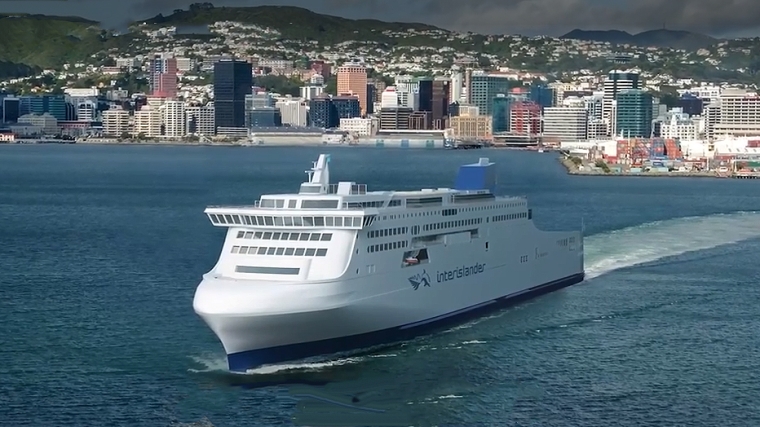
The Government will take another few months to consider options for replacing the ageing Cook Strait ferries after cancelling Labour’s project in December last year.
Finance Minister Nicola Willis, and the newly-appointed Minster for Rail Winston Peters, told reporters on Wednesday that a final decision wouldn’t be made until after March.
This means they have missed an informal deadline—December 11—set by Peters and backed up by other ministers, and will have to return to the issue in the new year.
In the meantime, Cabinet has agreed to a confidential “fiscal envelope” and set up a limited liability company to procure two new ferries within that budget.
Willis said the total budget was commercially sensitive but would need to be less than $3.2 billion, which was the estimated price of finishing Labour’s iRex project.
She said enough due diligence had been done to establish it was possible to build two new ferries and port-side infrastructure by 2029, plus pay a break fee, for less than that cost.
These are likely to be smaller, more basic ferries. Willis said she wanted “Toyotas not Ferraris”, and didn’t want to have to spend large amounts on infrastructure upgrades.
End of the track
David Seymour, leader of the Act Party, said it was highly unlikely that rail-enabled ferries could be procured within the $3.2 billion budget set by Cabinet.
Train carriages can be loaded directly onto existing ferries, effectively connecting the North and South Island railways. Labour ordered two rail-enabled ferries for $551 million and was planning to spend another $1.5 billion upgrading ports to facilitate them.
Willis canceled the entire project after discovering the port upgrade costs had doubled to $3 billion and could increase further. It is likely a cheaper alternative will require freight trains to be unloaded onto the ferry and reloaded back onto trains on the other side.
In a press release, the Act Party said indicative costs for an alternative were “approximately half” the $3 billion cost of iRex, of which the Crown had only committed to pay $2.2 billion.
This aligns with numbers reported by Stuff which suggested a set of ferries costing $900 million and a break fee of up to $300 million, plus minor port-side upgrades and sunk costs. When asked, Peters said this report was “drivel”.
Not angry, just disappointed
Despite the patchwork of hints, hard facts are still few and far between. Wednesday's announcement contained just three developments: Peters taking control of rail, a budget of less than $3 billion being set, and a decision being postponed until next year.
Ia Ara Aotearoa–Transporting New Zealand, a road freight association group, said its members were disappointed by the lack of certainty and failure to find an alternative.
"Frankly, a year on from the cancellation of the iReX project, we would have expected more progress to have been made towards the procurement of new vessels and portside infrastructure," chief executive Dom Kalasih said in a statement.
Labour leader Chris Hipkins said a year after the ferry replacement project was canceled, New Zealanders deserved to hear the government’s new plan.
“All we got today was an announcement about an announcement,” he said. The replacement ferries may be three or four years away, whereas Labour’s were planned for 2026.
“Nicola Willis still doesn't have any new ferries, still can't say how much it's going to cost, still can't say who's ultimately going to pay for it all; I think that’s hugely embarrassing”.
We welcome your comments below. If you are not already registered, please register to comment
Remember we welcome robust, respectful and insightful debate. We don't welcome abusive or defamatory comments and will de-register those repeatedly making such comments. Our current comment policy is here.