
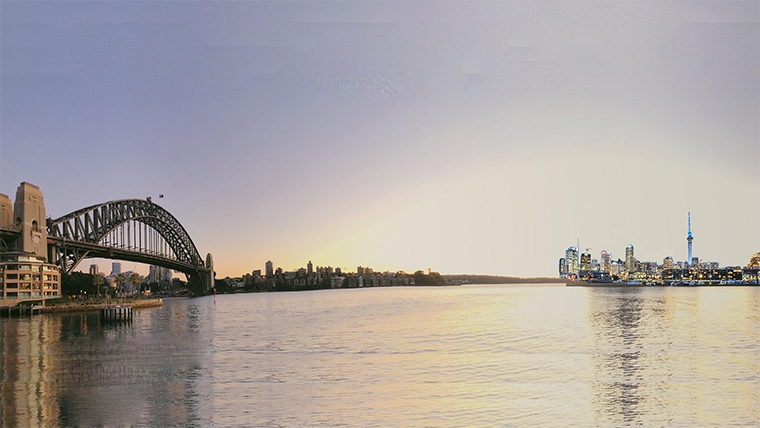
Australia is both a blessing and a curse for New Zealand.
On the plus side, it’s an important security partner, a favourite sporting rival, and the second largest market for kiwi exports.
Those crucial exports have held up in recent times thanks to the relative strength of the Australian economy. However, that economic strength is a double-edged sword for NZ. Australia’s higher wages, lower unemployment, and faster growth are currently acting as a magnet for thousands of kiwi workers.
Of course, this is not a new problem. NZ has been exporting citizens to Australia for decades. The kiwi-born population in Australia is now around 700,000, many of them trained at the expense of the NZ taxpayer.
Source: Stats NZ https://www.stats.govt.nz/news/net-migration-loss-to-australia-in-2023/
Unsurprisingly, the movement west is cyclical. That cycle is driven to a significant extent by economic factors like wage levels, unemployment, and the cost of housing.
Net migration from NZ to Australia has been rising steadily since 2020. What happens in Australia in 2025 will obviously have a major impact on the direction from here.
It’s difficult to predict the future in any year, but this year looks particularly uncertain for Australia. Three issues stand out – the federal election due before May, the imminent return of Donald Trump to the White House, and the sluggish state of the Chinese economy.
It’s generally accepted that the upcoming election is too close to call. The incumbent Labor government is in its first term and might normally expect to make a second term. However, these are not normal times.
Incumbency proved a heavy burden in elections around the world in 2024. This was often a result of voters, rightly or wrongly, blaming governments for cost-of-living pressures. There’s no reason to believe Australian voters in 2025 will be any more forgiving.
The cost of living is the biggest concern for Australians. And it incorporates many issues that are electorally bad news for the centre-left Labor government, including the housing ‘crisis’, stubbornly high interest rates, and elevated levels of immigration that the government seems unable to control.
Housing is a policy nightmare. Many young Australians struggling to rent a house (let alone buy one) want lower rents and lower house prices. But many policies that might achieve such outcomes are anathema to existing homeowners and landlords. It’s a lose/lose situation for the government.
Part of the problem is the wave of immigrants, both permanent and temporary, who have poured into Australia post-Covid. This has placed enormous pressure on the housing market, particularly in the inner suburbs of Sydney and Melbourne. However, these immigrants, many of them highly skilled, are needed to fill labour shortages.
Many mortgaged home buyers are being crushed by the recent rapid rise in interest rates. The government is desperate for the Reserve Bank to provide relief through lower interest rates. If that relief doesn’t come before the election, the government will suffer.
Cultural issues are another problem for Labor. Prime Minister Anthony Albanese burnt significant political capital on the unsuccessful referendum on an Indigenous Voice to Parliament.
He also has problems arising from the Israel/Palestine conflict. On the one hand, many Muslim voters in key marginal seats argue that his government has been too soft on Israel and has not done enough to fight Islamophobia in Australia. On the other hand, many Jewish voters contend he has been too supportive of the Palestinian cause and has allowed antisemitism to go unchecked.
Labor’s greatest electoral asset is the weakness of the opposition. The Liberal/National Coalition is bereft of both new ideas and appealing politicians. Their leader Peter Dutton is not an easy sell. Nor is their signature policy of introducing nuclear power, particularly in the electorates where the nuclear reactors might be located.
An unpopular government versus an unappealing opposition? The result may well be a rise in the number of seats won by independent candidates, including the so-called ‘teal’ candidates (economically centrist but socially progressive).
If that happens, Australia will probably end up with a minority government. That would mean greater economic uncertainty and a government with limited ability to undertake the major reforms required to move Australia forward.
And then there’s the factors beyond Australia’s control – Trump and China.
No one knows what Trump will do when he takes office. However, from what he’s said to date, two risks stand out for Australia. The first is his policy on trade. Australia is a trading nation and would lose out from any US steps that reduced international trade. More specifically, if Trump imposed tariffs on US imports from China, that would damage China’s export business which in turn would lead to reduced Australian exports to China of iron ore and coal.
The US is the key to Australia’s security arrangements – via ANZUS, the Quad, AUKUS, and the presence of US troops on Australian soil. What would happen, and how would Australians and their politicians react, if Trump pursued an isolationist foreign policy? Or if he adopted a much stronger pro-Israel strategy in the Middle East?
China is the other great unknown. It faces numerous economic challenges going into 2025, including debt problems, an ageing population, and weak consumer demand.
Much of Australia’s economic success over the last three decades is attributable to the exponential growth of China. That country now takes a third of Australia’s exports. That’s a boon for Australia but it also represents an exposure. Those exports generate tens of billions of dollars of government revenue. The federal budget is very sensitive to changes in both the volume of coal and iron ore exported to China and the prices achieved for those commodities. A major downturn would spell economic and political trouble.
A federal election, a new US president, and an uncertain Chinese economy. Not to mention an ongoing war in eastern Europe, an increasingly hostile Middle East, and a US share market at dizzying heights.
And those are just the risks we know about. The only certainty is that other risks will emerge as the year proceeds.
Australia enters the new year in reasonable economic shape. Debt levels are high from a historical perspective but manageable compared to many other capitalist democracies. Importantly, unemployment is still only 4% and the economy is growing (just).
That’s good news for kiwi exporters. However, it also suggests Australia may continue to attract kiwi workers. The level of attraction may ultimately depend on what happens in New Zealand in 2025.
*Ross Stitt is a freelance writer with a PhD in political science. He is a New Zealander based in Sydney. His articles are part of our 'Understanding Australia' series.
We welcome your comments below. If you are not already registered, please register to comment
Remember we welcome robust, respectful and insightful debate. We don't welcome abusive or defamatory comments and will de-register those repeatedly making such comments. Our current comment policy is here.