
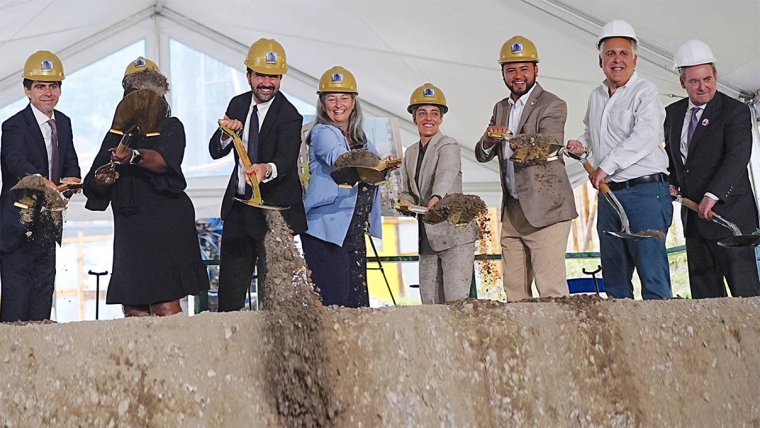
When New York City Mayor Zohran Mamdani named Anthony Shorris and Lina Khan to lead the city’s Economic Development Corporation (EDC)—as president and board chair, respectively—he did more than fill two important vacancies in his administration. He also underscored his recognition of a key challenge with which the left has long grappled: how to deliver not only economic redistribution but also economic growth.
As is customary for the left, Mamdani’s winning electoral message focused on the redistribution side of the equation: improving affordability, advocating a rent freeze, providing free use of public buses, establishing municipal grocery stores, pursuing racial equity, delivering universal childcare, and taxing the wealthiest households. Since assuming office at the beginning of this year, he has made notable progress on many of these promises, while strengthening daily governance and the delivery of basic services, reducing bureaucracy, and promoting housing construction.
Mamdani’s initial successes are all the more striking because, like other American mayors, he faces structural limits on his policies, including a state government that circumscribes the city’s scope of action on taxes and regulation, and a bond market skeptical of redistribution. Moreover, New York City is the center of a fractured metropolitan economic region in which the city drives growth—and covers the costs and problems this process creates—while politically independent suburbs capture much of the wealth.
Compounding the challenge, US President Donald Trump’s administration is particularly hostile toward Mamdani, who has become a test case for the kind of people-oriented progressive agenda that Republicans (and many Democrats) decry as incompatible with growth and innovation. But Mamdani is not alone in facing such criticism, nor is this exclusively an American issue. Across Europe, leaders promising economic justice have often struggled to convince the public that they can deliver dynamism.
This has been the case for Germany’s Social Democrats, whose redistribution-oriented proposals have been inadequate to prevent their polling numbers from sinking into the single digits in some states. It has also been true for France’s left-wing alliance, which largely touts a redistribution-focused program, including a higher minimum wage, price controls, and a wealth tax. In 2024, more voters reported trusting Marine Le Pen’s far-right party on the economy than the left-wing alliance or President Emmanuel Macron’s centrist alliance.
Spain’s leftist governing alliance has seemingly flipped the script, delivering some economic growth. But its approval ratings are falling, partly because of the lack of progress on another key element of the economic-justice agenda: housing affordability.
These political difficulties point to a fundamental challenge. At a time of historic inequality and inadequate public investment, redistribution is essential; but no jurisdiction can tax and regulate its way to affordability. A growth-enhancing agenda that generates good jobs and productive capacity is also crucial.
Harvard’s Dani Rodrik offers a way forward. Under his “productivism” framework, governments build the capacity to create good jobs at scale, not in manufacturing—a sector that evokes much nostalgia, but has limited potential for employment growth—but in services like health care, logistics, hospitality, and child and elder care. This approach is consistent with progressivism, as it “puts less faith in markets” and “is suspicious of large corporations,” while emphasising “production and investment over finance, and revitalising local communities over globalisation.”
Elements of this framework are apparent in the EDC’s agenda for New York, which includes the use of “city-owned land, financing, and investment” to “create good jobs” and “support small businesses.” And Mamdani’s selections appear well-suited to implement it. Shorris is a veteran of New York City government—having served as executive director of the Port Authority and first deputy mayor under Bill de Blasio—who is respected by the city’s business community.
In contrast, Khan, who chaired the Federal Trade Commission under President Joe Biden, built her reputation on challenging the concentration of corporate power and using government to defend workers, small businesses, and consumers from it. Beyond the EDC, New York’s first-ever deputy mayor for economic justice, former Acting Secretary of Labor Julie Su, will defend workers’ rights, such as by supporting unionisation, promoting worker training, and improving job quality.
But protecting workers and supporting small businesses will not deliver good jobs at scale. Mamdani’s administration must also find ways to work with the large firms in the industries that anchor New York City’s economy and fund its budget, namely finance, health, logistics, and technology. If Mamdani cannot show progress on this front soon, he will give the left’s critics more fuel in the run-up to November’s midterm elections.
The experience of Britain’s new Labour prime minister, Andy Burnham, shows just how delicate the balancing act will be. As mayor of Greater Manchester, Burnham helped lay the groundwork for that region to become Britain’s fastest-growing, including by investing in areas like education and public transport. These efforts were bolstered by the devolution of some spending and decision-making powers to regional authorities.
As prime minister, Burnham has called for more “flexibility” within fiscal rules to finance investments like the “biggest council house-building program since the postwar period,” alongside increased defense spending. But the bond market reacted negatively to Burnham’s plans, fearing a sharp increase in borrowing. Higher interest rates could constrain Burnham’s program and the UK’s overall growth potential.
Burnham also wants to take devolution further. Mariana Mazzucato of University College London believes that this can play a powerful role in driving inclusive growth, as long as it is pursued in the context of a national industrial strategy. But the political pressure to deliver quick victories could undercut Burnham’s ability to satisfy various stakeholders—voters, the bond market, and businesses considering investment. The same goes for Mamdani.
Nonetheless, Mamdani has shown that he is not afraid to tackle hard problems. Though delivering growth alongside equity might be among the thorniest economic-policy challenges today, his appointment of Shorris and Khan, with their contrasting reputations and experiences, suggests that he understands it. With Mamdani’s mayoralty having emerged as a kind of bellwether for progressive politics, the entire Atlantic left should be rooting for him.
Rick McGahey, a senior fellow at the Institute on Race, Power and Political Economy, is a former executive director for the Joint Economic Committee of the US Congress. Copyright: Project Syndicate, 2026. www.project-syndicate.org
We welcome your comments below. If you are not already registered, please register to comment
Remember we welcome robust, respectful and insightful debate. We don't welcome abusive or defamatory comments and will de-register those repeatedly making such comments. Our current comment policy is here.