
sign up log in
Want to go ad-free? Find out how, here.

Gene Frieda explains why any strategy for reducing global imbalances must account for China's exchange-rate management

Public Policy / opinion
Gene Frieda explains why any strategy for reducing global imbalances must account for China's exchange-rate management
Renminbi

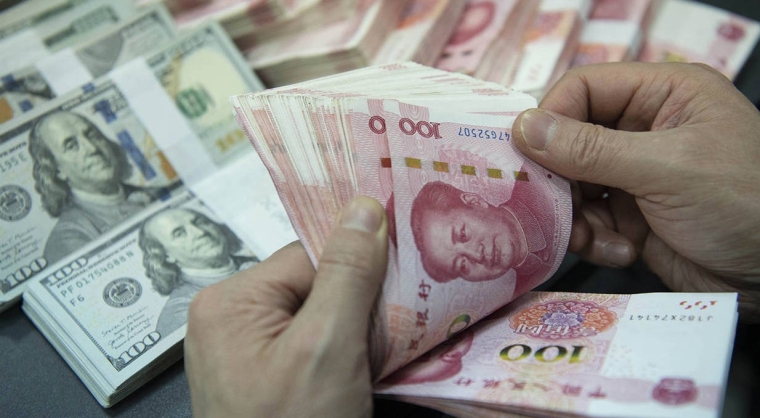
China’s undervalued exchange rate is often read as a symptom of the imbalance that underlies its surpluses. This is the wrong metaphor. The exchange rate is better understood as a price: by suppressing the renminbi’s value, the Chinese government not only obscures the underlying imbalance, but also disables the main mechanism for correcting it. The result is a deliberate policy of self-harm.

By the International Monetary Fund’s assessment, China’s real exchange rate fell by 14% in 2021–25, while the country’s officially reported current-account surplus rose to 3.8% of GDP. China’s exchange-rate management is not just about keeping the currency at a particular level; it also offers exporters an implicit volatility guarantee. With most exports still invoiced in dollars, a tightly controlled renminbi-dollar exchange rate reduces uncertainty over domestic-currency revenues. Competitors can hedge, but at a cost; Chinese manufacturers receive much of their insurance from the state.

The reasoning behind this policy lies in the framework within which it is devised, which does not aim primarily to maximise welfare or even growth. Instead, President Xi Jinping’s government has, since 2012, pursued a “security-first” model, which emphasises resilience alongside growth. Policymakers must plan for sanctions, while accounting for Xi’s ambition to secure control over Taiwan.

As Harvard’s Gita GopinathPierre-Olivier Gourinchas of the University of California, Berkeley, and the London Business School’s Hélène Rey recently noted, the “disease” underlying China’s surpluses is a policy mix that produces too much saving, including by suppressing household consumption. But the cure is not a mystery: IMF staff estimate that stronger social spending and reform of the hukou household-registration system could lift consumption by as much as 3% of GDP.

The barrier to progress is not policy design; it is policy preference. For those who are concerned about the global imbalances China’s surpluses create, the question is how to make the costs of this preference untenable. To treat the exchange rate as a mere symptom, as Gopinath, Gourinchas, and Rey advocate, would be to fail to recognise the power of prices to change behavior.

Gopinath, Gourinchas, and Rey are right that a currency’s role in trade invoicing and global finance is endogenous. Excess saving from underconsumption and overinvestment generates appreciation pressure, which is absorbed through capital controls and state-asset accumulation. But an endogenous variable can still be an instrument: by resisting appreciation, China’s government stops the real rate from correcting the imbalance and reinforces the profitability of the sector that produced it, thereby entrenching the distortions behind the surplus.

The costs end up on balance sheets—and they are mounting. The IMF estimates that China’s broad, augmented public-sector debt reached approximately 127% of GDP in 2025, while official data indicate that commercial bank net interest margins have compressed for six straight years, from 2.2% in 2019 to a record-low 1.4% last year. China is not running out of money, but it is running out of painless ways to deploy it. A weak, stable renminbi preserves exporters’ cash flows, sustains employment and tax revenue, and defers loss recognition across these balance sheets. It does not repair the financial system, but it does buy time.

Renminbi appreciation would not, on its own, rebalance the economy. But by increasing households’ purchasing power over imports and compressing tradable-sector margins, it would raise the cost of avoiding reform. Dollar invoicing reinforces both channels: the prices in renminbi of dollar-priced imports fall roughly one-for-one as the renminbi’s value rises, while sticky foreign-currency export prices push the adjustment onto exporters’ domestic revenues.

To be sure, as Gopinath, Gourinchas, and Rey note, the initial effects of renminbi appreciation would be deflationary and, given the prevalence of dollar invoicing, the impact on export prices would be delayed. Absent a change in the savings-investment balance, a forced appreciation could be matched by falling prices, returning the real exchange rate and the surplus to levels near where they began.

But that reversion is not neutral: the deflation that reverses the appreciation is the same deflation that compounds the real debt burden across public and private balance sheets. China can hold the real rate down only through a debt-deflation dynamic, the effects of which it cannot absorb indefinitely. At some point, it will have to choose between a deepening slowdown and the reflation it has resisted.

The G7 can accelerate this process. As Brad W. Setser, a former deputy assistant US treasury secretary, and Shahin Vallée of the German Council on Foreign Relations, have observed, resistance to currency appreciation forces China and other Asian surplus economies to accumulate reserves, yet the scale and liquidity of those assets make diversification away from G7 currencies extraordinarily difficult. This is an underappreciated source of G7 leverage, and in their view, the group should make use of it by issuing a joint, conditional tariff threat on Chinese exports.

To understand the scale of the appreciation pressure China faces, consider the amount of currency state institutions absorb: Setser estimates that forward-adjusted foreign-exchange intervention purchases reached US$320 billion in 2025. This is why Setser and Vallée’s proposal makes sense. The tariff would offset the price advantage created by an undervalued renminbi just as the cost of replacing that subsidy is rising, making reflation the least costly way of upholding the same model.

Crucially, the tariff threat must be conditional and reversible, with reflation being framed as China’s own choice, not capitulation. The conditionality is the face-saving off-ramp.

China’s imbalances create the surpluses, and exchange-rate management enables the country to externalise the adjustment. This makes fiscal excess easier to sustain in deficit economies, particularly the United States, whose deficits attract the foreign savings that official demand helps sustain. While currency adjustment is no substitute for structural reform, under present conditions, reform is unlikely without it.


*Gene Frieda, a former global strategist at PIMCO, is a senior visiting fellow at the London School of Economics and a non-resident fellow at Bruegel. Copyright 2026 Project Syndicate. Used with permission.

We welcome your comments below. If you are not already registered, please register to comment

Remember we welcome robust, respectful and insightful debate. We don't welcome abusive or defamatory comments and will de-register those repeatedly making such comments. Our current comment policy is here.

8 Comments

Article title says tenminbi? Needs an R

Up
0

Great article... for illustrating the perils of using standard macroeconomics frameworks to understand economic and political strategy. Look at the logic - Chinese households are saving too much, not consuming enough, China is pursuing a 'deliberate policy of self-harm'. Good grief.

China is absolutely manipulating its exchange rate to suppress imports and ensure that they run a chunky current account surplus. But is that to protect against sanctions? Not primarily, no. A current account surplus leads to a build-up in ownership of foreign assets. China is using those assets to secure supplies of critical minerals as well as influence across strategic locations. They're playing the long game - setting themselves up for the next 100 years when success will depend on continued access to real resources.

The ghouls at the IMF etc think China is 'cheating' and that other countries should punish them with sanctions to force them to play by the rules. The chutzpah! The US is literally using military force to steal oil! Japan and the US have just thrown tens of billions at protecting the Yen. I could go on.

Up
5

Jonny Foe,

The recent US/Japan currency intervention was ostensibly to prop up the Yen, but was it not also or perhaps primarily done to stop Japan selling some of its Treasury holdings?

Up
0

Very little coverage of this in MSM

Up
0

Yes, my read was it was a move to stop US rates going up at the long end. 

Up
0

China is absolutely manipulating its exchange rate to suppress imports and ensure that they run a chunky current account surplus.

China has intervened heavily to prevent the renminbi from appreciating, which kept Chinese exports relatively cheaper and supported an export-led growth model. Japan also manipulated its currency as a producer and exporter nation.

Even though both countries buy U.S. debt, Japan has had a free pass because it is not classified as a "non market economy". China is. Along with the other suspects: Angola, Armenia, Azerbaijan, Belarus. Georgia, Kyrgyz Republic, Laos, Moldova, Russia, Tajikistan, Turkmenistan, Uzbekistan, Vietnam.

Trump targeted China and Vietnam in particular with the tariffs, partly because of the trade deficits. That both countries manipulate their currencies makes sense to me. They're not SWAP nations with the Federal Reserve like Japan is.  


Up
0

Yes, Jonny - in my view its a curious mixture of unbridled western chutzpah and glaring self contradictions.


#1 The article calls the policy "deliberate self-harm," but the second paragraph explains how it successfully protects and subsidises Chinese manufacturers. If it achieves the state's goal of dominant industrial output and export growth, it is a deliberate strategy for state-led competitive advantage, not self-harm. 


#2 While a 3.8% GDP surplus is high, the article implies this is solely due to currency manipulation. It ignores structural drivers of China's surplus, such as high domestic savings rates, and property sector stagnation directing capital into manufacturing and the productive real economy.


#3 It also ignores the  fundamental structural divide in macroeconomics: the clash between Western market-liberal theory and state-directed credit policy (often referred to as asset-backed money creation or state capitalism).


#4 China’s economic structure is not "broken" by Western metrics; it is operating on an entirely different blueprint designed to avoid the exact financialisation crises currently plaguing Western economies.


#5 The original IMF-style statement treats the exchange rate as a standard market price that needs to float freely - this logic fails in China's system...


(i) In the West, private commercial banks create the ~97% of the money supply through credit expansion, which heavily flows into real estate, equities, and financial derivatives (creating asset bubbles). 


(ii) The People’s Bank of China (PBOC) and state-owned commercial banks operate largely as public utilities. Money creation is directly channelled into the physical, real economy, such as high-end manufacturing, green energy infrastructure, and industrial capacity.


(iii) Because credit is systematically directed into productive supply rather than domestic consumer demand, a massive industrial surplus is the intended, logical outcome of the system, not a market failure or currency distortion.


#5 The article attempts to frame China's low consumption as a symptom of a suppressed currency. This is complete nonsense - on the contrary China's high savings rate is deeply systemic:


(i) Decades of low-to-moderate consumer price inflation, have naturally incentivised a high household savings rate.


(ii) This is the investment engine of a credit based system. In Western economic theory, low consumer spending is viewed as an emergency (under-consumption). In China's model, those high domestic savings act as the vital capital pool that the state-run banking sector uses to fund massive industrial investments without relying on volatile and completely uneccessary foreign debt.


#6 The article also ignores the systemic fragilities inside the Western financial architecture:


(i) The "Fiat-Ponzi-Casino" Reality: For decades, Western nations (particularly the US) have relied on the privilege of issuing the global reserve currency, allowing them to run massive fiscal deficits by selling long-dated government debt to the rest of the world.

(ii) The Breaking Point: With Western central banks forced to manipulate interest rates to manage spiralling sovereign debt loads, bond markets are showing extreme volatility.


SUMMARY


As you picked up on Jonny, the incredible arrogance, including quoting the IMF estimating that stronger social spending and reform of the hukou household-registration system could lift consumption by as much as 3% of GDP. They don't need advice from any branch of the Western based finacial casino. 


Besides, China has the 2nd highest NIIP (Net international Investment Position) at +$4.07 trillion, and is recognised as the world's largest official sovereign creditor through its huge cross-border development and infrastructure lending.


Meanwhile, the US has a mind-numbing total debt (including unfunded liabilities) of $1.43 million per tax paying citizen with Japan in 2nd spot at $384,000, UK at $320,000 and Belgium at $265,000.


Framing China's industrial strategy as a "deliberate policy of self-harm" or "currency manipulation" effectively serves as a narrative distraction. It attempt to shifts blame away from the structural failure of the Western financialised model onto China's state-backed industrial success - its a severe case of chutzpah on steroids.


Up
1

Funny how the west has focused so heavily on monetary rules to create wealth from numbers, while the Chinese are the 0ones seeing the world for what it is: Real resources. They know that when the USD fails eventually they will need access to real resources, and they are poised to be able to capitalise on this when it finally happens. 

Up
0