
This article originally appeared in LawNews and is here with permission.
The government has declined to provide a detailed breakdown of its legislative priorities as the end of the parliamentary term looms in just over a month, raising questions about high-profile reform proposals such as banning children from social media and outlawing deepfakes.
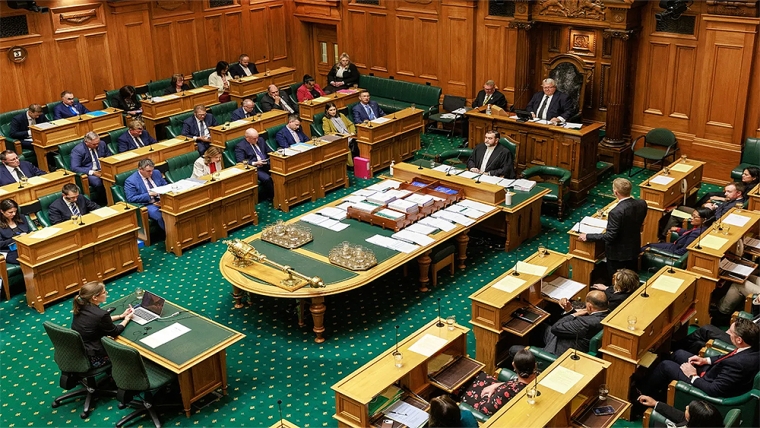
As of August 21, there were 100 bills awaiting Parliament’s approval. The House is scheduled to adjourn on September 24, before the 54th Parliament is formally dissolved on October 4, ahead of the November 7 election.
Asked for a list of bills that the government wants passed into law before the deadline, Leader of the House Louise Upston’s office would only nominate long-awaited RMA reforms, contained in two pieces of proposed legislation – the Planning Bill and the Natural Environment Bill.
“The government continues to progress a reform agenda focused on fixing the basics and building the future for New Zealand,” a spokesperson said. “One example is RMA reform, which will be a game-changer for getting things built in our country and a driver of economic growth. As the minister has previously said, those bills will pass before the election.”
Constitutionally, bills that are still passing through the legislative process lapse when Parliament dissolves, so the new Parliament can begin with a clean slate.
Section 20 of the Constitution Act 1986 allows members in the new House to pass a resolution to reinstating any business that lapsed, but an incoming government is likely to shelve the bulk of its predecessor’s plans to implement its own priorities.
Legislation that has been passed can be repealed, although that is a more complicated process.
Silence on social media ban
Aside from RMA reform, probably the highest profile bills before Parliament relate to online safety. National MP Catherine Wedd has a private member’s bill, the Social Media (Age-restricted Users) Bill, which was introduced on October 23 but has not yet gone to first reading.
ACT’s Laura McClure’s Deepfake Digital Harm and Exploitation Bill is before the Social Services & Community Select Committee, with a report due on November 20, a fortnight after the election.
Education Minister Erica Stanford has taken control of Wedd’s bill to examine how a social media ban would work and attempt to build cross-party support but her office did not respond to a query about whether there was likely to be any progress before the election.
The proposed social media ban is languishing despite an Education & Workforce Select Committee report calling for urgent action because “online harm is fast-moving and occurring on a global scale”.
That’s not to write off the possibility of movement on the issue before the election, if it’s considered appealing to voters. The government has shown that when necessary it can ram through legislation swiftly using urgency, as seen last week with legislation banning climate tort lawsuits and last year when sweeping pay equity reforms were enacted at lightning speed.
There are at least two bills in the queue which tie into the government’s tough-on-crime platform and could generate eye-catching headlines if passed before the election: the Summary Offences (Demonstrations Near Residential Homes) Bill, currently awaiting its second reading, and the Summary Offences (Move-on Orders) Bill, which the Justice Select Committee is due to report on by September 3.
Legislative logjam
A number of government bills are well advanced in the legislative process and could comfortably pass before Parliament dissolves.
They include the Disability Support Services Bill, Oranga Tamiriki (Responding to Serious Youth Offending) Bill, Commerce (Promoting Competition and Other Matters) Bill, Financial Markets Conduct Amendment Bill, Public Works Amendment Bill, Regulatory Systems (Courts) Amendment Bill and Plain Language Act Repeal Bill.
However, the timetable looks tight for the Courts Remote Participation Bill (introduced on June 30 but yet to have its first reading), Community Magistrates Legislation Amendment Bill (Justice Select Committee report not due until December 30), Overseas Adoptions Legislation Bill ((Justice Select Committee report due November 12), and the Fair Trading Amendment Bill (Finance & Expenditure Select Committee report due November 27).
The fate of Greens MP Kahurangi Carter’s Copyright (Parody and Satire) Amendment Bill, which appropriately enough had its first reading on April 1, is no laughing matter. The bill is before the Social Services & Community Select Committee with a report due on October 1, a week after Parliament dissolves.
Other private member’s bills that will be under pressure are the Legislation (Definitions of Woman and Man) Amendment Bill, from NZ First’s Jenny Marcroft, and the Modern Slavery Bill, co-sponsored by National’s Greg Fleming and Labour’s Camilla Belich, which has a report from the Education & Workforce Select Committee due on August 31.
The Improving Arrangements for Surrogacy Bill appears to have been dropped in the too-hard basket. It was originally referred to the Health Select Committee in May 2022, under the previous government. Since then it has been the subject of four committee reports, two during the current Parliament.
The most recent, tabled March this year, unanimously recommended that Parliament pass the amended bill, but there has been no action since.
*Neil Sands is Deputy Editor at LawNews. This article originally appeared in LawNews and is here with permission.
We welcome your comments below. If you are not already registered, please register to comment
Remember we welcome robust, respectful and insightful debate. We don't welcome abusive or defamatory comments and will de-register those repeatedly making such comments. Our current comment policy is here.