
The Green Party says New Zealand’s economy is at an impasse, “trapped in a low-productivity, low-wage paradigm” that is overly-reliant on agriculture, mass tourism and property speculation.
Launching its economy and innovation policy on Tuesday morning, the Green Party policy document states that if elected, they will “rescope” Investment Boost to focus on incentivising “productive investment that aligns with industry policy objectives, decarbonisation and decent work principles”.
Investment boost rescope
The investment boost tax policy was the centrepiece of the coalition government's 2025 ‘Growth Budget’, offering a $1.7 billion annual tax incentive for investments in productivity-enhancing capital assets. The policy allows businesses to immediately deduct 20% off the cost from their taxable income, and still claim depreciation on the remaining 80% over time.
This effectively brings forward the tax benefit and lowers the cost of investment by shifting some of the risks and opportunity costs from firms to the Crown. It aims to encourage earlier and larger investment in productive assets than would otherwise occur. Treasury estimated in 2025 it will increase gross domestic product by up to 0.5% over the next five years and would carry a gross fiscal cost of $6.6 billion over the forecast period.
Green Party co-leader Chlöe Swarbrick says: “We will rescope the directionless Investment Boost ... to instead drive research and development towards 3% of GDP. Two per cent is considered the international benchmark for a competitive economy. We’re currently languishing at 1.5%.”
Jobs
The policy document says New Zealand is "currently economically ill-equipped to deal with the climate challenge, growing inequality, and the technological transformation lapping at our shores".
"We presently systemically underinvest in the development of our people and the high-value jobs they need."
While New Zealand doesn’t control things like the “global winds of change or the Strait of Hormuz”, the Greens say that "we do control the investments we make, and the ability to coordinate our economy to decarbonise, protect and create jobs, and build resilience to fossil fuel shocks”.
The party also is confident that its economic development plan will create an extra 64,000 jobs on top of the 220,000 that Treasury has projected employment to grow by over the next four years.
New Zealand's jobless rate as of the June quarter was 5.6% - the highest it has been for more than a decade, with 166,500 people unemployed in April, May and June.
Thousands of jobs will be in the construction, engineering, science and technology, education, health and public service sectors, the Greens' document says. “Our modelling shows that strategic public investment can create thousands of jobs for New Zealanders immediately, while laying the groundwork for longer-term economic transformation.”
After four years, the party says its election policy investment would “increase productive economic activity and add around an extra 1% to GDP, while creating jobs in every region and across a wide range of industries”.
If elected, the Green Party also plan to:
- Build a sovereign decarbonised economy that "shields households and businesses from imported shocks"
- Create Mission Fellowships which are “industry policy objectives-linked fellowships” for early- and mid-career researchers and technical specialists
- Establish a funding and commercialisation pathway to help New Zealand innovators move from business experimentation and research through to validation, commercialisation and scaling
- Restore core science operating funding to work towards the goal of aligning the country’s Research & Development (R&D) spend to 3% of GDP
- “Back Kiwi-Made” by using public purchasing power to support “good New Zealand solutions and give them a fair chance to prove themselves
- Boost funding for tertiary research, innovation and capacity - this includes restoring funding for initiatives like the centres of vocational excellence
“A Green Government will ensure that if public money, procurement, data, or intellectual property contribute to private gain, then the public shares in the returns," the policy document says. "The government will ensure conditions are attached to public funding, rather than allowing the socialisation of risks and the privatisation of rewards."
When it comes to infrastructure, the party wants to:
- Recognise infrastructure investment as “essential to real fiscal sustainability and long-term resilience”
- Prioritise public and community ownership “where infrastructure is essential and should serve public good outcomes”
- Support locally grounded infrastructure planning with iwi, hapū, councils, workers and communities to sequence investment around “real delivery capability”
- Address the “infrastructure deficit across public housing, hospitals, schools, water, energy, transport and climate adaptation”
The cost
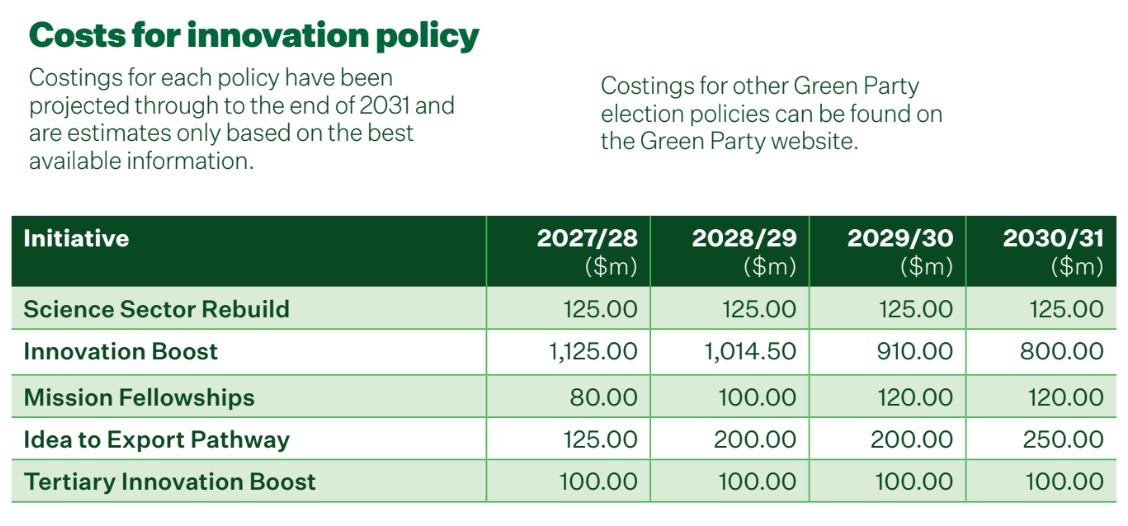
The total projected cost of the Green Party's innovation policy is about $5.94 billion over the forecast period.
Here are the party’s costings for its economic development plan:
The Greens say economic consultancy Infometrics has examined the approach and assumptions underpinning the employment and GDP impacts of “selected Green Party proposals, and confirm that the impact analysis appears to be a reasonable assessment, conditional on the underpinning assumptions for the approach taken to the multiplier analysis”.
Greens will not let New Zealanders be ‘passengers in their own economy’
Swarbrick says her party is “serious about the economy".
“Our investment in transport, clean energy and genuinely fixing the basics and building the future will create an additional 64,000 jobs on top of the 220,000 forecast over the next four years," she says.
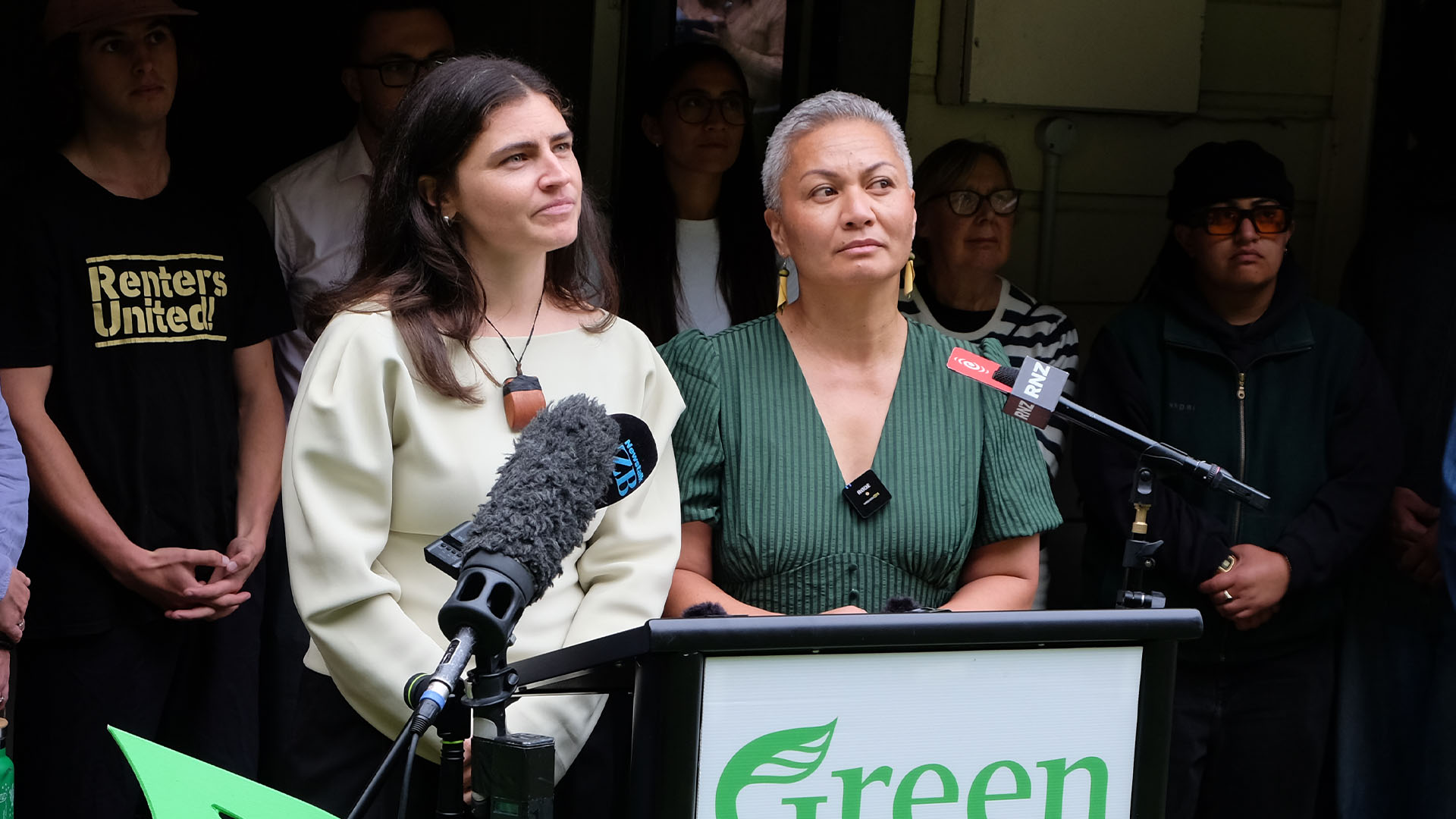
This also comes after the Greens announced its “jobs guarantee” pledge over the weekend, costing $4.7 billion through to mid-2031, with co-leader Marama Davidson promising every 16-24 year old who had been out of work for six months a pathway into a job. The party has also promised to scale up funding for the Mayors' Taskforce for Jobs through all councils, which the party estimated would create 32,000 local jobs.
Swarbrick says her party will not let New Zealanders be “passengers in their own economy”.
"We will ensure Government investment and incentives drive us where we all want to go: higher wages, sustained research and innovation, better education, resilient infrastructure, healthy nature and a country we can be proud of.”
Davidson says New Zealand has no shortage of talent, creativity and hard work.
“What’s missing is the masterplan to turn it into good jobs, higher wages and a fairer economy.”
We welcome your comments below. If you are not already registered, please register to comment
Remember we welcome robust, respectful and insightful debate. We don't welcome abusive or defamatory comments and will de-register those repeatedly making such comments. Our current comment policy is here.