
My search for truth inside China has been stymied. Banned from the China Development Forum (CDF), after participating for 25 years as the longest-attending foreign delegate, I feel like an outsider in what was once the country’s most prestigious international gathering. Deteriorating relations with former friends in Hong Kong, some of whom avoid eye contact with me now, have not helped matters. In both cases, I was cut off after offering constructive criticism—highlighting structural malaise in the mainland economy and a loss of autonomous identity in Hong Kong—the essence of what we call debate in the West.
Fortunately, there are other avenues for engagement. One is the Bund Summit in Shanghai, which I attended last week. It reminds me of the CDF in the early days, when, under the leadership of the late premier Zhu Rongji, the exchange of views was focused, vigorous, and open. As one well-connected Chinese friend conceded, “The CDF is now a government conference. The Bund Summit is the real thing—the best conference in China today.”
This year’s agenda, organized around the theme of “Technology, Geopolitics, and the Global Economy,” demonstrated the summit’s breadth and depth: there were panels on monetary policy, fiscal and debt challenges, global imbalances, new energy sources, AI, currencies, and trade. Discussions were structured to reflect strong opinions both inside and outside of China.
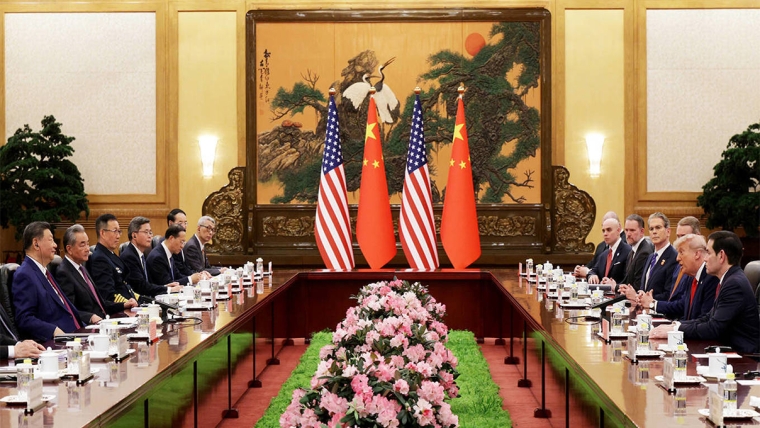
Not surprisingly, I was most interested in two sessions—a dinner at which I spoke and a follow-up panel the next day—on Sino-American ties. Both sessions considered whether the relationship between the United States and China is entering a new, less contentious chapter following the first two of this year’s four summits between US President Donald Trump and Chinese President Xi Jinping. The possibility of a new era hinges on the notion of “constructive strategic stability” that Xi and Trump are now stressing.
To be sure, constructive strategic stability is a classic example of the word salad that diplomats often offer as sustenance in bilateral discussions. But, based as it is on the principles of “respect, fairness, and reciprocity” that were underscored in the readouts of the recent Trump-Xi summit in Washington, this new chapter appears to come as welcome relief, especially when compared to the “reciprocal” tariffs that Trump launched on last year’s “Liberation Day.” After raising the tariff rate on China to 145%—an absurdly high level—the administration backed down only after Xi played his rare-earths card, underscoring Trump’s TACO reputation (“Trump always chickens out”).
But a new label for the bilateral relationship does not constitute a new power-sharing initiative. Some have argued that this year’s Trump-Xi summits are paving the way for a G2 system, in which the US and China set global economic strategy and address geopolitical pressures like the wars in Ukraine and the Middle East. While rumors of a trilateral summit between Trump, Xi, and Russian President Vladimir Putin at next month’s Asia-Pacific Economic Cooperation forum in Shenzhen lend some credence to this view, the consensus at the Bund Summit was that a G2 is not on the cards.
Lastly, it was widely agreed at the Shanghai gathering that the biggest takeaway of the recent meetings between Trump and Xi is their willingness to buy time. Both leaders are preoccupied with domestic concerns. The last thing they need is another dispute over trade, let alone a technological or military conflict.
This aligns with my own assessment of the current state of the US-China relationship: stable for now, but with an uncertain future. The Chinese participants in this year’s Bund Summit were just as realistically cautious: like me, they do not trust Trump’s newfound constructive perspective on China. Abrupt policy shifts are the norm for the US administration. Most recently, Trump fiddled with Canadian tariffs in an effort to boost Republican congressional candidates in Maine, Michigan, and New Hampshire. He also issued an executive order to countermand newly enacted legislation (which he signed into law) under which he can impose secondary sanctions on China for purchasing oil from Iran and Russia.
I went further, arguing that whatever Trump says today has no bearing on America’s long-term strategic commitments to any nation. His mendacity and treachery know no bounds—just ask Canada, Ukraine, and European NATO members. He would not think twice about reversing course on foreign policy, even on something as critical as maintaining stable relations with China. In line with this perspective, the Chinese participants in the Bund Summit were more interested in what the post-Trump era means for Sino-American ties. They were particularly interested in whether that era could begin as soon as November 4 of this year—the day after the midterms—rather than after the presidential election in 2028.
The honest exchange of views in Shanghai was a heartening demonstration of what truth-telling in China can still be about. The deep insights shared by knowledgeable experts from both sides of the Sino-American divide gave me hope for what the world’s most consequential relationship can look like in a post-Trump future. Between now and then, I’m afraid the best we can hope for is a tenuous stability.
*Stephen S. Roach, a faculty member at Yale University and former chairman of Morgan Stanley Asia, is the author of Unbalanced: The Codependency of America and China (Yale University Press, 2014) and Accidental Conflict: America, China, and the Clash of False Narratives (Yale University Press, 2022). Copyright: Project Syndicate, 2026, published here with permission.
We welcome your comments below. If you are not already registered, please register to comment
Remember we welcome robust, respectful and insightful debate. We don't welcome abusive or defamatory comments and will de-register those repeatedly making such comments. Our current comment policy is here.