
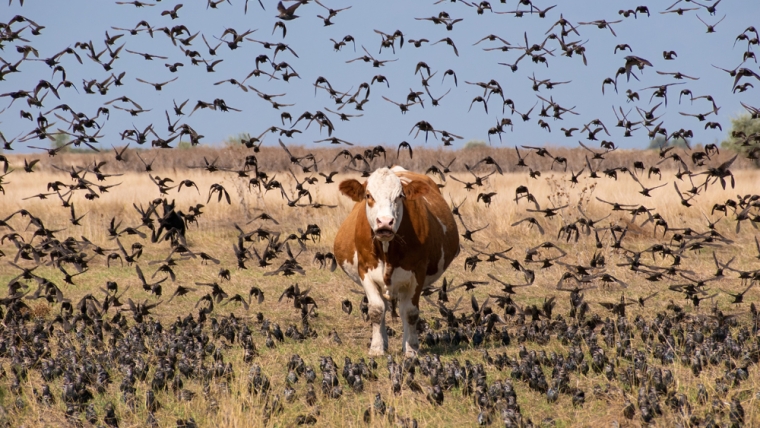
My knowledge about bird flu was very little until I received a request to find someone who could assess the risks within a New Zealand context, including a suggestion that I might, if necessary, self-nominate.
I could not identify anyone who would want to stick their head up on this one, so I decided to go on a journey of self-exploration. Here, I share what I learned.
Bird flu is the term for a large family of viruses, with avian influenza being the more formal name. These viruses have been around since at least the 1880s, but my bet is they have been around since birds evolved. In the last 30 years, a particular category of bird flu, called H5N1, has come to human attention.
H5N1 viruses are always evolving through ongoing mutations and we now have variants that can transfer between both bird species and many animal species. The mammal species include seals, sea lions, cats, foxes and cattle. In all likelihood they can transmit and multiply in other species.
Different viruses also have the ability to swap DNA, referred to as reassortment, something that I very loosely refer to as ‘viral sex’. This is how they can take evolutionary jumps. For example, type A viruses, which include both bird flu and some human flu viruses, are sufficiently closely related for this to occur if they infect the same person or animal at approximately the same time.
For several years there have been large die-offs of seals along the coasts of South America and these are caused by H5N1 viruses. Characteristics of seals include that they spend time in large groups and on occasions are likely to eat dead birds. These two characteristics combine to facilitate virus transmission.
Cattle infections appear to be new. However, in the last month at least 36 herd infections have been identified within USA dairy herds in at least eight states. The cows do get sick, and the virus does transfer between cattle within a herd. I have not found any reports of cattle mortalities.
There appears to be uncertainty as to how the virus spreads between herds. Has it been new infections from infected birds or has it been from animals being transported between farms? At this stage I have no firm opinion as to which of these has occurred.
If it is the former, then the latest version of H5N1 has in all likelihood transferred widely to bird species that congregate among themselves and also visit cow barns. If it is the latter then the implication is that it has been present in cattle for some time for it to have spread so widely.
I can develop arguments both for and against either of these transmission routes. However American virologists are now saying that the evidence they have suggests it has been in cattle since late 2023. There is also some evidence that the cattle variant of H5N1 can transfer back to birds.
There is nothing new about H5N1 transferring to humans, with this typically occurring in association with poultry farms. World Health Organisation data show there have historically been more than 800 cases in recent decades in humans with a 53% mortality rate. Most of these have been in workers on poultry farms in Asian countries.
However, there are two ultra- important caveats here. The first is that there have been no reports of H5N1 variants transferring between humans.
The second caveat is that there are only two known cases to date of the virus apparently transferring directly from cattle to humans and neither of the human cases have led to mortality or been particularly severe. However, these people were healthy workers, not sick elderly folk. Fingers crossed that this latest variant transferring from cattle proves to be not particularly severe in humans.
The likelihood of H5N1 reaching New Zealand and affecting humans is currently assessed by most professionals in the field as being low. This is despite some H5N1 variants having reached all parts of the world except Australia and New Zealand. We don’t import cattle to New Zealand and at this stage there is no evidence of transmission between humans. Of course, everything changes if it does find a bridge from humans to humans.
Note that in the above paragraph I have not used the term ‘expert’. This is because in matters like this there are no experts. The relevant professionals are all on a learning journey. However, the relevant New Zealand professionals have been doing their own scenario analyses, so hopefully there is a state of readiness.
One possible way that H5N1 bird flu could transmit to New Zealand is via across-hemisphere migrations of wild birds. This could be godwits, which migrate to New Zealand and back to high latitudes in the Northern Hemisphere each year. However, any infected godwit may or may not survive the long exhausting journey.
Alternatively, it arrive via waterfowl which occasionally come across from Australia. Currently, there is no evidence of Australian waterfowl such as geese and ducks being infected.
If the latest variant does arrive via bird migrations and then gets into our own wild bird populations, then the effects could be devastating to these native birds. The virus would then likely transfer to rodents and cats.
Another possibility is that it could come in via cattle semen. Hopefully the semen will be tested.
The good news for humans is that the genetic code for the latest H5N1 variant is known and is publicly available to virologists. This should facilitate rapid development of vaccines. Also, in contrast to the COVID viruses, existing Type A flu vaccines do provide a level of protection.
From a human health perspective, the most likely transfer to humans would then be via handling of sick or dead birds, including poultry, or perhaps from cats, or by drinking unpasteurised milk. There is already evidence that it does get into cow milk but is killed by pasteurisation.
As for me, I am now going to keep a watching position with a focus on reports from international science organisations. In the meantime, I won’t be losing any sleep. We live in a world where there are so many things that one can worry about but do so little to change. Accordingly, I simply plan to focus on living each day to the full.
*Keith Woodford was Professor of Farm Management and Agribusiness at Lincoln University for 15 years through to 2015. He is now Principal Consultant at AgriFood Systems Ltd. You can contact him directly here.
We welcome your comments below. If you are not already registered, please register to comment
Remember we welcome robust, respectful and insightful debate. We don't welcome abusive or defamatory comments and will de-register those repeatedly making such comments. Our current comment policy is here.