
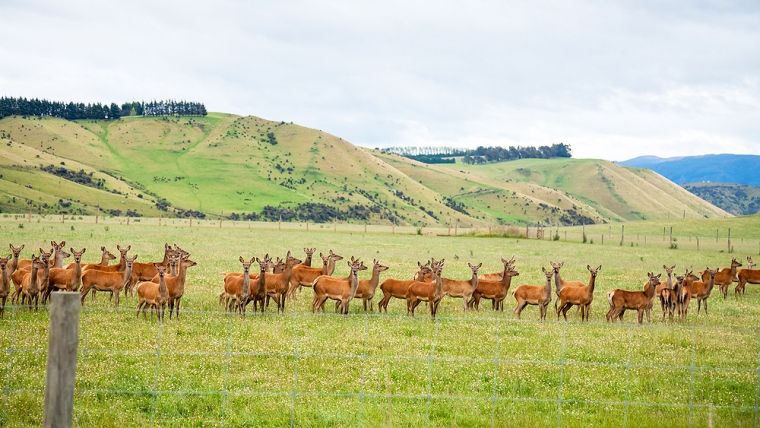
With lamb and beef prices at levels few farmers would have expected a couple of years ago, making the case for introducing another livestock species might seem a little harder.
But BakerAg consultant Matt Carroll says deer continues to stack up, and the argument for farming them may be less about replacing sheep or cattle and more about what another species can add to the overall farming business.
Carroll has run the numbers across breeding and finishing systems and says deer remains comparable with sheep and beef at current returns.
On his modelling, four breeding hinds per hectare at 90 percent reproduction, weaning a 58kg fawn at $6/kg, produces around $1253 per hectare. His comparable sheep model, based on six ewes per hectare at 130 percent weaning and a 30kg lamb at $5/kg, produces around $1107 per hectare.
The cattle comparison comes out differently on a per-hectare basis because of the stocking rate, reinforcing the point that simply comparing one stock unit with another does not necessarily tell you how each species performs within a farming system.
“I think the key thing is that it’s still comparable. It still fits. It still works,” says Carroll.
There are also premiums within the deer industry that are not always obvious from the published schedule. Quality assurance programmes can add around $1.50 and sometimes as much as $2/kg, depending on the programme and processor.
Perhaps more importantly, Carroll believes deer’s long-standing reputation for volatility deserves another look.
Venison has historically been regarded as a more volatile product than lamb or beef and that perception has influenced both farmers and lenders. Carroll says the market over recent years tells a different story.
“The volatility thing I’ve always pushed back on because volatility in prices is just agriculture,” says Carroll.
“You get it in the dairy industry. You get it everywhere. It’s just farming, and it’s not specific to one species by any means.”
Covid was the obvious exception.
The venison industry had built a significant part of its market around high-end restaurants and the European white-tablecloth trade. When restaurants around the world closed almost overnight, that strategy was badly exposed.
What followed, however, has changed the way New Zealand venison is marketed.
Greater emphasis has gone into retail, particularly in North America, while work has continued to develop other markets including China. That has reduced the industry's dependence on the traditional European game trade and helped flatten what was once a strongly seasonal venison schedule.
That change matters on farm.
Under the traditional model, farmers often had to push young deer through winter to meet the chilled trade. Missing the target could mean holding animals while the schedule was falling.
Carroll says a flatter schedule gives farmers more flexibility to grow animals according to what suits their farm rather than chasing a narrow marketing window.
“The farmers can actually just do what they do well and grow out good animals and get return from it, instead of having to meet market requirements,” says Carroll.
It is when deer is considered as part of a mixed farming system, however, that Carroll believes the argument becomes more interesting.
Rather than asking whether deer should replace sheep or cattle, the better question may be what happens when all three are incorporated into the same business.
Carroll is a strong advocate for diversification, although he acknowledges it comes with additional management complexity.
A farm carrying sheep, cattle and deer has another set of priorities to manage, but it also has another income stream and is less exposed to what happens in any single market.
“A diversified business, it just means you’ve got your finger in a few more pies,” says Carroll.
“You might not get as big a win if you’re not solely in that stock class, but it means you get to share the wins over the longer period, because we’re not farming for one year here. We’re farming the longer term.”
There are practical benefits as well.
Sheep, cattle and deer have different breeding cycles and different feed demands. On a hill country property, spreading lambing, calving and fawning across spring can create more options around pasture management.
That becomes particularly relevant when conditions turn dry.
Carroll's first rule in a difficult season is simple: look after the breeding female.
“I always say to clients, it’s look after mum,” says Carroll.
The aim should be to prevent a drought from affecting production beyond the season in which it occurs. Allow breeding stock to lose too much condition and the consequences can carry through into subsequent scanning, calving or fawning performance.
Deer provide some additional management options.
A farmer expecting a dry summer can wean fawns before the rut to reduce pressure on hinds. That may mean accepting a lighter weaner, but it can protect hind condition and future reproductive performance.
On a mixed farm there are further choices around when lambs are finished or sold, how cattle are used and where feed is prioritised.
Velvet stags can also fit well in summer-dry environments because their greatest feed requirement occurs during spring when pasture growth is generally strongest. Once velvet has been harvested and regrowth completed, feed requirements can fall back towards maintenance as summer conditions tighten.
None of this removes one of the traditional barriers to deer farming: infrastructure.
Deer fencing costs more than simply using an existing conventional fence, but Carroll says the gap has narrowed considerably as the cost of conventional fencing has increased.
New deer fencing can sit in the high $20 to low $30 per metre range, while topping up suitable existing fences can potentially be done for considerably less depending on their condition.
There is also a substantial amount of existing deer infrastructure around the country that is no longer being used for deer.
Carroll recently visited one property with around 900 hectares behind deer fencing but no deer.
The increasing problem of feral deer is creating another interesting dynamic. Some farmers are considering deer fencing boundaries or productive flats simply to keep wild deer away from crops and pasture. Once that infrastructure is in place, introducing farmed deer becomes another option.
The animals themselves have changed as well.
The image of deer farming built around dark sheds and difficult animals bears little resemblance to many modern deer operations.
“Deer sheds nowadays are big, lots of air, lots of light and lots of airflow, and they want to be able to see what you’re doing,” says Carroll.
“It’s not the animal that was farmed in the 70s by any means.”
Temperament has become an important selection trait and Carroll says good stockmanship remains fundamental.
“If you’re a good stockman, there’s no reason why you can’t farm deer just as well as you farm sheep and cattle.”
For farmers considering deer for the first time, Carroll sees venison as the simpler entry point.
Velvet can generate strong returns, but it requires considerably more infrastructure, certification and specialist knowledge. Facilities need to meet requirements for velvet removal and storage and those harvesting velvet need the appropriate training and certification.
Carroll suggests farmers without previous deer experience learn to farm hinds and produce venison before making the additional investment required for velvet.
There is also no need to jump straight into a large-scale conversion.
Farmers with existing deer fencing can start by investigating how deer might fit their current system. The Deer Hub provides technical information, while the New Zealand Deer Farmers Association's branch network can connect prospective farmers with people already farming deer in their region.
Finding suitable breeding stock and spending time with experienced deer farmers can then provide a relatively measured pathway into the industry.
That approach is probably more important than any individual gross margin calculation.
Current lamb, beef and venison prices will change. They always do.
The stronger case for deer is that another species gives a farming business another set of options.
It can spread market exposure, alter the timing of feed demand, provide another way of responding to a dry season and create an additional income stream without necessarily displacing sheep or cattle altogether.
It does make the business more complicated and, as Carroll points out, farmers need to understand what each stock class earns, what it requires and what the opportunity cost is when one species is prioritised over another.
But complexity and resilience can sometimes be two sides of the same coin.
For the right farm and the right farmer, deer doesn't have to replace anything.
It simply has to earn its place.
Have a listen to the podcast to hear the full story.
Angus Kebbell is a producer at The Weekly Hotwire. You can contact him here.
We welcome your comments below. If you are not already registered, please register to comment
Remember we welcome robust, respectful and insightful debate. We don't welcome abusive or defamatory comments and will de-register those repeatedly making such comments. Our current comment policy is here.