
As we head into the November election, the key focus of political or parties seems to be tax, plus the need to work towards a balanced budget, plus whether election lollies can be funded. Entangled somewhere in amongst this are inflation, cost of living, unemployment and mounting infrastructure needs.
It is a story that presents a difficult and even depressing outlook. It seems that the best years could well be behind us. Like Nero who fiddled while Rome burnt, are we missing the big picture?
Unfortunately, the big picture includes that there are no easy answers. Neither of the main parties, nor for that matter the minor parties, are putting together the pieces of a rough-edged puzzle. It is much harder than they are acknowledging.
When I came back to New Zealand with my family at the turn of the century, after nearly 20 years overseas, I easily convinced myself that there were good years ahead. New Zealand had just gone through 15 years of restructuring and economic pain.
I did not like the amount of poverty that I was seeing here compared to Australia where I had been based, while also working further afield. However, I had expectations that our primary export industries were going to prosper and that this would underpin economic growth.
Until COVID arrived in 2020, things did work out that way to a large extent. It wasn’t all smooth sailing but the overall trend seemed clear.
Between December 1999 and December 2019, national GDP grew by 77%. This gave an annual compound rate of increase of 2.9%. After making allowance for the population increasing by 29% over this period, per capita GDP grew by an annual compounding rate of 1.7%.
These figures are in constant value dollars after taking account of inflation, and are derived from Reserve Bank and Stats Department source data.
In the latest 6.5 years from December 2019 through to June 2026, our national economy grew by 10.0% in total, giving an annual compound growth rate of 1.5%. But our population grew by 7.8%, so per capita GDP rose by only 2.2% in total over this period. On average, annual per capita GDP increased by only 0.3% each year.
In these recent years, the population grew rapidly, at 1.2% per year, very close to the rate at which it grew in the preceding 20 years. But the economy has lagged behind.
Let me summarise by quoting the key outcome numbers again: per capita GDP rose, in inflation adjusted terms, by 1.7% per year for the 20 years following the turn of the century. However, it has on average only been increasing at 0.3% per year since December 2019.
This is a long enough period that we must question whether growth, at least on a per capita basis, has effectively become close to a long-term stall. We cannot explain this away as just a short-term economic cycle.
Important questions also have to be asked as to how national income is shared among the population. A lot of working people would correctly argue that their own personal living standards have recently declined. They have not seen that 0.3 percent annual growth in GDP transferring to their own incomes. Also, they see no evidence this is going to change.
At a personal level, I have spent most of my professional life working within agriculture science and agribusiness, with a focus on the linkages between resources, economics, and value chains through to markets. When I go to a foreign country, one of the first things I want to do is visit some supermarkets and see what people are buying.
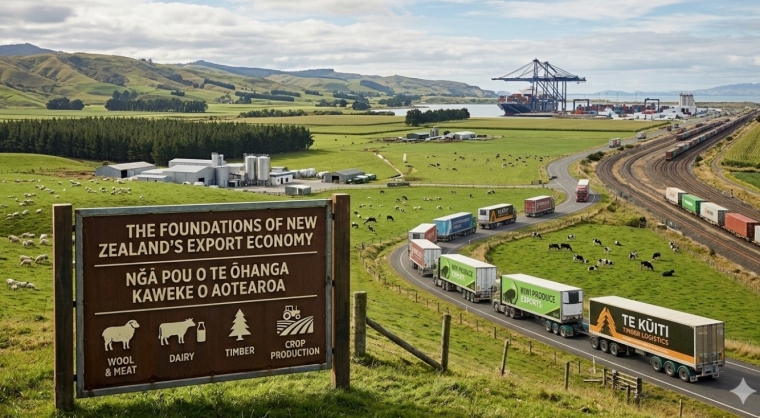
MPI data tell us that primary industries currently comprise 82 percent of our merchandise exports. Then comes tourism and education as overseas dollars within services. There is not much else. Indeed that ‘not much else’ has been declining as a percentage of the total for the last 20 years.
I am also conscious that most agricultural product prices are currently either at or close to record levels. However, it cannot be assumed that these prices will be sustained.
There was a time when high export prices would have flowed through into overarching economic growth, but that seems to be no longer happening to the same extent. Other things are getting in the way.
Much of the apparent growth in exports in the last ten years, when quoted in nominal New Zealand dollars, has been driven by the declining value of that dollar. Back in 2017, the New Zealand dollar was worth more than 80 American cents. As I write this, it is worth 56.5 American cents. Also, the New Zealand dollar was worth close to parity with the Australian dollar back in 2017. Currently New Zealand’s dollar is worth 81 Australian cents.
If it were not for depreciation of the New Zaland dollar, our export prices in New Zealand dollars would be much lower. Of course, that same depreciation has also led to higher import prices.
Our dollar has depreciated because economic growth has been low and inflation has been high. Our government accounts have been in annual deficit each year since 2019. As for the current account between New Zealand and the rest of the world, that has been in annual deficit every year since 1973!
These two deficits, one at government level and the other at national level, indicate that we have been living beyond our means for a long time. It’s a Ponzi structure. To date, we have ‘solved’ that problem by borrowing more and more. We have also sold many assets. At some stage it has to stop.
With interest piling up from the deficits in both government accounts and our national current account, we use an increasing proportion of taxes to pay our internal debts, and an increasing quantity of export income to balance the financial outflows in the national current account. We have got ourselves in a pickle.
At this point I need to reinforce the notion that in getting ourselves into a pickle, our internal economy has indeed become a Ponzi. The internal economy has outgrown our export economy, and can only survive, albeit in association with inflation, with more and more funds flowing in from overseas.
There used to be a time when we could rightly claim our economy was export-led. However, right now, of 48 countries in the OECD, there are only four that have exports as a lower percentage of their economy than New Zealand.
There was a considerable period when our exports comprised more than 30 percent of the economy. For example, between 1998 and 2008 our exports comprised more than 30 percent of GDP each year. In 2001 and 2002 they exceeded 35 percent. However, in the most recent five years from 2021 to 2025 they comprised an average of only 23 percent of GDP.
The decline in exports as a proportion of the economy might not matter so much if we were a large country with huge natural resources, plus a huge internal market, and huge manufacturing opportunities. But it sure matters if you are a small country at the far end of the world with an absence of critical natural resources, a small internal market, and no scale for manufacturing.
There is simply no way we can economically manufacture cars, trucks, computers, electronic goods, television sets, most pharmaceuticals, and even whiteware. And that is just a start. There are logical reasons why our manufacturing sector is so small.
Looking forward, the big question is, with minimal manufacturing and resource-based industries constrained by nature, where might sustained growth come from in New Zealand?
Twenty-five years ago, that question was easy to answer.
Back then, I knew that there were considerable land-based opportunities that lay ahead for New Zealand’s primary exports. Having first travelled through China in 1973, and subsequently undertaken commercial market research in China, I also knew that China was going to be particularly important as a market. However, I did under-estimate how quickly that might happen.
Alas, land-based opportunities are now much more constrained than they were 25 years ago. I know that because I am still closely involved in agricultural research and development. Yes, opportunities do exist, but the easy runs have all been scored. It is going to be hard work.
At some time in the future, I will talk about the land-based work I am currently associated with, including its emphases on all of sustainability, economics, and well-being. But now is not the right time to do that. I simply emphasise here that the easy runs have all been scored.
As for markets, much of our future remains in Asia, but many of those countries, such as China, Japan, Korea and Thailand now have declining populations. Others such as India, Malaysia and Indonesia have birth rates that have either dropped or are now dropping below long-term replacement rates.
On the upside, India does have current economic growth in excess of six percent per annum, and Indonesia’s economy is currently growing at more than five percent.
However, the challenges for New Zealand with India include that, despite current high economic growth, average living standards there are currently very low, with more than 60% of the population living in rural areas, plus they don’t eat beef for religious reasons, plus New Zealand and all other countries remain locked out of their dairy market. So, as for elsewhere in Asia, but for somewhat different reasons, India is going to be hard work for New Zealand.
Indonesia is somewhere that also faces huge challenges but we do need to work harder.
These facts all lead to very strong indications, that once again, there are no easy runs to be scored.
Given these facts, why is New Zealand’s population still growing rapidly?
In part, it is because births still exceed deaths by around 20,000 per annum. However, in recent years it has been net immigration, which takes account of New Zealanders leaving to live elsewhere, that has been the main cause of population increases.
If this situation continues, then it will have minimal effect on export volumes. This is because the major export industries are using less and less labour. It is natural resources, not labour, that are the big constraint for export products.
In contrast, the demand for imports will continue to rise in line with the population increase. This will lead to further depreciation of the New Zealand dollar and higher import prices.
With ongoing use of the population pump, per capita increases in living standards will become close to impossible. We need to face up to this reality.
Of course, any population policy that reduces immigration will bring its own challenges. For a start, the short-term apparent benefits of a Ponzi debt-based economy will disappear. This reality will be painful. But the long-term benefits of a stable population in a resource-constrained world cannot be ignored.
I had planned to write a lot more about the significant challenges of moving to a stable population, but I have decided to leave that for another article. Here, I will finish by simply deploring the populism and partisan attitudes with which immigration policy so often gets entangled, including racist elements.
Instead, I ask that we focus on the future realities of a small natural-resource constrained nation, distant from international markets, in a complex world of uncertainty and strife.
*Keith Woodford ONZM was Professor of Farm Management and Agribusiness at Lincoln University for 15 years through to 2015. He is now Principal Consultant at AgriFood Systems Ltd. You can contact him directly here.
We welcome your comments below. If you are not already registered, please register to comment
Remember we welcome robust, respectful and insightful debate. We don't welcome abusive or defamatory comments and will de-register those repeatedly making such comments. Our current comment policy is here.