
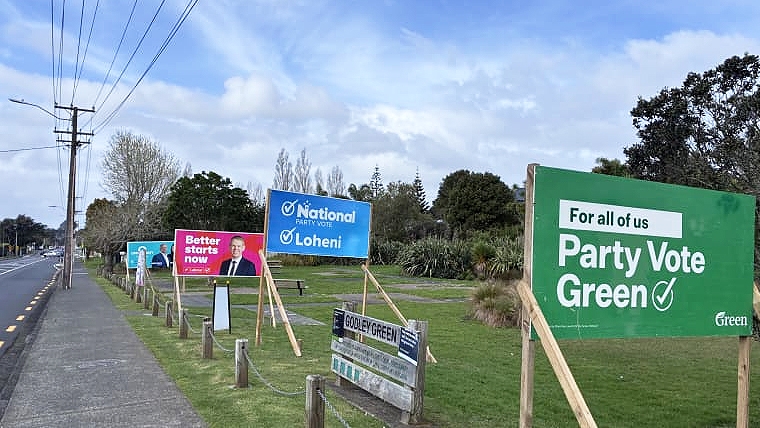
New Zealand's primary sector heads into the 2026 election in a rather different position from where it stood three years ago.
Agricultural emissions pricing has been abandoned, methane targets have changed, restrictions have been placed on the conversion of productive farmland into exotic forestry, freshwater regulations have been altered and legislation replacing the Resource Management Act has passed.
At the same time, some of the coalition Government's rural programme remains unfinished. The replacement freshwater framework is not complete, the Gene Technology Bill has not passed and the promised return of livestock exports by sea did not happen.
So with election day approaching, rural voters have something more useful than promises alone to consider. They have three years of Government against which National, ACT and New Zealand First can be measured, alongside quite different proposals from Labour, the Greens, Opportunity and Te Pāti Māori.
Strip away the campaigning and the fundamental question is what each party believes New Zealand farming should look like over the next decade.
National's answer is largely based around production.
It wants New Zealand to double the value of its exports by 2034 and argues the way to achieve that is through less regulatory friction, greater access to water and agricultural inputs, new technology and expanded overseas markets.
Its new agricultural package proposes 19 national farming standards covering activities including farm plans, irrigation, water storage, effluent, fertiliser, drain maintenance, farm quarries, tracks, culverts, wetlands and agricultural aviation.
The principle is relatively straightforward. National does not believe a farmer undertaking an ordinary agricultural activity should face fundamentally different rules simply because the farm happens to sit on the other side of a regional council boundary.
Water is another major part of that strategy, including $300 million in concessional lending for water-storage projects, a national water-infrastructure pipeline and national standards intended to make lower-risk water storage and irrigation easier.
There is little ambiguity in the overall direction. National believes New Zealand can and should produce more.
That ambition, however, raises an interesting question when placed alongside the Government's carbon-forestry policy.
The coalition has undoubtedly tightened the rules around wholesale farm conversion. Exotic forestry entering the ETS is now restricted on LUC classes 1 to 6 and that represents a material change from the previous settings.
But the pathway from pastoral farming into carbon forestry remains open.
Up to 25 percent of LUC 1-6 land on an individual farm can generally still be registered as exotic forestry in the ETS. In addition, a national ballot system allows another 15,000 hectares of LUC class 6 land to potentially be registered each year.
That additional allocation is significant.
If fully utilised, 15,000 hectares a year amounts to 150,000 hectares over a decade, before considering the separate 25 percent farm allowance and applicable exemptions.
That does not mean all of that land will inevitably be planted. Obtaining a permit does not guarantee eventual ETS registration and not every hectare of class 6 land has the same agricultural productive value.
But there is clearly demand. The first 2026 ballot was oversubscribed.
It leaves National with a legitimate policy tension.
If productive class 6 country is expected to contribute to the ambition of doubling New Zealand's export value, how much of it can continue moving out of pastoral production and into exotic carbon forestry before the two objectives begin pulling against each other?
The Government has put brakes on wholesale conversion. It has not stopped it.
That issue has also become more politically interesting because Labour has moved.
Labour now says the ETS is broken and argues the existing system has created an incentive for exotic forestry to compete with food production while allowing major emitters to purchase offsets rather than make sufficient reductions themselves.
It is proposing an urgent review of the ETS, a temporary pause on new forestry registrations while that work takes place and new rules aimed at preventing whole-farm conversions.
That represents a significant change in the politics surrounding carbon forestry.
The argument is increasingly no longer whether carbon-driven whole-farm conversion creates problems for rural New Zealand, but what should be done about it.
Labour's approach comes with its own questions.
Reducing New Zealand's reliance on forestry offsets while retaining international climate commitments means greater emissions reductions may have to occur elsewhere in the economy. That potentially carries costs for emitters, consumers and businesses.
There is no cost-free solution.
Freshwater provides a much clearer dividing line.
National is moving towards nationally consistent rules and a more risk-based regulatory approach.
ACT wants to go considerably further.
It supports national standards for ordinary farming activities, stronger property rights and a nationally consistent methodology for setting freshwater limits. It also wants Te Mana o te Wai removed from freshwater regulation.
Labour says it would use the 2020 freshwater framework as the starting point for a new process, although it argues that would not necessarily be the final result.
The Greens favour stronger science-based national environmental standards, greater protection of drinking-water sources, reducing stocking pressure where catchment conditions require it and phasing out synthetic nitrogen fertiliser.
Opportunity combines stronger environmental standards with greater use of market mechanisms around pollution.
These are not minor differences in regulatory detail. They represent quite different views about who should determine environmental limits and how much flexibility individual farmers and catchments should have in meeting them.
Climate policy produces another divide.
The coalition abandoned agricultural emissions pricing and reset the 2050 biogenic methane target.
ACT would go considerably further. It wants agriculture permanently outside the ETS and has proposed repealing the Zero Carbon Act, removing the net-zero target and abolishing the Climate Change Commission. It is also prepared to reconsider New Zealand's involvement in the Paris Agreement if international commitments do not, in its view, properly recognise the different warming characteristics of methane.
National has instead chosen to change domestic methane settings while remaining within the international climate framework.
Labour remains committed to international climate obligations but has not campaigned on simply reinstating its previous agricultural emissions-pricing scheme. Its current position is that agriculture would not be put into the ETS and emissions reductions should increasingly come through technology and changes in farming practice.
The Greens favour substantially stronger agricultural emissions reductions.
Again, the question is not simply whether agriculture should reduce emissions. It is who determines the target, what mechanism is used and who ultimately carries the cost.
New Zealand First occupies an interesting position within the current coalition.
It shares many of National and ACT's concerns around agricultural emissions pricing, freshwater regulation and productive farmland being lost to carbon forestry.
But economically it is more willing to intervene directly in markets.
Its "Use It or Lose It" dairy proposal would allow qualifying processors investing in new value-added capacity to access substantially greater volumes of Fonterra milk under regulated supply arrangements.
The objective is to encourage more dairy processing, employment and value creation within New Zealand.
That highlights a genuine difference between ACT and New Zealand First.
ACT generally prefers markets to determine where investment and capital go. New Zealand First is more prepared to use Government policy to influence where economic value is created and retained.
The Greens offer perhaps the clearest alternative to the production-led model.
Their agricultural policy starts from the position that environmental limits should play a greater role in determining the intensity and type of farming.
The party advocates a regenerative food, fibre and forestry system with greater emphasis on freshwater, biodiversity, climate and food security.
The economic question is what that transition would mean for production.
If stocking intensity falls and inputs such as synthetic nitrogen are reduced, physical production may also fall unless improvements in productivity compensate.
The Greens' argument is that New Zealand should move towards higher-value, lower-impact production and that long-term agricultural prosperity ultimately depends on protecting the natural systems farming relies upon.
Opportunity brings another set of economic questions.
It supports regenerative agriculture, agroforestry, native forestry, biodiversity markets, agricultural research and greater investment in water storage.
But its most significant proposal for farmers is a land-value tax.
Productive rural land would face a proposed rate of 0.5 percent, lower than the party's general 1.75 percent land-value tax.
At 0.5 percent, a farm with a land value of $5 million would face a headline annual land tax of $25,000. At $10 million it would be $50,000.
Those numbers cannot be considered in isolation because Opportunity is proposing a much wider tax restructuring, including a Citizen's Income and changes to income tax.
The party argues shifting taxation from work towards land would lower land values and make farm ownership more achievable for younger farmers.
That produces a genuine trade-off.
Lower land prices could make succession and farm ownership easier, but an annual tax based on land value becomes another fixed cost for a business whose income can fluctuate considerably through drought, flooding, commodity prices and input costs.
Te Pāti Māori approaches the primary sector primarily through whenua Māori, Māori food production, food sovereignty, freshwater and Māori economic development.
It supports regenerative Māori agriculture, Māori-owned food businesses and local food systems and is explicitly opposed to GE food, putting it at odds with the more permissive gene-technology approach favoured by National and ACT.
Then there is the Government's record.
On several important rural issues National, ACT and New Zealand First can point to substantial change.
Agriculture has been removed from the ETS. The previous agricultural emissions-pricing programme was abandoned. The methane target has changed. Restrictions have been placed on whole-farm conversion into exotic ETS forestry. Winter-grazing and stock-exclusion regulations have been changed. Legislation replacing the RMA has passed and new trade access has been secured.
But some significant promises remain incomplete.
The replacement freshwater framework has not been finished.
Freshwater farm-plan reforms are still being implemented.
The Gene Technology Bill has not passed.
And livestock exports by sea were not reinstated.
That distinction matters.
Passing legislation is different from implementing it. Holding an inquiry is different from changing conditions on farm. Announcing reform is different from farmers actually experiencing it.
Equally, where Government has delivered significant changes, those should be recognised.
The rural choice in this election is therefore more complicated than deciding which party is the most "farmer friendly".
National is asking for another term to continue a production and deregulation-focused programme.
ACT wants to push considerably further on property rights, regulation and climate policy.
New Zealand First combines support for increased primary production with a greater willingness to intervene in markets and regional economic development.
Labour is attempting to rebuild its relationship with rural New Zealand while retaining stronger environmental and climate settings than the coalition parties.
The Greens are offering a fundamentally different agricultural model based on stronger ecological limits and lower-impact production.
Opportunity wants to change both environmental incentives and the economics of land ownership.
Te Pāti Māori puts whenua, food sovereignty and Māori economic development at the centre of its approach.
Ultimately, the important questions for rural New Zealand extend well beyond campaign slogans.
How much food and fibre should New Zealand aim to produce?
How much productive land should be allowed to move into carbon forestry?
Who should determine freshwater limits?
What responsibility should agriculture carry for climate change?
How far should New Zealand go with gene technology?
How much should Government intervene in agricultural markets?
And how does a country heavily dependent on agricultural exports continue increasing the value it earns from the land while protecting the productive capacity required to generate those exports?
Those are the choices sitting behind the rural vote on 7 November.
Farmers will make up their own minds about the answers.
But with the primary sector still doing much of the heavy lifting in New Zealand's export economy, the consequences will extend well beyond the farm gate.
Have a listen to the podcast to hear the full story.
Angus Kebbell is a producer at The Weekly Hotwire. You can contact him here.
We welcome your comments below. If you are not already registered, please register to comment
Remember we welcome robust, respectful and insightful debate. We don't welcome abusive or defamatory comments and will de-register those repeatedly making such comments. Our current comment policy is here.