

In a recent article I focused on the economic constraints New Zealand faces as a consequence of being a small resource-constrained country, distant from markets, with stagnant and declining living standards for a proportion of the population. I focused on the importance of increasing exports to pay for the inevitable increase in imports with an increasing population, but pointed out that the ‘easy runs’ had all been scored.
Hence, I advocated in that article as to the importance of moving towards a stable population. Here, I want to focus on the complexities of such a move.
The first step is to put aside some of the misinformation which colours the debate. It is in that context that I present a Figure.NZ graph of New Zealand’s population cohorts as at June 2025. The data is originally from Stats NZ.
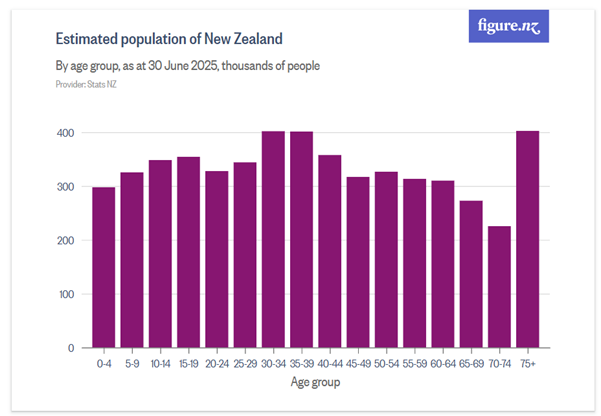
These and other data tell us that there are currently close to 1 million people aged 65 years and above. In fact, the number will soon creep over one million, possibly as early as 2027.
Most of these people currently aged 65+ are ‘boomers’, born between 1946 and 1961. The last boomers turn 65 in 2029.
The non-boomers who are currently aged 65+ are those who are already aged more 80.
These 80+ people were born before the boomers in the years of the Great Depression and World War 2, when birth rates were relatively low.
Then there are four cohorts, each of five years, predominantly post-boomers. These four cohorts include births between 1960 and 1979. Each of those cohorts now contains a little over 300,000 people. By 2045 they will all be in the 65+ category.
So far, all of these four cohorts have retained broadly similar numbers to what they started out with at birth. Inward migration, outward migration, and deaths, have roughly balanced out.
The size of these cohorts, plus increasing longevity, plus surviving boomers who by 2045 will all be aged 85+, means that by 2045 there will be approximately 1.4 million New Zealanders aged 65+.
Essentially, this number of 1.4 million aged more than 65 is already ‘baked in’ by historical decisions, although some immigrants continue to arrive into the youngest of these cohorts. To the extent there is uncertainty in these numbers, it is increasing longevity that is the major unknown.
It is notable that none of the age groups considered in the above paragraphs is a ‘bulge’ as they are often described in the media. Rather they are part of an ongoing surge.
It is in the period after 2045 where the biggest surge of ‘oldies’ will occur. These are the cohorts born between 1980 and 1999. These New Zealanders will start joining the 65+ age group in 2045.
Estimating the number of New Zealanders in the 65+ age group from 2045 onwards is challenging. This is because the number who reach this age is very much a function of current and future immigration policy. All we know is that these cohorts, when they reach 65+, will be larger than any cohorts that have gone before.
Hence, even with minimal net immigration from now on, the number of New Zealanders exceeding 65 years of age could easily be approaching 2 million as we pass through the 2050s. In broad terms, we are looking at the 65+ group at that time comprising about 30% of the total population, compared to about 18% currently. With high immigration in the next few years, this percentage would inevitably go even higher.
Here, I want to emphasise that historical immigration policies, particularly over the last 15 years, supposedly to solve recent and current issues, lies at the heart of the problems that will be handed over to New Zealand’s population 20 and more years ahead.
If significant net immigration continues to occur over the next 15 to 20 years, then there can be no alternative to economic and social destruction in the 2050s and beyond.
Next, I want to focus on the four cohorts in the above figure currently aged less than 20 years.
On first inspection, it appears that these cohorts have been declining in size over time. Do we have the start of a crisis from not enough births?
Indeed, it does appear that births have been dropping off. But this is largely a mirage. In fact, as each of these cohorts has been working its way through childhood, it is increasing in size as a result of immigrant children who arrive with their parents.
To illustrate this point, I asked AI to draw me a graph of live births in each year from 1930 to 2025 (below).
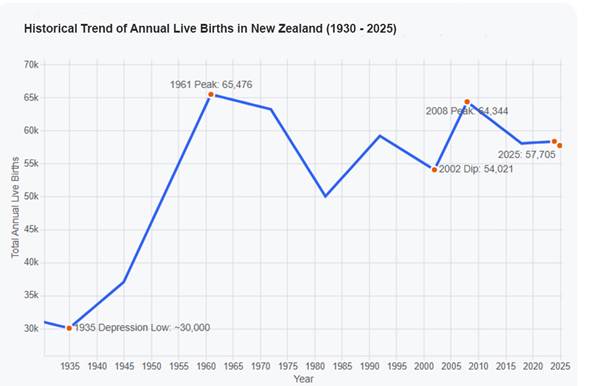
This graph tells us that there has been no overall decline in live births since 1982. Our current annual birth numbers are still more than in most of the boomer years.
The big decline in the number of births in the 1970s was largely due to birth-control pills, plus women purposely delaying motherhood, plus married women either staying in employment or returning to employment. A lot of that was due to ‘the pill’. Since then, the number of births each year has bounced around with an upward tendency, but without a convincing trend.
I expect some readers will want to question this lack of a downward trend, saying that it seems to contradict the current reality that New Zealand women, on average, now only have approximately 1.6 children, with this being well below the replacement rate.
In fact, there is no contradiction in the above statements. New Zealand currently has more women of child-bearing age than it has ever had before, and this is what has kept the absolute number of births from declining over the last forty years.
The next figure (below) shows the change in projected age distribution between 2023 and 2053, once again using Stats NZ data as put together by Figure.NZ, and based on the Stats NZ ‘medium’ (or median) set of assumptions.
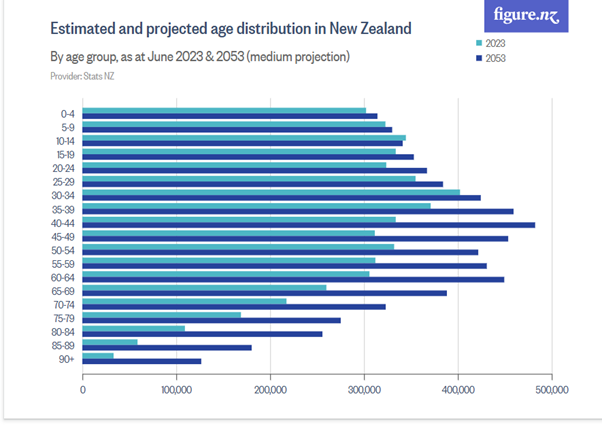
The first key message in this graph that I want to focus on here is that the total population numbers for people aged 75+ is projected to more than double by 2053, from approximately 400,000 now to more than 800,000 then.
As for the specific 85-89 cohort, Stats NZ projects they will increase more than three-fold. The number of people over 90 will increase four-fold.
Essentially, the numbers in the 75+ age groups is largely ‘baked in’ with people who are already present in New Zealand and are already in their 50’s or older.
The remaining uncertainty about the total number of 75+ residents at that time relates to how much life expectancy will increase over this period through to 2053. My own subjective opinion is that the Stats NZ medium projections overestimate how much life expectancy is going to increase over this period, but that does not change the big picture.
No matter how I work the numbers, New Zealand is going to be a very different place in the 2050s from where we are sitting right now.
The other key message in this graph is that all population age cohorts are estimated to increase from current numbers until later than 2050.
Population collapse may well occur within that time in countries like Japan, where the birth rate has been below the replacement rate of 2.1 children per woman of child-rearing age since 1973.
But population decline, let alone population collapse, is highly unlikely in New Zealand for at least 20 years. This is because births still exceed deaths by approximately 20,000 each year. We have time to deal with that particular problem if and when it becomes truly evident.
The story that I have outlined above is indeed complex. In the process of analysing lots of data, I have spent many hours looking at the numbers. What I have written above is just a summary. But let me summarise it further.
The big message is that high immigration in the years directly ahead, and for at least the next 15 years, is going to create great additional challenges for those generations that follow. At the very least, we need to move to targeted immigration that replaces genuine shortages, and this needs to be done now.
Currently we have over 30,000 employers able to sponsor immigrants. As just one example, there are some 80 employers who can sponsor vape store workers.
Working towards a stable population will not solve all of our economic problems. But it is a prerequisite as a first step. As for thinking that immigration in the next 15 years can solve the problem of an aging population, that is fanciful. Instead, it will inevitably increase the problems faced by forthcoming generations.
There may be a time in the future when significant immigration does again become worthy of consideration. But that time is not now.
Given all of the above realities, the superannuation issue facing New Zealand stands out as being very major. In a forthcoming article, I plan to explore the combination of policies available to deal with that very big conundrum.
*Keith Woodford ONZM was Professor of Farm Management and Agribusiness at Lincoln University for 15 years through to 2015. He is now Principal Consultant at AgriFood Systems Ltd. You can contact him directly here.
We welcome your comments below. If you are not already registered, please register to comment
Remember we welcome robust, respectful and insightful debate. We don't welcome abusive or defamatory comments and will de-register those repeatedly making such comments. Our current comment policy is here.