
Opportunities to utilise our minerals are few and far beween in NZ, and we look with envy at how Australia has been able to build a robust economy around theirs.
This venture utilising our lignite reserves to produce nitrogen fertiliser looks an exciting opportunity.
But it does raise another question.
NZ agriculture has prided itself on its low cost grass production systems based around white clover fixing its nitrogen for free.
Has our drive to maximise production clouded our judgement, and is our future production going to be driven by "what comes out of a bag", similar to British agriculture?
As we now see in profits from sheep and beef farms, (and dairy farms when the payout was lower), it's increasing costs that kill profits.
Is a more N fertiliser pasture system giving extra production but at the expense of profit?
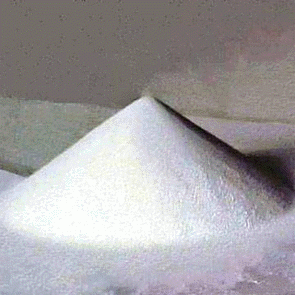
Transforming Southland lignite to fertiliser would pump an estimated $377 million a year into the NZ economy, based on the present international price for urea. Joint venture partners Solid Energy and Ravensdown have been crunching the numbers as part of their investigations into a lignite-to-fertiliser plant in the Gore district reports Stuff.
Solid Energy has access to an estimated 1.3 billion tonnes of lignite in the district and has several multi-million dollar projects on the drawing board, including two pilot plants to be operational by next year and the lignite-to-urea plant, scheduled for commissioning in 2016. The plant would create about 500 jobs and turn an estimated two million tonnes of lignite into 1.2 million tonnes of urea annually.
The Government-owned coal miner and farmer-owned fertiliser co-operative yesterday trumpeted the economic benefits of unlocking "the previously unused (and) under-utilised resource to make NZ fundamentally wealthier". At today's world urea price of US$265 per tonne ($362), the NZ GDP would be up UD$377m a year.
Ravensdown strategic development general manager Richard Christie said both companies were enthusiastic about bringing new technologies to NZ that would release the value of the lignite resources in Eastern Southland, create high-value fertiliser to replace imports and provide export potential.
We welcome your comments below. If you are not already registered, please register to comment
Remember we welcome robust, respectful and insightful debate. We don't welcome abusive or defamatory comments and will de-register those repeatedly making such comments. Our current comment policy is here.