
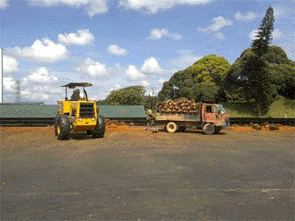
The use of palm kernel extract as a quality supplement is often a source of debate, with the "green brigade" suggesting it's causing rainforest destruction.
Farmers paint a different story, saying they are utilising a waste product to grow more food than could be produced without it. They say they source the PKE from palm oil produced in a sustainable way.
Farming outdoors is a practice of matching supply of feed with the demand from stock. The late winter, early spring this year, showed there are times in a grassland pasture system where this is impossible, and supplements need to be fed to match stock demand.
Other supplements do not provide the energy required, or have limitations of feeding under wet conditions.
The intensification of agriculture produces different challenges on the environment, but farmers must grow food in a sustainable way, and at a price the consumers can afford. Only by utilising the land asset efficently can they do that, and PKE feeding at strategic times helps them achieve this.
PKE supplementary feed is sustainably produced and highly effective, dairy farmers argue.Taranaki dairy farmers are refusing to get caught up in the controversy surrounding the use of palm kernel extract (PKE). Arguing that PKE is a valuable supplementary feed that is sustainably produced, farmers are rejecting claims by Greenpeace and other environmental groups that PKE use in New Zealand is causing the destruction of rainforests in Southeast Asia reports The Taranaki Daily.
Federated Farmers Taranaki dairy section chairman Derek Gibson said he believed PKE was a sustainable product and that forests were not being cut down to provide it. PKE was a cost-effective product that was easy for farmers to use and one that they could put in and out of their feeding systems at short notice. Farmwise consultant and dairy farmer Michael Joyce, of Otakeho, said when farmers fed PKE to their dairy cows, they were turning a waste product into a valuable food at a time when there were global food shortages.
The alternative to the use of palm kernel was to cull animals. "I suppose you could store more maize, but if it's wet, you can't feed maize," he said. Mr Topless said the ready availability of PKE allowed farmers to farm for a good year rather than plan an average level of production.He believed the global demand for palm oil was a bigger issue than dairy farmers' use of PKE, a byproduct that would otherwise be dumped. "Dairy cows are just mopping up the demand created by human beings."
Fonterra, whose subsidiary rural supplies company RD1 imports and sells PKE, asserts that its supply is safe, traceable, sustainable and grown on land previously used for growing rubber."The industry exists to produce palm oil and palm kernels. It is estimated that 98 per cent of the processors do not even process the expeller, as PKE represents only a tiny fraction of the value of the palm oil and palm kernels. PKE is clearly not a core driver of the industry." RD1 sold PKE supplied by Wilmar International, which practised a no-burn policy and which belonged to the Roundtable for Sustainable Palm Oil.
"New Zealand dairy farmers use PKE as a supplementary feed [and] it plays an important role in feeding cows during adverse weather such as drought," Fonterra said. "Pasture remains the dominant source of feed for cows, with PKE generally making up just 1 per cent of the New Zealand dairy cow diet." New Zealand is expected to import 1.4 million tonnes of PKE this year.
We welcome your comments below. If you are not already registered, please register to comment
Remember we welcome robust, respectful and insightful debate. We don't welcome abusive or defamatory comments and will de-register those repeatedly making such comments. Our current comment policy is here.