
Over the next few weeks we are extending our series on the New Zealand wine industry, this time based on the Deloitte 2012 industry benchmarking survey.
By Tim Burnside and Paul Munro*
 With annual export earnings of $1.2 billion the New Zealand wine industry is now ranked as New Zealand’s eighth most valuable export earner.
This is a far cry from the small domestically focused industry that existed 30 years ago and despite the recent financial challenges experienced the industry has continued to grow.
In recent years the industry has experienced the impacts of the Global Financial Crisis, supply imbalances, high external debt levels, the increased presence of bulk wine sales, and winery struggles, failures and receiverships.
Now in its seventh year the annual Deloitte financial benchmarking survey, produced in conjunction with New Zealand Winegrowers, has tracked the impact of these issues on the financial performance of wineries within the industry. Last year this survey reflected signs of an industry turnaround but the expectation was that it would take time to fully flow through to wineries.
The results of the seventh annual survey on the whole confirms further improvement but there is certainly still a long way to go to be at a point where the financial returns from the industry provide an appropriate financial return on the capital invested.
Once again this year we collected two years of financial data so that we could make direct comparisons year on year rather than comparing to the previous surveys sample.
We are pleased to report that all but the $20m+ category have improved their profitability from the prior year when their two years data is compared, which given the majority of the categories recorded increases last year (from 2010), confirms a turnaround is definitely present within the industry, and showing signs that it is sustainable.
Despite the positive signs of a turnaround there is still a long way to go.
The $0-$1.25m category has recorded a loss this year suggesting financial volatility remains at the smaller end of the market. In addition only the two largest categories have recorded double digit profitability and returns on equity and assets are low.
The industry is still at a stage where financial returns would not be acceptable to investors, especially over the long term.
In recent years a concerning trend of high external debt has come through the results. It is pleasing to report that this year this issue does not seem as prominent as in the past, with debt levels reducing to more acceptable levels.
It appears that the expected pressure coming from lenders for wineries to reduce debt levels is starting to materialise.
Consistent with all our previous surveys exports remain an integral part of the New Zealand wine industry with all categories exporting greater than 50% of total sales into export markets. This is extremely positive as well given we are generally seeing an increase in case sales.
While this would be a product of the smaller harvest it could imply that demand for branded product is strengthening on the global stage meaning the potential damage to New Zealand’s reputation as a quality producer, by sales of bulk wine, may have been avoided, but further research would be necessary to confirm this.
Related to the dependence on exports and again continuing a theme from prior years is the fact that Exchange Rates have been ranked as the number one issue facing the industry. All of New Zealand’s export industries are hurting due to the high NZ dollar and the wine industry is no exception.
Deloitte perspective:
It is very pleasing to see that the Vintage 2012 survey results continue to support the signs of a turnaround within the industry which began last year.
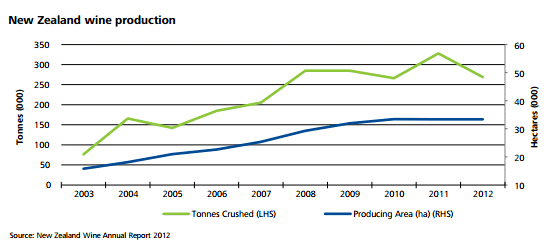
We do however consider, and we’re sure most industry participants would agree, that further improvement is necessary. As has been widely reported in the media the Vintage 2012 harvest of 269,000 tonnes was significantly reduced from 2011 at 328,000 tonnes.
As is illustrated in the graph below the New Zealand producing area has grown over the last ten years to 33,400 hectares but the last three have been constant at this level. This was on the back of, at the time, record harvests in 2008 and 2009 and the creation of a supply / demand imbalance.
With the reduced harvest in 2012, which has primarily been attributed to seasonal conditions, it is our understanding that wineries have begun to get a little nervous around future grape supply. This is supported by the increase in grape prices being reported and the fact that “Grape Supply – too little” has made a significant move in the list of issues facing the industry identified in our report.
Last year this issue was ranked ninth whereas this year it has been ranked fourth overall , and the $20m+ category having it in their top two.
It is hoped that if wineries and grape growers are considering planting additional vines, in a hope to mitigate this issue, that any such investment is carefully assessed to ensure it is strongly market led and there is no repeat of the supply / demand imbalance seen in recent years.
For the industry to create value, rather than prioritising additional plantings, the first task is to grow the value of sales rather than the volume of sales.
To do this an investment in brands and market development is required rather than investing in further vines.
Growing profitability will create value, but further improvement is definitely required.
Value driven, market demand led yield management needs to be the primary focus of wineries in the future to avoid the experiences of the last four years becoming a reoccurring trend.
-----------------------------------------------------------------
Paul Munro is a partner in the Christchurch office of Deloitte. You can contact Paul here ». Tim Burnside is an associate director at Deloitte.
We welcome your comments below. If you are not already registered, please register to comment
Remember we welcome robust, respectful and insightful debate. We don't welcome abusive or defamatory comments and will de-register those repeatedly making such comments. Our current comment policy is here.