
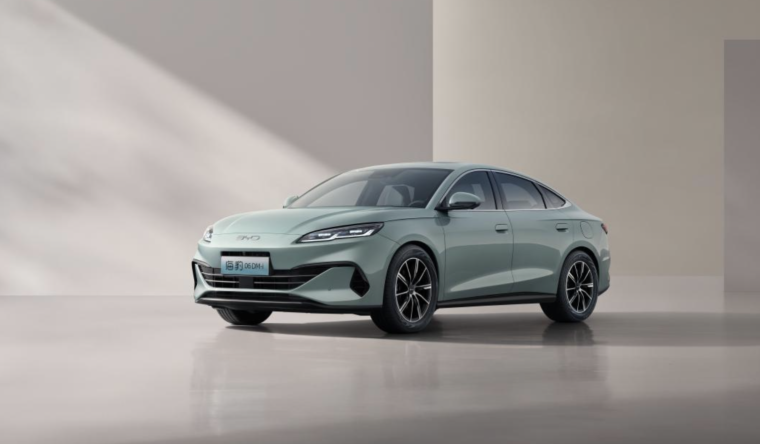
The car making arm of Chinese battery maker BYD has launched its fifth-generation DM-i power train technology, promising extraordinary long range thanks to new energy miserly plug in hybrid technology.
DM-i power trains have a claimed 46.02% thermal efficiency, using a mere 2.9 litres of fuel per 100 km. The result of that frugal consumption is a huge 2100 kilometre range, BYD says.
Improving the thermal efficiency of fossil fuel engines has become the holy grail of some car makers; the proportion of fuel converted to power can be as low as 20% and anything near or over 40% is considered excellent. Japan's Mazda said some years ago that it is working on a SkyActive technology engine with 56% thermal efficiency, which the company claimed would bring emissions down to electric vehicle levels.
The battery side of the hybrid power train is said have a power density of 70.28% with a new seven-in-one PHEV controller, and BYD's Blade Battery comes with a 15.9% energy density. It has what BYD calls "a pioneering full-vehicle thermal management system adaptable to all climates".
According to BYD, the new thermal management system governs heat across the battery, engine bay and cabin. In hot conditions, battery cooling and adaptive grilles for air intake seven up to 10% of energy, whereas in cold conditions it can reduce consumption by up to 8%.
BYD will use the DM-i power train in the Qin L and Seal 06 plug-in hybrid models, which in China sell for NZ$22,515 to NZ$31,540.
Whether or not the Qin L or Seal 06 will arrive in New Zealand, and if so, their specification levels and pricing is not known yet, local distributor Ateco told interest.co.nz.
Ateco and BYD recently launched the Sealion 6 SUV model, which starts at $57,990 plus on road costs. The Sealion 6 is a plug-in hybrid vehicle with a Xiaoyun DM-i drive train featuring a 1.5 litre petrol and a dual-motor electric engine.
The front-wheel drive model is rated at 1100 km range, and can go up to 92 km in electric-only mode. Combined output from the petrol and electric engines is 160 kW with 300 Newton metres of torque, and a fuel consumption of 1.1 l/100 km.
In AWD specification, the figures are 238 kW and 550 Nm output for the drive train, 81 km EV-only range, and a total driving range of 970 km. All figures as quoted by BYD, and likely to differ in real-world use.
We welcome your comments below. If you are not already registered, please register to comment
Remember we welcome robust, respectful and insightful debate. We don't welcome abusive or defamatory comments and will de-register those repeatedly making such comments. Our current comment policy is here.