

New Zealand Association of Scientists co-presidents Lucy Stewart and Troy Baisden have made initial comments on the Budget released by the coalition government this week, expressing their concerns about the ongoing collapse in funding for the research and university sector. Their article has been edited to fit interest.co.nz's format.
More investment in research and universities helps to lift nations out of recessions, enhances future wealth and productivity, without fuelling inflation, NZAS asserts, but this year's Budget will not deliver on that.
Normally when assessing a Budget from the science policy perspective, we can look for bright spots - new spending and initiatives. Analysing this year's Budget is an exercise in determining how bad the damage will be, on the back of previously-announced cuts such as the cancellation of the Science City infrastructure programme and the failure to renew the National Science Challenges.
There is one genuinely welcome new initiative - funding for Geonet, the National Seismic Hazard Model, and the National Geohazards Monitoring Centre has been extended out until 2027, acknowledging the long-term nature of the funding needed to support this vital work in our geologically active nation.
However, looking out to 2027 the Budget has also forecast a total of $35 million dollars of actual cuts to the Marsden Fund, the Health Research Fund, the Strategic Science and Innovation Fund, and the Endeavour Fund in that year - perhaps to generously give researchers three years to find new jobs overseas.
Spending is otherwise flat, in a time of record inflation and on the back of decades of underfunding of the sector. There is no sign of anything which could come close to making up for the loss of the National Science Challenges, which NZAS has already seen translate into proposed job cuts in the public science sector.
"I expect to see more job losses across the sector before the end of the year. This failure to invest, at a time when the research and science sector has struggled to do more with insufficient funding for years already, will have inevitable consequences in loss of expertise as people move to better-funded research sectors overseas, as infrastructure continues to fail, and as research simply does not get done." - Dr Lucy Stewart
The lack of funding follows a familiar pattern established over many years.
Today’s budget doubles down on a pattern spanning four decades, in which New Zealand’s governments have been world leaders in choosing not to invest in the future. Aside from 1991, I doubt there’s ever been such a clear case that we’re determined to fall behind peer nations with our investment in research, science, innovation and technology. The same goes for the tertiary education sector.
"The budget is worse than a 'nothing burger' for science. The relatively positive support for GeoNet and key capability GNS Science appear to be propping up areas previously funded by the Earthquake Commission (EQC) and the National Science Challenge on Resilience" - Professor Troy Baisden.
There are no other bail-outs for areas of national importance that had been supported by National Science Challenges. These received about $97 million per year in their peak years, with $64 million this year and no funding after next month. There are also no new bail-outs or capital expenditure support packages for the ‘Science City’ institutions in Wellington, most notably Callaghan Innovation.
Not even agricultural research was spared from the Budget cuts, which is surprising given the vital importance of the sector to New Zealand's economy.
Given the composition of the coalition, farmers might have hoped for some new research, but if there is I can’t spot it. Instead, the Ministry of Primary Industries is cutting about $4.6 million per year from its Sustainable Land Management and Climate Change Research in coming years (a total cut of $13.6 m over three years).
The total lack of new funding comes on top of the inflation over the past year, and on a background of flat or decreasing funding. Out in 2027 and beyond, there’s a plan to pare back flagship contestable research funds, including Marsden and Endeavour by a small but significant amount.
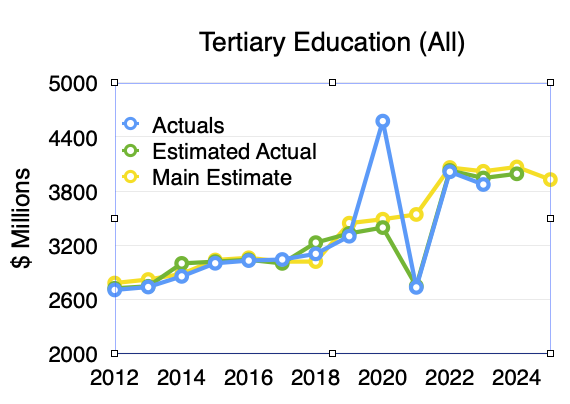
Although funding for the tertiary sector grew between 2012 and 2019 by around 24%, there seems no intention of resuming that increase.
The Table of Estimates produced with the budget also allows us to look back, from an estimate for the year just ended to finalised funding in previous years. Funding for the entire tertiary education sector has flatlined, following the period when Government helped stabilise the sector during the pandemic’s impacts.
Government research and development (R&D) increased even faster, but is now declining the researchers said. Excluding the R&D Tax Incentive and similar categories, our investment appears to have increased from about $820 million in 2015 to $1.4 billion or more in 2020 and 2021, falling back to $1.15 billion in recent years before stabilising at $1.1 billion.
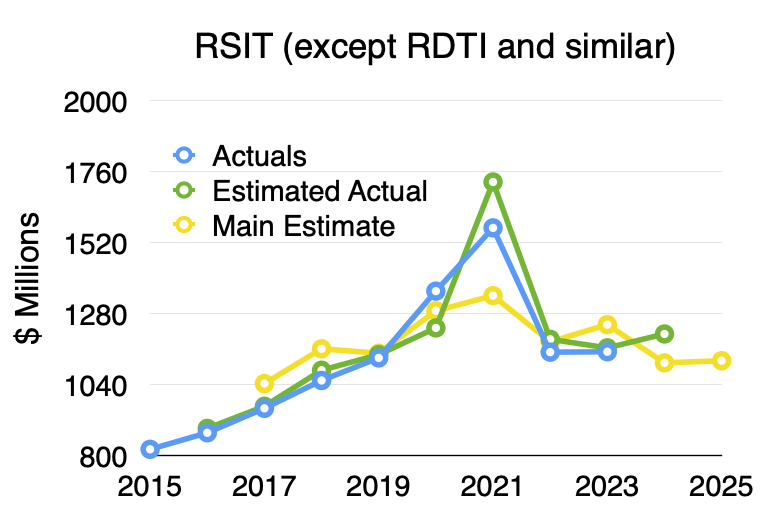
This explains why times feel tight in parts of the sector doing well, and desperate in others. That should come as no surprise, as cabinet papers from 2021 to the present have expressed a lack of confidence and sought reforms, which will now extend in the university sector.
The pressure is on Peter Gluckman, leading two advisory groups which must make a case for the reforms to help us rebuild the mojo that drives investment and success across the science system and universities. The groups will need to provide vision and hope for science and technology to address our biggest challenges with effective strategies in areas such as primary industries, and coping with climate change and hazards.
Peer nations are investing more and more, and we should as well."
We welcome your comments below. If you are not already registered, please register to comment
Remember we welcome robust, respectful and insightful debate. We don't welcome abusive or defamatory comments and will de-register those repeatedly making such comments. Our current comment policy is here.