
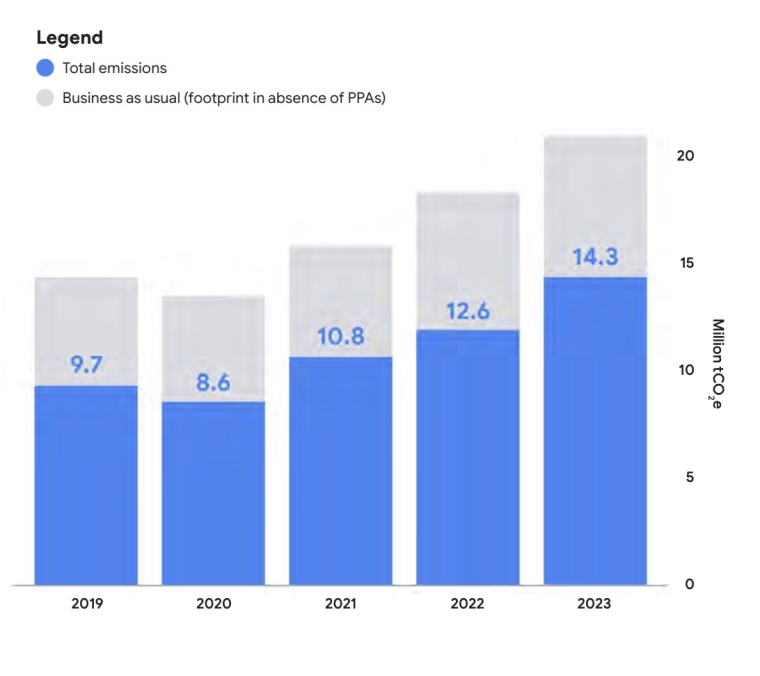
Tech giant Google has released its 2024 environmental report, which says the company's Scope 1, 2 and 3 greenhouse gas (GHG) emissions rose by 13% last year.
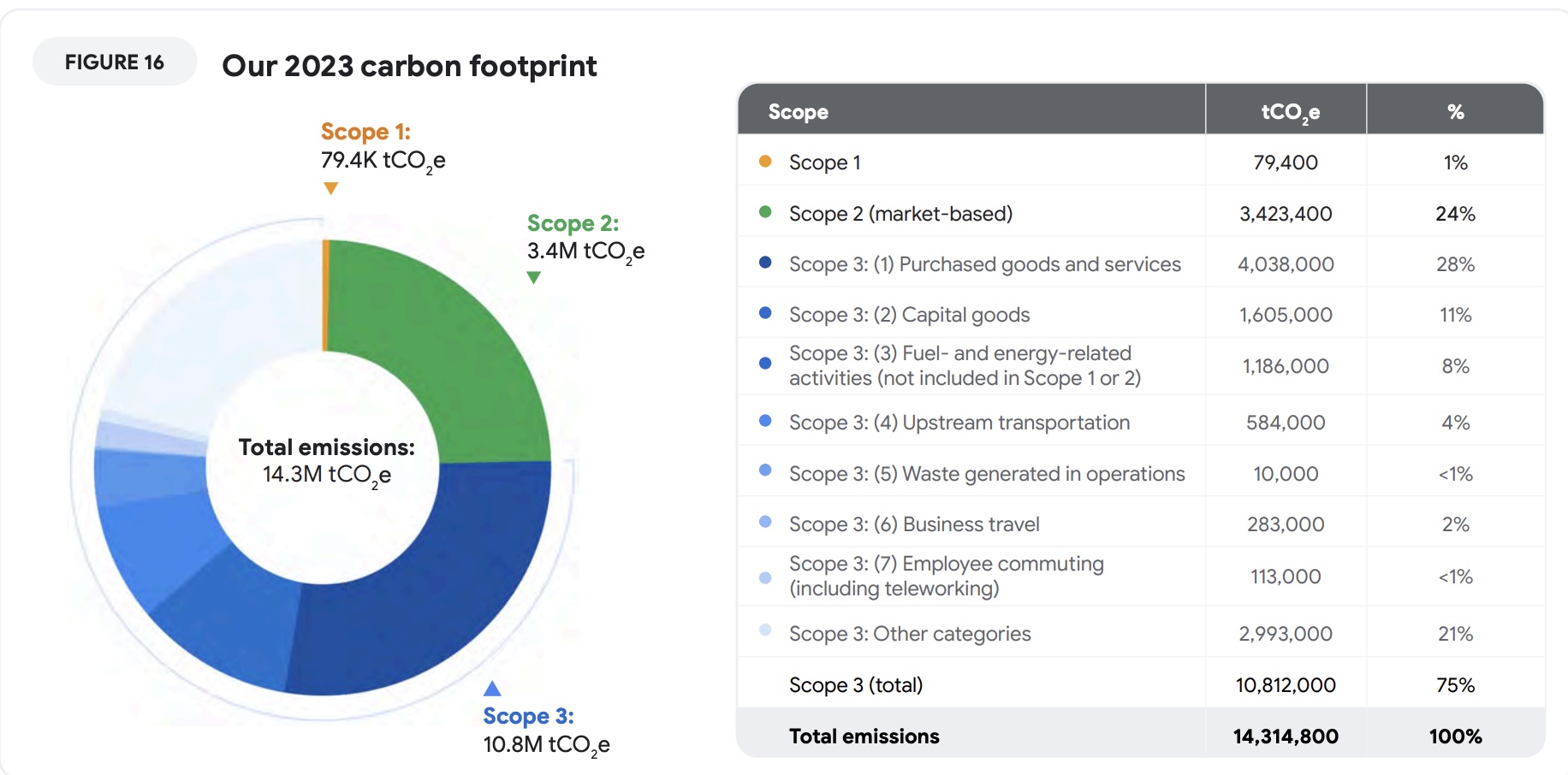
The three emission scopes capture what companies put out from their own properties, the energy the buy, and their operations. In Google's case, the 2023 increase was by and large due to increased energy use at its data centres in 24 locations worldwide.
Overall, despite Google targeting net-zero carbon, with a 50% reduction the Scope 1, 2 and 3 emissions by 2030 compared to 2019, it has increased GHG output by 48%. Last year saw Google emit a total of 14.3 million tonnes of carbon dioxide.
Google's large GHG emissions increase follows Microsoft reporting a similar trend in May, having blown past its environmental targets in a similar fashion.
Despite the jump in emissions, Google said it continues to make progress towards its goal of reaching net-zero across all its operations and value chain by 2030. As part of that, Google's environmental and sustainability bosses Kate Brandt and Benedict Gomes said the tech company is scaling artificial intelligence (AI), using it to accelerate climate action.
Brandt and Gomes said doing so is "just as crucial as addressing the impact associated with it [AI]". In the report, Google boasts that it has built world-leading efficient infrastructure for the AI era including new Tensor Processing Unit (TPU) hardware that uses two-thirds less energy than the prior generation of the integrated circuit.
TPUs are used for machine learning. Google also said it has identified tested practices that are in use now, which reduce AI model training energy requirements hundred-fold, and drop associated emissions by up to 1000 times.
Overall, Google believes AI has the potential to help mitigate 5% to 10% of global GHG emissions by 2030, through information organisation, improved prediction, and better organisation.
Google also said that its data centres on average are 1.8 times as energy-efficient as typical enterprise facilities. The company is also working on reducing fresh water usage for data centres, saying it will replenish 120% of what it uses by 2030.
Whereas Google replenishes just 6% of freshwater used in 2022, the figure had risen to 18% by last year.
For context, Google said that the latest available estimates show global data centre electricity consumption at 240-340 terra Watt hours (TWh) which it said is about 1% to 1.3% of global demand.
In terms of emissions, Google said 2022 estimates suggest cloud and hyperscale data centres contribute just 0.1% to 0.2% of greenhouse gases globally, with its own facilities adding even less to the total.
For 2023, Google estimated that its data centres used 7% to 10% of global demand for such facilities, at 24 TWh.
Helpfully, Google offers AI insights for the 2024 environmental report. Here's the AI summary:
This source, from Google's 2024 Environmental Report, details the company's commitment to sustainability and its efforts to combat climate change. A key theme is Google's use of AI to drive its sustainability initiatives, which is demonstrated through examples such as their 'Cool Roofs' tool and partnerships to monitor methane emissions.
However, the source also acknowledges the environmental impact of AI, noting a 13% increase in their total GHG emissions largely due to increased data centre energy consumption.
Despite this, Google maintains its commitment to achieving net-zero emissions by 2030 and outlines a multifaceted approach that includes transitioning to 24/7 carbon-free energy, investing in carbon removal technologies, and promoting responsible water stewardship across its operations and supply chain.
Beyond these internal efforts, the source also highlights Google's broader commitment to using technology to address global environmental challenges through partnerships, research grants, and open-source platforms like Google Earth Engine.
We welcome your comments below. If you are not already registered, please register to comment
Remember we welcome robust, respectful and insightful debate. We don't welcome abusive or defamatory comments and will de-register those repeatedly making such comments. Our current comment policy is here.