
A big issue with today's electric vehicles (EVs) is that their batteries are heavy. Obviously, this has a number of downsides, including lowered energy efficiency and more wear and tear on roads, tyres and brakes, for example.
Researchers are working on improving that situation, with one approach being to make the battery a structural component of EVs - like the BYD SEAL sold in New Zealand (review coming soon).
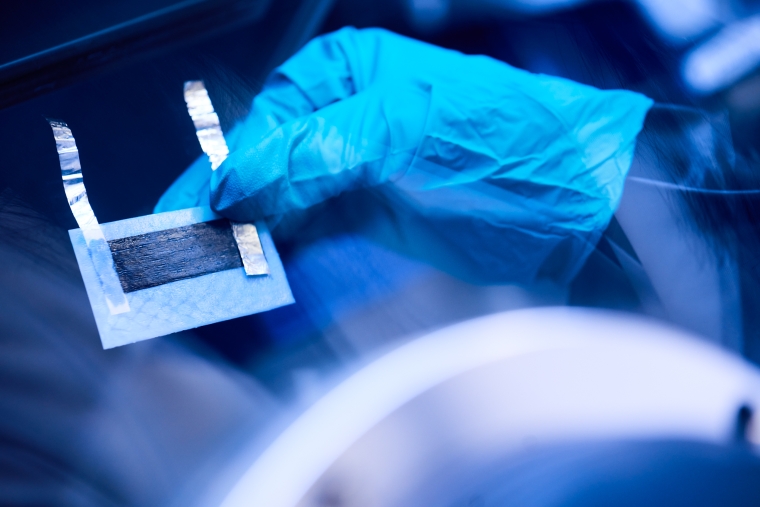
A group of researchers at the Chalmers University of Technology in Göteborg, Sweden, have created a carbon fibre composite battery, for "massless energy storage"; the battery acts as structural member that is as stiff as aluminium, and energy-dense enough for commercial applications, the researchers say.
In practical terms, the researchers envisage this could bring us EVs with a 70% increase in driving range, on a single charge. It's not just EVs that stand to benefit from structural batteries: they could halve the weight of laptops, and enable credit-card slim smartphones, the researchers say.
The Chalmers uni team is led by professor Leif Asp, and comprise Richa Chaudhary Johanna Xu, and Zhenyuan Xia. They have been working on how stiff and strong carbon fibres can store electricity chemically, functioning as electrodes in lithium-ion batteries since 2018.
Now their work has produced a battery with 30 Watt-hours per kilogram energy storage. This is lower than what comparable lithium-ion batteries today can manage, but if the carbon-fibre units can be structural and weigh far less, they will reduce the overall energy usage of EVs, for example.
Video from 2021 on structural battery research.
"Investing in light and energy-efficient vehicles is a matter of course if we are to economise on energy and think about future generations. We have made calculations on electric cars that show that they could drive for up to 70% longer than today if they had competitive structural batteries," research leader Leif Asp, who is a professor at the Department of Industrial and Materials Science at Chalmers said.
With an elastic modulus from 25 to 70 gigapascal, a measure of stiffness, the battery material can carry load as well as aluminium, the researchers said.
"In terms of multifunctional properties, the new battery is twice as good as its predecessor – and actually the best ever made in the world," Asp, who has been researching structural batteries since 2007, said.
One important feature of the new battery tech is that it doesn't use "conflict minerals" like cobalt or manganese.
Here's how the researchers describe it:
"The developed battery concept is based on a composite material and has carbon fibre as both the positive and negative electrodes – where the positive electrode is coated with lithium iron phosphate. When the previous battery concept was presented, the core of the positive electrode was made of an aluminium foil.
The carbon fibre used in the electrode material is multifunctional. In the anode it acts as a reinforcement, as well as an electrical collector and active material. In the cathode it acts as a reinforcement, current collector, and as a scaffolding for the lithium to build on. Since the carbon fibre conducts the electron current, the need for current collectors made of copper or aluminium (for example), is reduced, which reduces the overall weight even further.
In the battery, the lithium ions are transported between the battery terminals through a semi-solid electrolyte, instead of a liquid one, which is challenging when it comes to getting high power and for this more research is needed. At the same time, the design contributes to increased safety in the battery cell, through reduced risk of fire."
Plenty of engineering is required still before the battery tech can be commercialised and mass-manufactured, and the Swedish university has set up the Sinonus venture company for the purpose.
Update Professor Leif Asp has provided a further clarification on how the weight savings are achieved.
"The potential mass savings are realised on the systems level. That is, by replacing monofunctional components (ie. a structural part and a battery) with a multifunctional material based component.
In this way reduced weight results if the mass of the multifunctional material component is less than the sum of the mass of the two monofunctional components," Asp said.
He referred to prior research from the KTH Royal Institute of Technology on the topic, and some earlier work from the United States Army Laboratory Research that illustrates the principle for the Tesla Roadster.
Asp said the examples show that even with moderate electrical efficiency of say 50 per cent of the monofunctional device, it is possible to achieve weight savings if the structure has a structural efficiency of 50 per cent or more:
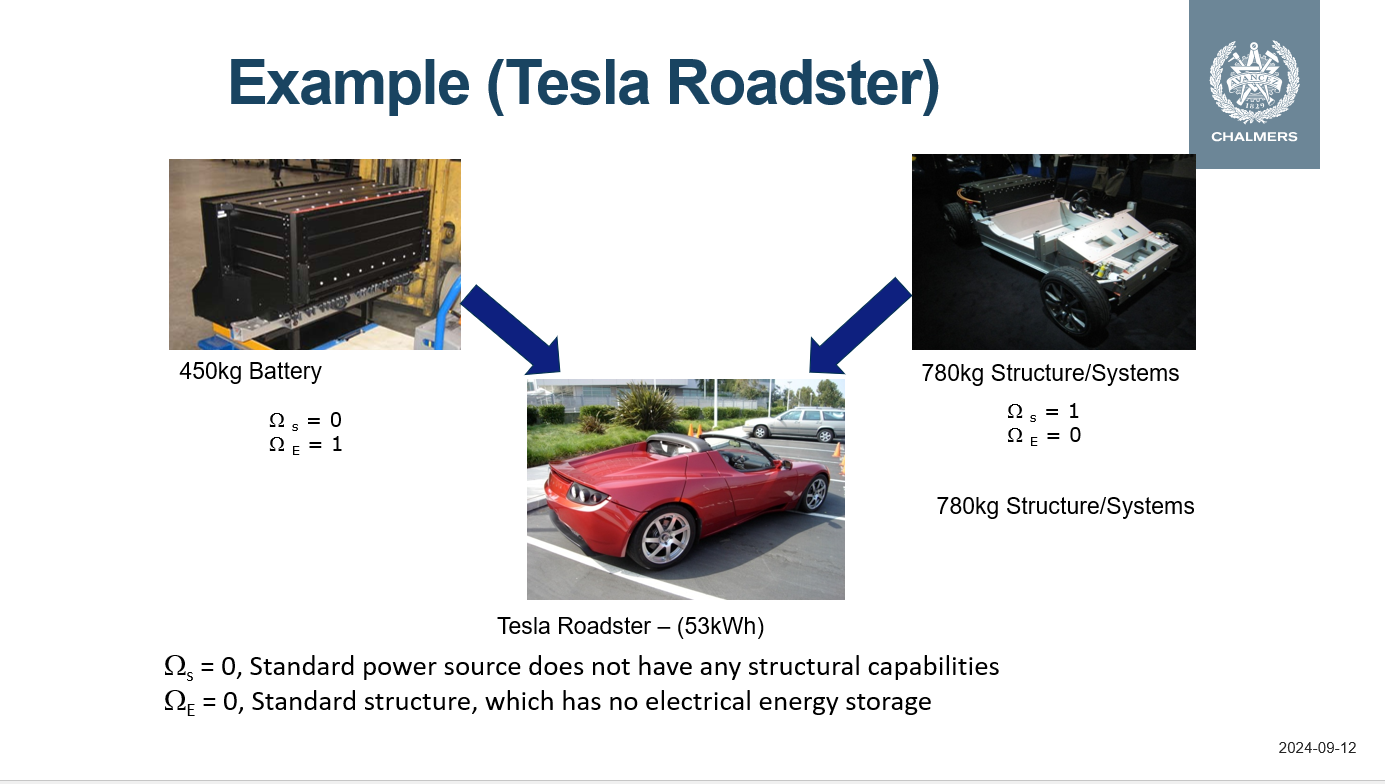
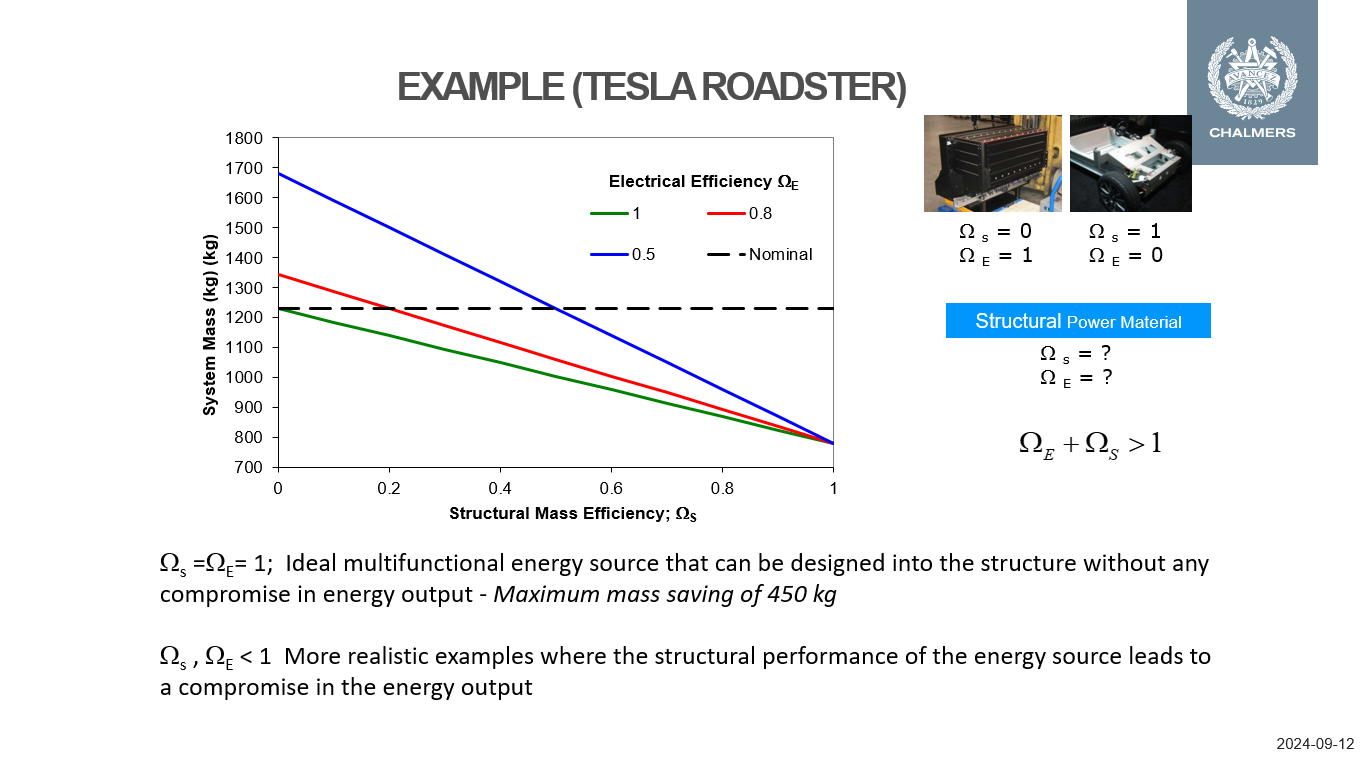
"Please note that we need to further increase the multifunctional properties (i.e. energy density, power density, stiffness and strength) to introduce these in to propulsion systems for e-vehicles, Asp added.

We welcome your comments below. If you are not already registered, please register to comment
Remember we welcome robust, respectful and insightful debate. We don't welcome abusive or defamatory comments and will de-register those repeatedly making such comments. Our current comment policy is here.