
Electric vehicles continue to be a focal point of innovation, as researchers and engineers work to improve designs, to get around to get around drawbacks such their heavy weight and lower the cost of manufacturing them.
Improved battery designs is what we hear a great deal about. The development of structural batteries promise substantially lower weight for EVs, which in turn will increase their range as less energy is required for propulsion. Toyota is one car maker that is working on improving battery technology so that by 2026, full-electric EVs will have 1000 kilometre cruising range.
Despite the extended range the next-generation performance batteries will be faster to charge, cheaper and be combined with further efficiencies in car aerodynamics and weight reduction. Toyota is also looking at bipolar lithium-ion high performance batteries for 2027-28. That's also when the Holy Grail of battery technology that uses solid electrolytes is expected to enter mass production.
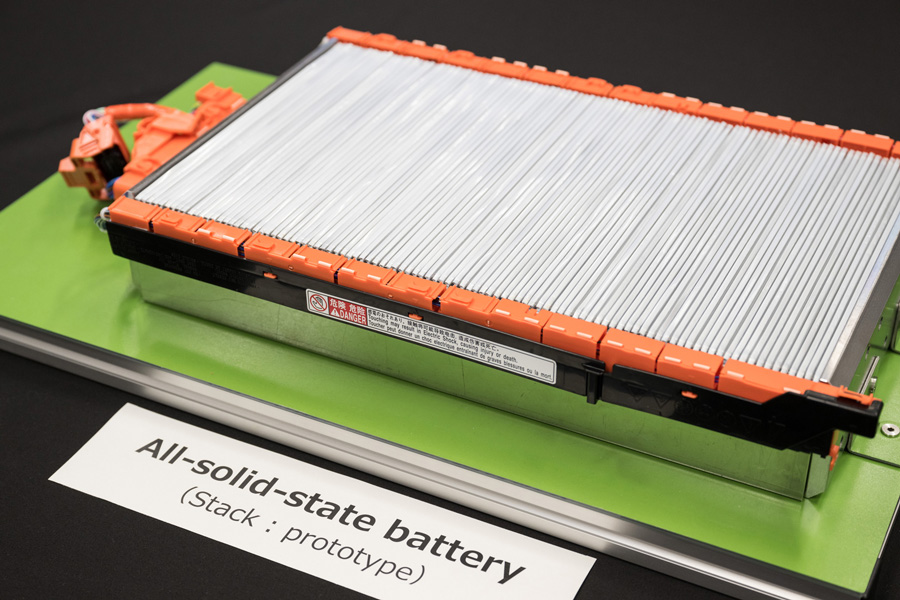
Electric vehicle pioneer Nissan said it too is developing solid state batteries. China's giant battery tech corporations BYD and CATL have thrown their hats into that ring, and Nio appears to have a vehicle with 150 kWh solid state battery ready to roll already. SAIC's MG brand is supposed release a solid-state battery EV in the second half of next year. Samsung's putting silver into batteries which apparently works great.
Not to be outdone, Mercedes-Benz is investing in United States battery maker Factorial, which reckons it'll produce high-energy density storage units for EVs for the next decade. This is not a complete summary and it's fair to say there's quite a bit going on in BatteryTech-land.
Get your EV motor running
There's more that can be done to improve EVs though, and Cambridge-based market intelligence firm IDTechEx has looked at the motors they use. Its report, Electric motors for electric vehicles 2025-2035: technologies, materials, markets and forecasts makes for fascinating rabbit hole to go into.
One issue is the use rare-earth elements (they're not actually rare) for permanent magnets in electric motors. Abbreviated as REEs, they are mainly produced in China, and European car makers and Tesla are trying to figure out how to use alternative electric motor designs for that reason.
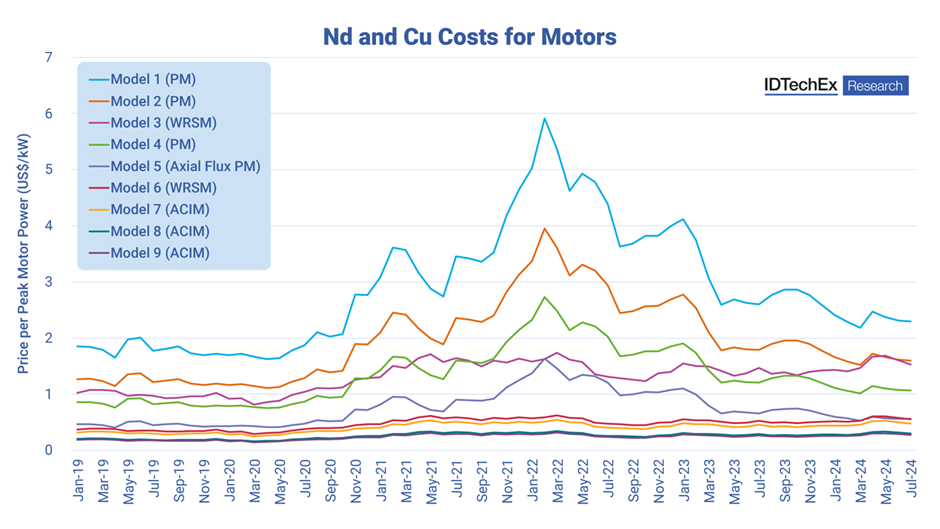
IDTechEx noted that permanent magnets made with REEs are expensive. They often take up around a third of a motor's bill of materials, despite only forming a relatively small part of the unit.
A problem here is that wound-rotor synchronous motors that don't use magnets are expensive to make due to copper windings, and aren't as efficient.
Swapping out REEs for other materials such as ferrites and aluminium-nickel-cobalt (AlNiCo) works, but requires more magnetic material as they don't provide the same level of performance.
Efficiency is a key factor to reducing EV costs, IDTechEx said. Even a small increase in efficiency can make a fairly large difference. IDTech calculated that if a motor has 96 per cent efficiency instead of 93 per cent, it would lower the energy needed for a 75 kWh vehicle by roughly 2.9 per cent for the same range. That would reduce the battery cost by the same amount. Based on a battery cost of US$100 per kWh, it could save US$200.
How many motors will be needed for the EV market in 2035? IDTechEx reckons over 160 million, with 30 per cent using REE-free technologies.
Pancake motors to the rescue
There's more than one way to propel an EV, and IDTechEx mentions axial flux motors. That name might evoke the very cool Æon Flux sci-fi for some of us, but it refers to electric motors where the gap between the rotor and stator is aligned parallel with the axis of rotation.
More commonly used radial flux motors, as the name implies, align the gap radially with the axis of rotation.
What buys is some fascinating advantages, like torque increasing by the cube of rotor diameter whereas radial axis motor twist only rises by the square.
Motors can also be flat, much lighter in weight, and the copper windings for them can be simpler, and there's a greater area for cooling. Axial flux motors have been made for aircraft, and for marine electrification.
A company owned by Mercedes-Benz, the amazingly named Yokeless and Segmented Armature (YASA) is working on an engine that weighs 7 kilograms and which produces 220 kW, or 31 kW per kg.
YASA motors are used in production supercars like the hybrid Ferrari SF90 and 296GTB, and the Lamborghini Revuelto, more for the sake of augmenting power than saving on fossil fuel (the Lambo has V12 as well as electric motors.)
For more real-world applications of axial flux motors, there's China's state-owned Dongfeng Corporation's ProteanDrive. Dongfeng has two types of motors, the Pd18 and Pd16, which produce a huge amount of torque at 1500 Newtonmetres and 800 Nm respectively.
ProteanDrive motors can be built into the wheels of cars, buses (like Olli the autonomous public transport vehicle in Glenelg, South Australia) and lorries.
And look; they can be used to convert true and tested cars like the Land Rover Defender to EV technology:
Vehicles built that way have no drive shafts, gears, differentials etc to worry about, as the motors are mounted into the wheels. Which Dongfeng has done, with its E70 and the luxe Voyah ZhuiGuang (something to do with chasing light?). The motors are lightweight, remember.
Axial flux motors aren't new as such, and they are commercially produced albeit not at the scale of radial flux ones. There's Agni Motors, which is using a pancake axial flux design by Cedric Lynch which among other applications have been used in zero-emission racing motorbikes.
The ability to come up with new and completely different vehicle designs is an important advantage that EVs bring to the table, and which is often overlooked.
We welcome your comments below. If you are not already registered, please register to comment
Remember we welcome robust, respectful and insightful debate. We don't welcome abusive or defamatory comments and will de-register those repeatedly making such comments. Our current comment policy is here.