
Recently at the Kaiwaka ChargeNet station, I talked to an EV owner with an Audi about batteries and car range. As one does, because EV owners are as I’ve observed, a social lot. The Audi in question was used for commuting between the Far North and Auckland, and I asked the owner if she enjoyed it.
“Not really. It’s much more involved than I’d like; you have to work out when it’s OK to use the air conditioning, not charging it more to 80%, and other things like that. With hindsight, I should’ve got a hybrid instead but I’m stuck with this for a while,” she replied.
It was a useful reminder that in general, people want cars to do one thing - transportation - with minimal fuss. An Audi EV with a maximum range of 450 kilometres fully charged, if you take it easy and don’t use the aircon, less if you do, might be too much fuss for some people.
Enter the BYD SEAL Premium: this is a full EV, on which the computer estimated there was 650 kilometres range after it learnt how I drove. The SEAL Premium wouldn’t go quite as far as the estimate suggested, but the official 570 km was attainable and it went even a bit further at times. What’s more, the heat pump aircon and bum-cooling vented seats don’t reduce the range much, so you’re good to use them instead of opening the windows and go deaf in one ear while blemming down SH1.
BYD has another ace up its sleeve (and yes, I know, nobody puts playing cards up their sleeves anymore) which is the lithium iron phosphate (LiFePo) chemistry blade design battery. Without getting too geeky, LiFePo has a bit less energy density than lithium-ion ones but it handles being fully charged just fine. In fact, BYD suggests you charge the chunky 83 kilowatt hour battery to 100% once a week. Tesla and BYD use LiFePo batteries. It is also a structural part of the car chassis, and doesn’t eat into cabin space as much as other battery designs.
With all that in mind, I felt for the Audi owner and thought about offering to swap vehicles with her. Doing so might have counted as carjacking of sorts though and BYD’s local distributor ATECO would not have approved of it so I thought better of it.
Premium quick and but not Performance superfast
If you’ve been looking at the BYD EVs, you’ve no doubt seen the SEAL Performance model. This is a hugely fast sedan that does the 0-100 km sprint in a supercar-like 3.8 seconds. It has 390 kilowatt of power and 670 Newton metres (Nm) of torque divided up between two engines, propelling the car with all-wheel drive.
To handle that power, the Performance comes with frequency adjusting suspension and advanced torque control (iTAC).
The Premium model sits in the middle of the SEAL range, and doesn’t have all the go-faster bits. It’s real-wheel drive, has standard suspension and “only” 230 kW of electric power with the 0-100 time quoted as 5.9 seconds. I managed 6.1 seconds in sports mode, as measured by the handy dashboard chronometer. Plenty quick.
Other than that, it’s as well-specced as the Performance. Which is to say it has everything you need in terms of driver assistance features, decent-sounding audio from Denmark’s DynAudio, memory seats, vehicle-to-load (3.3 kW max), intelligent adaptive cruise control and lane keeping and steering assistance.
That makes the $69,990 RRP Premium the sensible choice in the range: the 50 km official range improvement is very welcome, It seems worth the $8k premium over the SEAL Dynamic that goes 460 km with a smaller, 61 kWh battery.
If you crave the 3.8 second 0-100 sprint, it’ll cost you another $12k and a loss of 50 km range (officially). Hmm, 3.8 seconds though...
Warranty is a solid six years or 150,000 km. That includes eight years of roadside assistance plus the main battery being guaranteed for eight years or 160,000 km with 70 per cent state of health.
A very Euro inspired SEAL
Pivoting to electric cars after starting off as a battery manufacturer in the mid-90s has made Shenzhen’s BYD a familiar name around the world. Speaking of the name, it comes from the original Yadi Electronics that the company was called, with a B added for alphabetical advantage in listings. That’s it: bi ya di. The Bring Your Dream backronym that was festooned on earlier BYD car models has now been dropped.
Why SEAL? There's an ocean theme going on here. So not the British singer who the kids haven’t heard of, or anything tarmac related. That’s why there are SEALIONs, DOLPHINS and SHARKS in the BYD range. Why the model names have to be capitalised is another question.
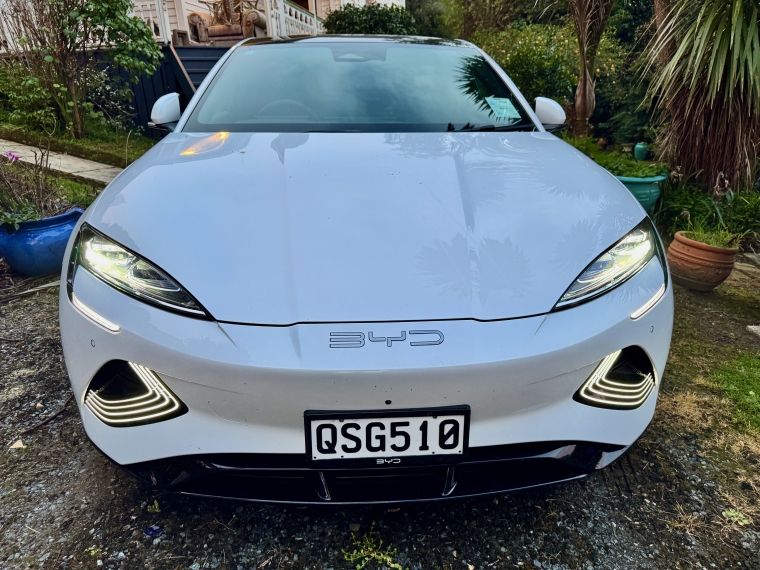
Looks are subjective, but to this writer’s eye, the SEAL’s design is really rather fetching and European inspired which is not so surprising as BYD's head designer is Wolfgang Egger who drew the beautiful Alfa Romeo 8C Competizione.
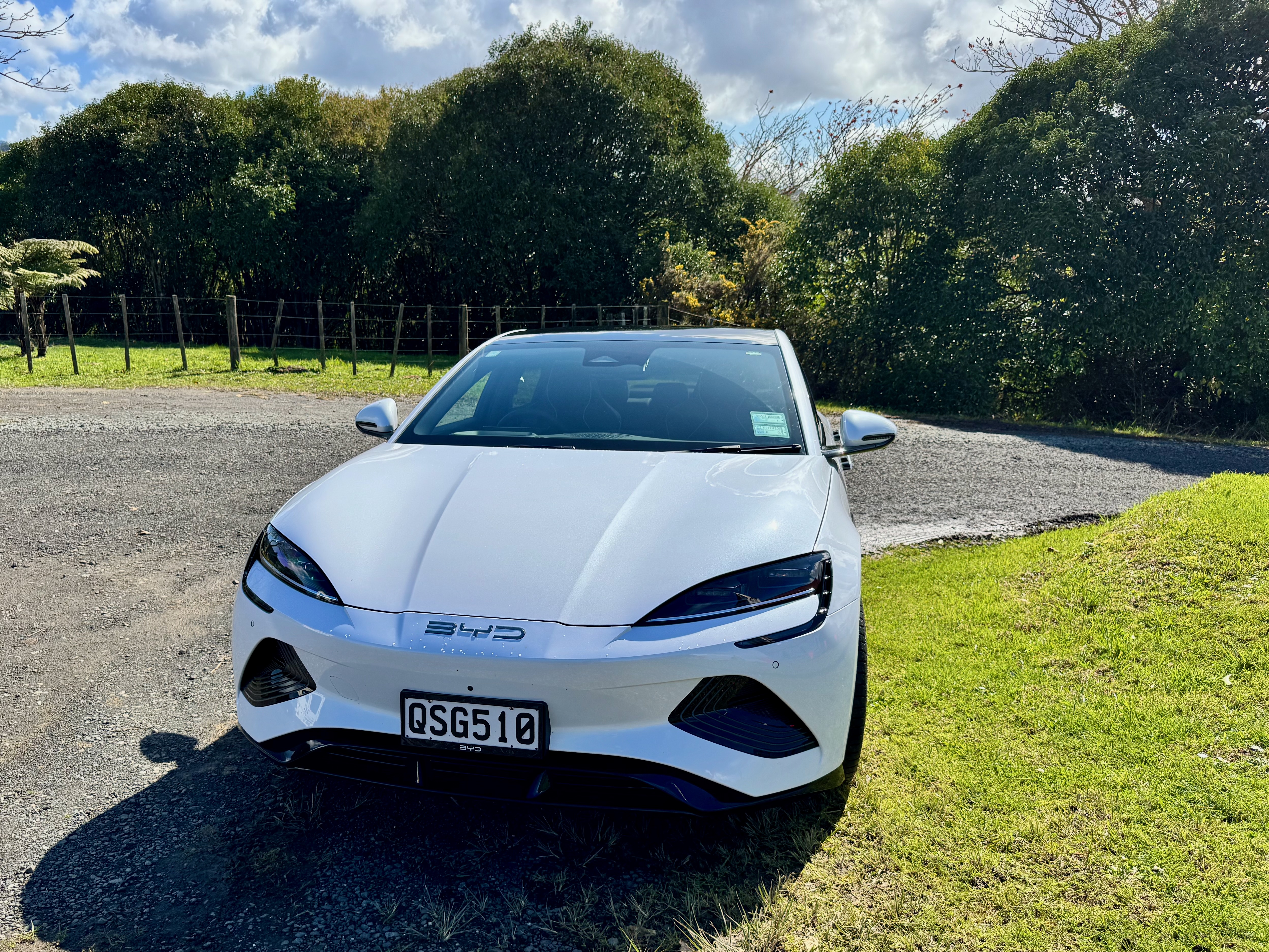
The review car was white, and there's nothing wrong with that per se but the Arctic Blue paint option surely has to be the one to go for.
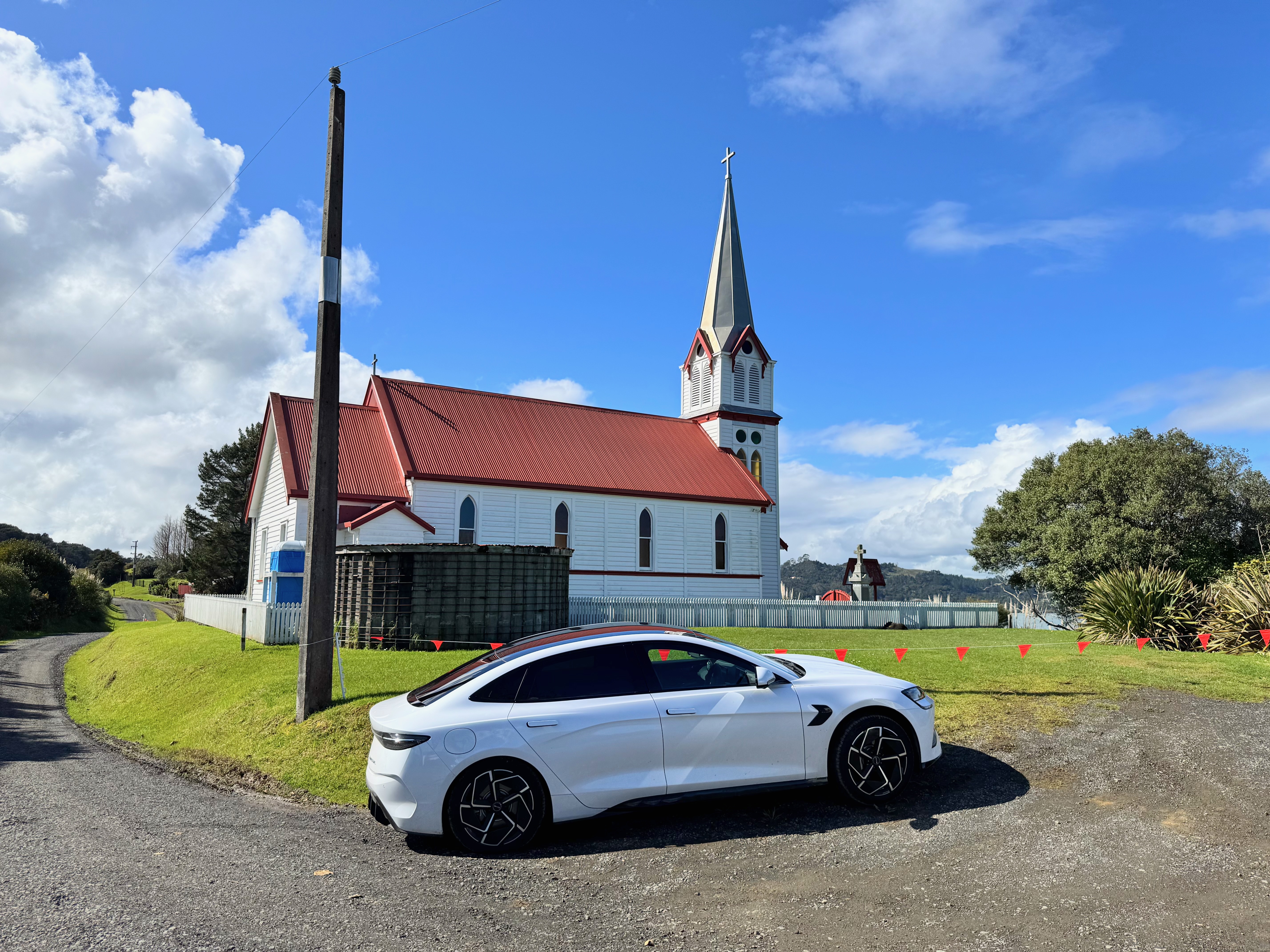
As you can tell from the pictures, the wheels are chonky 19-inchers with Continental tyres. They trade off good looks with increased vulnerability to flats and kerbing, and up the energy use; however, BYD’s suspension engineers have done an excellent tuning job so the ride is very quiet and comfortable even on rough tarmac. As is common with EVs, there’s only a tyre repair kit and not even a space-saver wheel in the SEAL Premium.
Step inside, and life behind the wheel is rather nice in a cabin where the materials feel very high quality and premium.
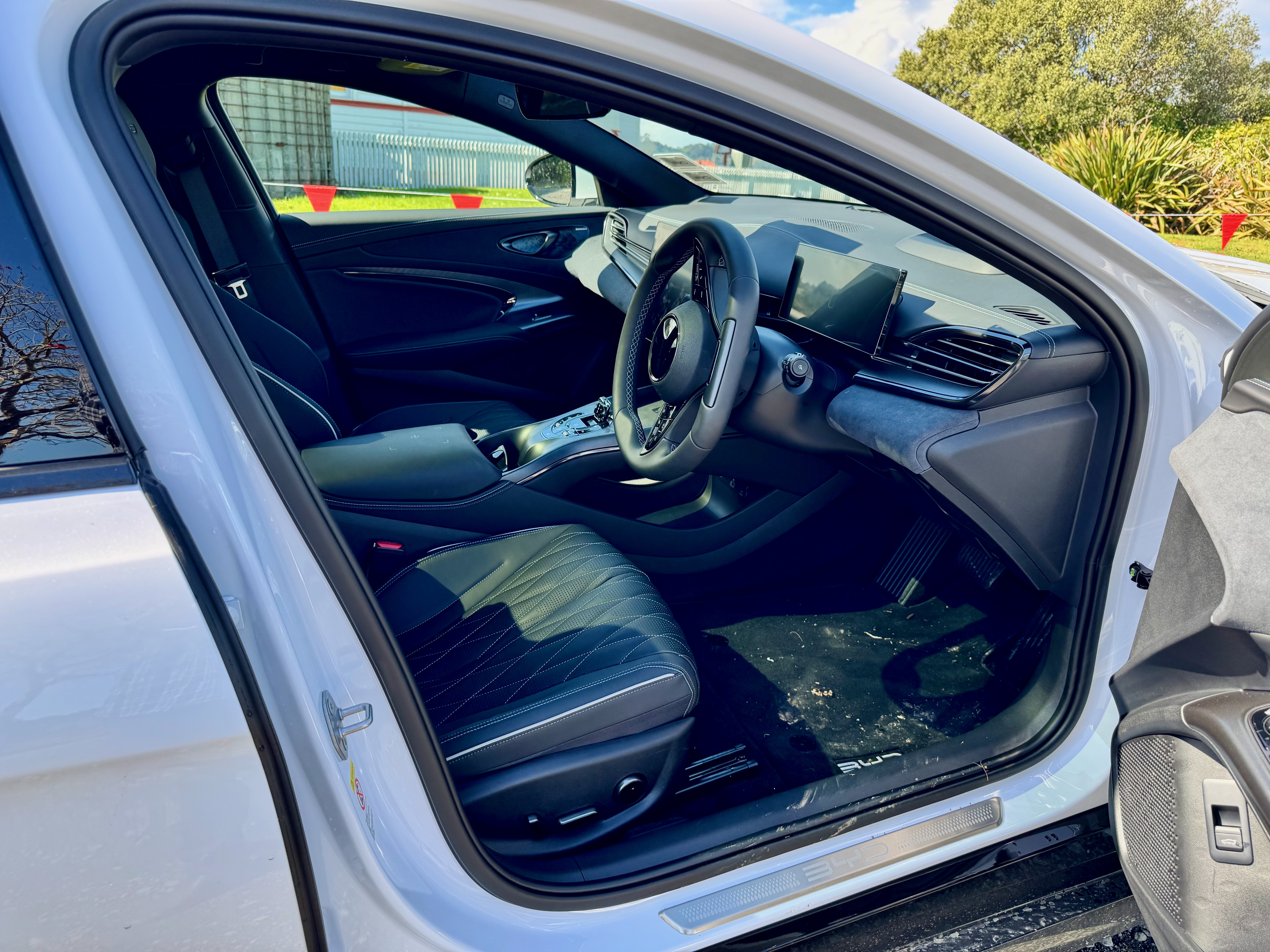
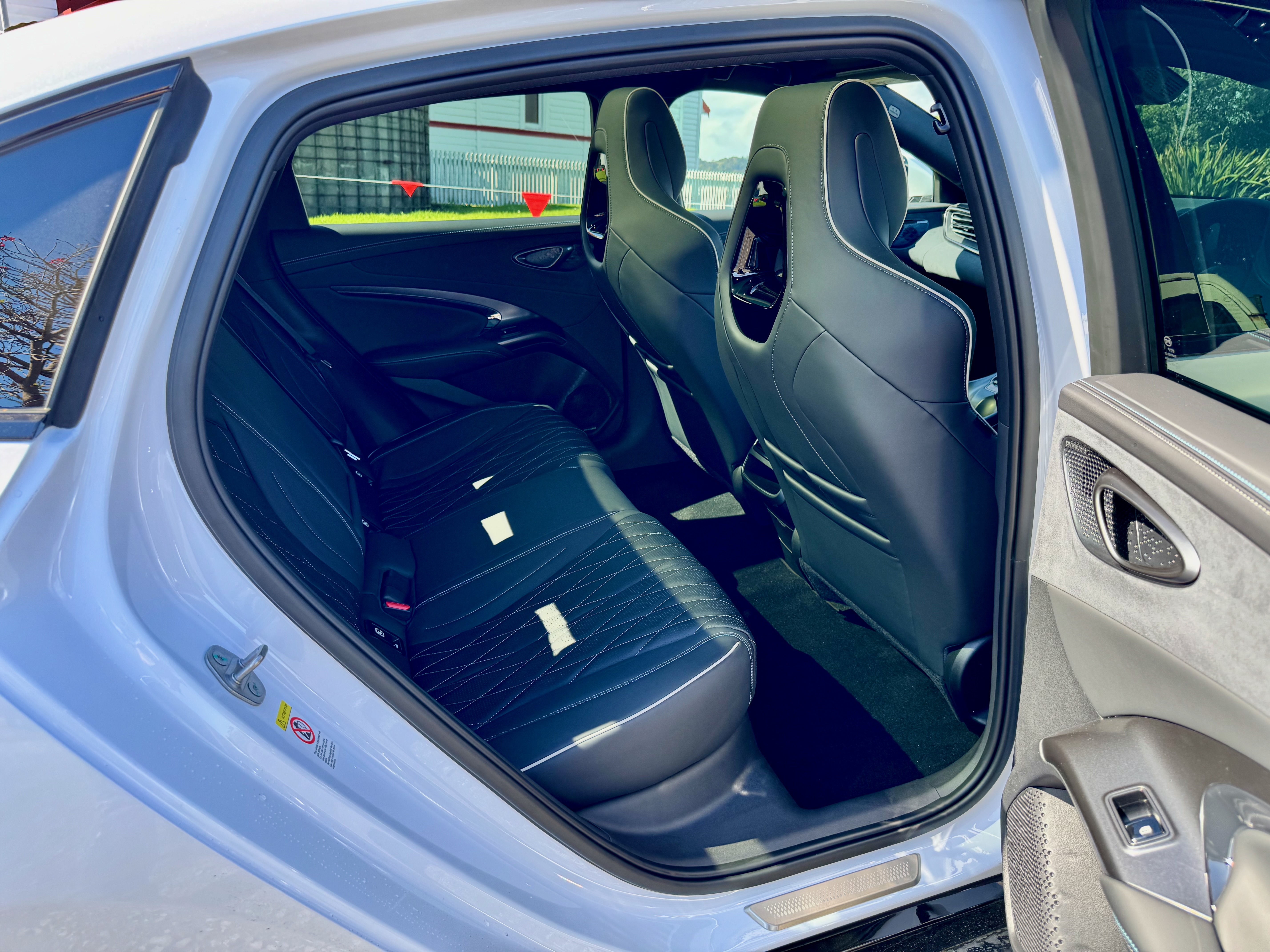
The leather upholstered front seats have power adjustment for the driver and passenger, so cost-cutting there. Rear seating is good too, with plenty of legroom. While the roof slopes aerodynamically which reduces rear headroom, yours 185 cm height truly fit into the rear seats just fine. Basketballers in the back might be tricky to accommodate in comfort though.
To set up the SEAL Premium to your liking and turn features on and off, you need to get the hang of the big 15.6-inch touchscreen, with the car operating system being Google’s Android Auto. The touchscreen does BYD’s trademark party trick of rotating 90 degrees. It would be useful if, say, apps in Apple Carplay (the SEAL connects iPhones wirelessly incidentally and there are two Qi charging pads) could make use of it, but they don’t.
Furthermore, slip on your glare-reducing polarising sunnies and the screen goes black in portrait mode, ditto the heads-up display.
“Oh no, I want physical buttons, and not everything on a touchscreen!” I hear you on that, and agree. Luckily, the many commonly used features can be accessed via the steering wheel buttons. Like, changing the temperature of the aircon. Also, there are stalks for the indicators and windscreen wipers, thank goodness. The stubby gear shift lever is traditional too, and it's surrounded by buttons for car functions like starting, switching the traction system on and off, and selecting the drive mode.
The drive modes make a quite a bit of difference for how the SEAL Premium behaves. Eco really means that, with car responses calmed down considerably; it doesn't add heaps to the range though, so leaving the Premium in Normal feels much nicer. Drop the Premium into Sports mode and you'll shave off 15 km or more of range, the steering stiffens and the car feels more responsive.
There are a few interesting translations in the car display, like “warm tip”, “the Windows [sic] opened”; the “comfort parking” thing I couldn’t instantly work out. It’s not self-parking which I’m a fan of, but OK, the sharp cameras with 360 degree view make it easy to do so manually. Instead, comfort parking appears to be a smooth braking feature.
BYD provides over-the-air software updates for the car, which is networked with cellular connection. None arrived during the review period.
One feature that looks great but feels suboptimal for New Zealand conditions is the panoramic glass roof. It’s insulated, but there’s no sliding cover, only a manual spring-loaded one. The glass roof makes the cabin feel more spacious and airier, but even with the insulation the heat of the sun can make it through to the inside of the car. Which is why you’ll appreciate the aircon being usable, and the vented front seats.
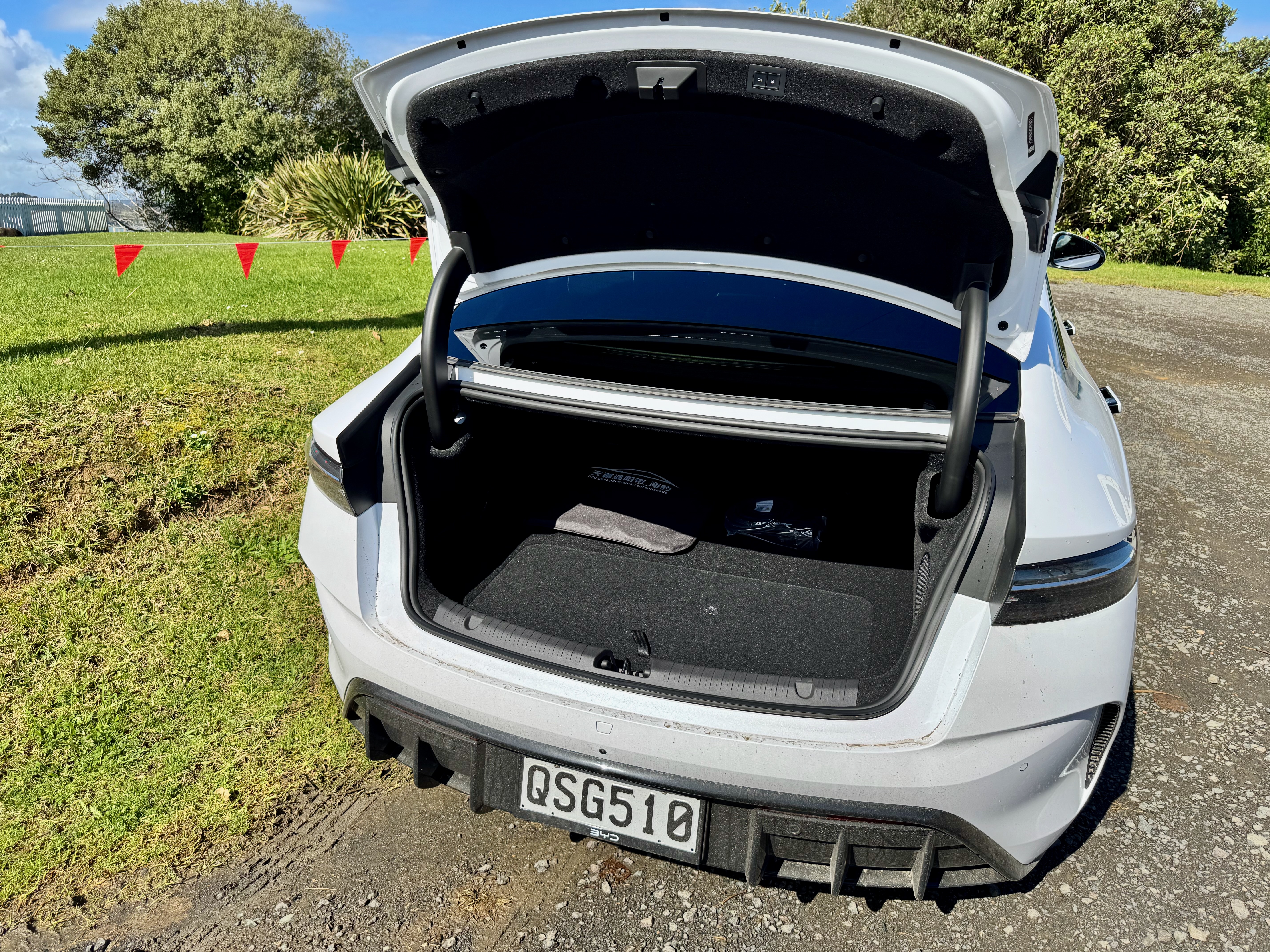
Other than that, the Premium is a sedan; while the rear seats fold down for additional luggage space, the boot isn’t hatchback-big and easy to access. It swallowed a huge ice hockey bag plus sticks, and there’s a small storage compartment under the front hood.
Driver assists still need fine tuning
Diving in town needs a little care as the SEAL is a low sedan. No doing the usual stunt driver jumps over speed humps that suburbanites engage in pursuit of economic growth, mmkay?
On the highway, the SEAL is simply lovely to drive. As I mentioned, it’s quiet despite the big wheels and you don’t think about 2000 kg weight while cornering. There’s more than enough acceleration, the brakes are fine, and the traction control means you’ll disappoint the kids who’ve learnt rear wheel drive is the thing for drifting.
ATECO said there are 29 BYD engineers stationed in the region to keep the marque’s cars running smoothly and they’ve already provided improvements. It would be great if the engineers could at least add an off-button for the incessant bonging sound the speed limit sign detection makes, when it usually erroneously thinks you’re going too fast.
This might not be possible though, as it appears BYD uses a third-party driver assist system. In a similar fashion, the lane keeping can at times be at odds with the autonomous steering. The latter picks the correct path through a bend which upsets the former as you get too close to the white lines. It’s meant to be intelligent, but ends up being twitchy on some stretches of road.
In fact, it is reminiscent of driving a BMW some years ago, in which the self steering kept you in the lane just fine but unnervingly kept correcting itself in a manner no human driver would. Toyota’s system is smoother. You can turn it all off, and the adaptive cruise control by itself works great, but having to do that each time you set off is a pain.
The SEAL Premium is also the first car I’ve tried that can use your smartphone as a digital key, as devised by Google and Apple. Here, BYD joins an exclusive club of car makers, including BMW, Genesis, Hyundai, Kia, Lotus, Mercedes-Benz, and Rivian.
For Apple iPhones, you add a digital key to the Wallet app on the device and that’s it: no more physical car key required. You can share keys with other smartphone users, and there’s a near field communications (NFC) sensor on the driver’s side wing mirror for entry and locking the car. The digital key can also be set for proximity sensing entry into the car, and it all works well. No more physical car key required.
The longer story here is that using your smartphone as a car key is most likely more secure than manufacturers’ entry devices. Furthermore, the keys can be managed for rental and short-term hire cars for example.
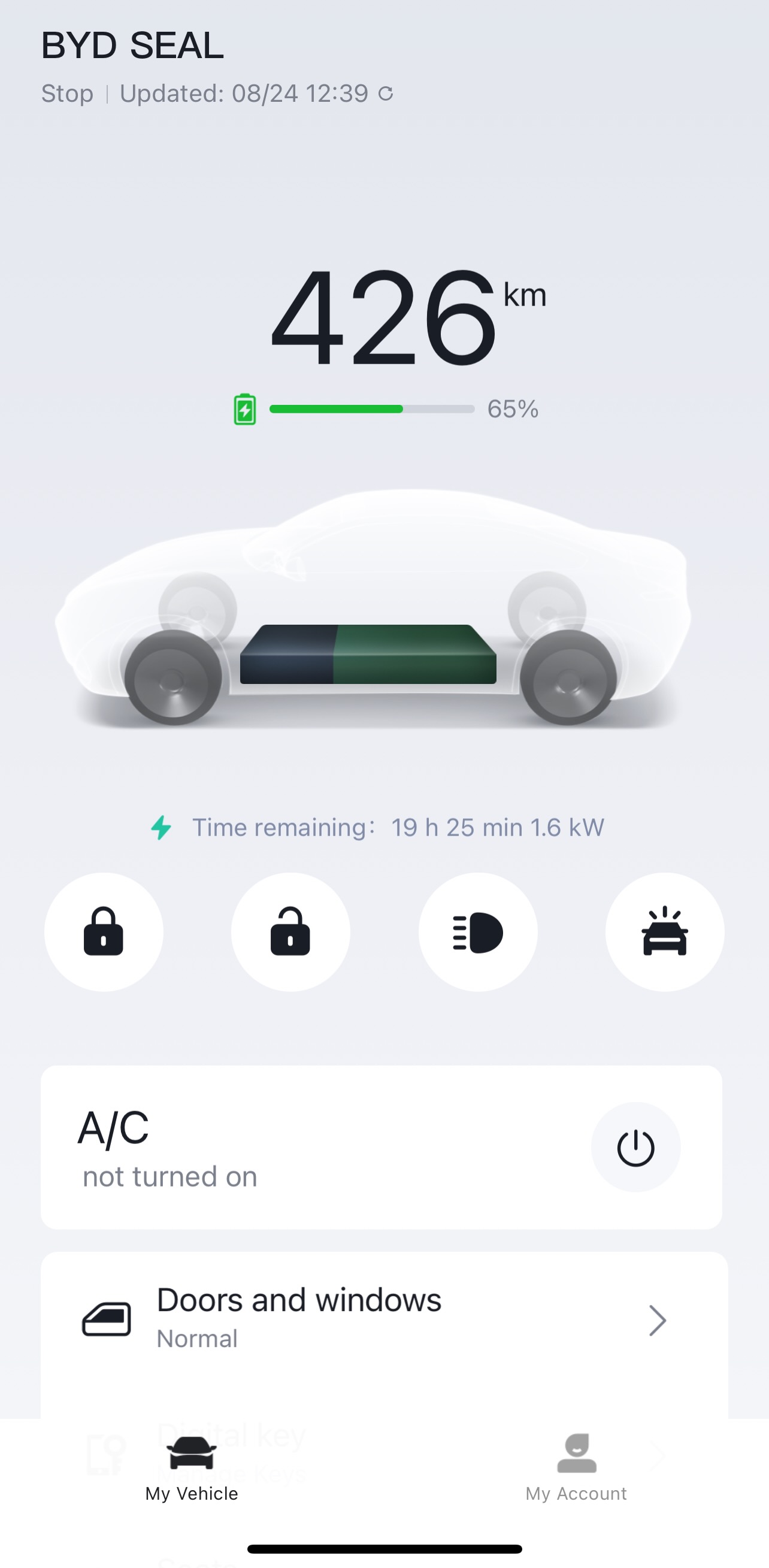
BYD’s iPhone app was quite good too, allowing remote control over some vehicle functions (no, not when moving and only the safe stuff when still). It did give overly optimistic range readings after charging sometimes, with the car reading 15-20 kms less compared to the app.
Decent charging rate
With the range the BYD SEAL Premium has, and I saw reported energy use of 13.8 to 20 kWh per 100 km, there was no need really to stop in Kaiwaka to charge. But, I wanted to see how fast the SEAL would charge, and what the tapering-off was like, once the battery hit 80%.
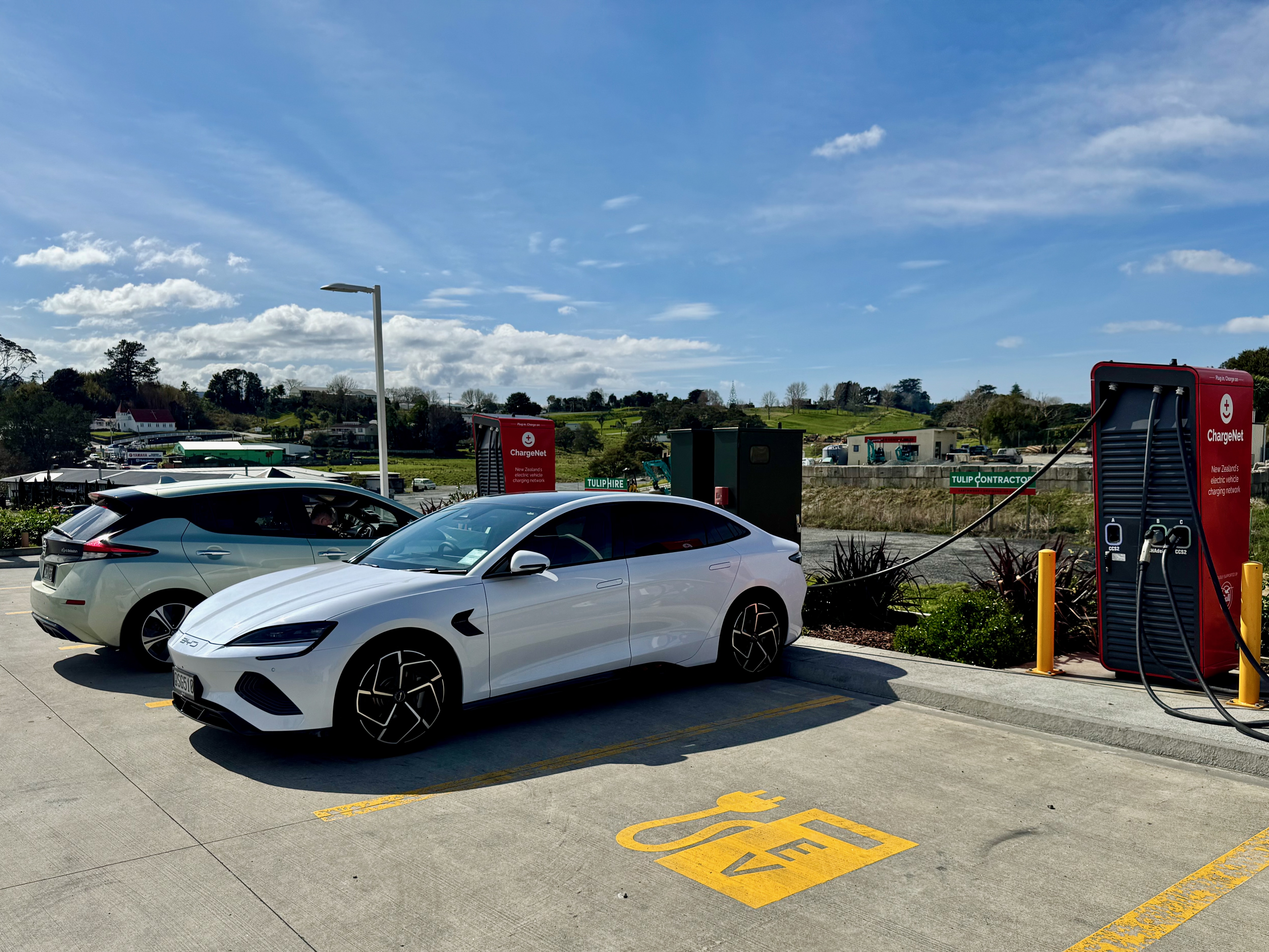
On the 300 kW ChargeNet charger, I saw just over 125 kW - the SEAL is rated at 150 kW max. Going beyond 80% gradually slowed down the charging, but even when you reached 95% the SEAL was still adding power at a rate of 45 kW. Which is really good, in my opinion. A twenty minute top up stop is ample.
AC charging maxes out at 11 kW and there’s a Type 2 adapter included. It'll take a long time to fill up the battery over a normal 230 Volt line (best I saw was 1.6 kW), but at least the option is there to add some kilometres at just about anywhere.
One pedal driving? We don’t need no steenken one-pedal driving!
There are two levels of power regeneration in the SEAL Premium. I drove at the highest setting to recoup electricity while coasting downhill (in the Premium, we’re not talking about my career). However, unlike most other EVs I’ve driven, there’s no one-pedal driving so you need to use the brakes to stop the Premium.
An ATECO rep told me that the reason for this is that one-pedal driving is very inefficient. That was a surprise, but Porsche thinks the same.
China taking a dim view of one-pedal driving after Tesla crashes, and apparently looking at banning it completely by 2026 could be another reason.
Conclusion: a very pleasant EV tourer
The BYD SEAL Premium turned out to be very easy to live with overall, striking a good balance between hi-tech and the traditional. Comfort levels are high, ditto the quality feel of the car, particularly when you consider the price of the Premium.
With the range the Premium is capable of, you’ll be depleted before the battery state of charge becomes a worry. Anything over 300 km is more than adequate for the vast majority of use cases, but an EV that goes further undeniably improves the driving experience. Add a wallbox at home, you’re looking at cheap kilometres despite the unfairly high road user charges (compared to petrol excise) on top.
We welcome your comments below. If you are not already registered, please register to comment
Remember we welcome robust, respectful and insightful debate. We don't welcome abusive or defamatory comments and will de-register those repeatedly making such comments. Our current comment policy is here.