
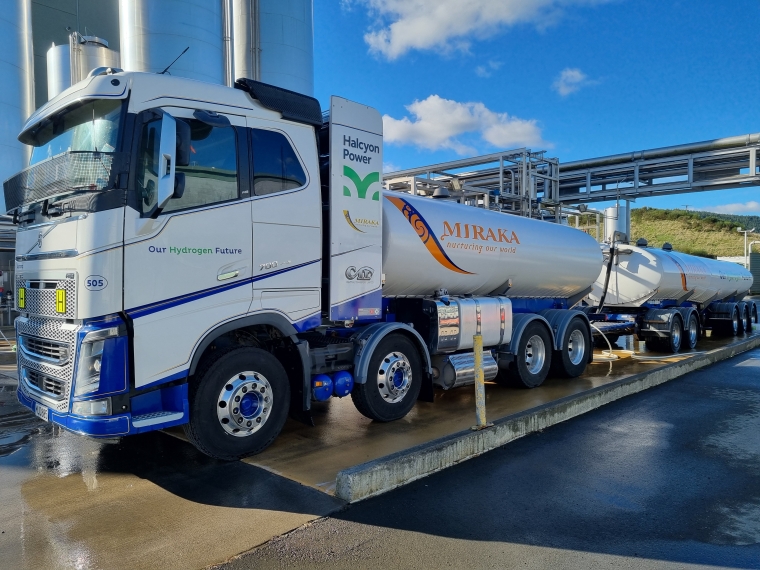
Transport Minister Simeon Brown and Minister of Climate Change Simon Watts have announced the Low Emissions Heavy Vehicle Fund, or LEHVF, which has $27.5 million in the kitty.
The LEHVF money will go towards offsetting the purchase of, as the name implies, low and zero-emission heavy vehicles. That's because of high upfront costs and the unknown total cost of ownership being the main barriers to uptake of LEHVs, the ministers said.
Now, organisations can offset up to a quarter of the vehicles' purchase price. This is in the context of heavy vehicles generating around 18% of New Zealand's greenhouse gas emissions.
Watts pointed to estimates suggesting that switching 500 diesel-only vehicles to LEHVs would remove 366,622 tonnes of carbon dioxide equivalent emissions in NZ.
To be eligible, new vehicles to be purchased have to be battery electric, hydrogen fuel cell electric, or hydrogen diesel dual fuel like the Miraka milk tanker, and have a gross vehicle mass (GVM) of 5.9 tonnes or higher.
Curiously, $5 million of the total in the fund "has been earmarked for low-emissions heavy vehicles: hydrogen-diesel dual fuel and plug-in diesel-electric hybrid vehicles that meet at least 30% emissions reductions," the Minister said.
We asked Te Tari Tiaki Půngao/The Energy Efficiency and Conservation Authority (EECA) chief executive Marcos Pelenur what that all means.
"When the programme was initially designed, dual fuel hybrid vehicles were excluded due to there being insufficient evidence that the technology had advanced beyond the demonstration phase," Pelenur explained.
"Following EECA’s successful trial of dual fuel hybrids with HW Richardson, the decision was made to expand eligibility of this fund to include dual fuel hybrids," he added.
In money terms, for the first year of the LEHVF, grants are capped at $4 million per vehicle importer/supplier, Pelenur said. Per vehicle operator, the amount is $1 million.
Caps for the following year will be set by 31 March 2025 and announced by the end of April 2025, he added.
"There are also capped maximums on funding for each vehicle category, including hydrogen-diesel and diesel-electric vehicles, depending on gross vehicle mass (GVM) and vehicle class."
"These categories are based on licensing and energy usage," Pelenur said.
Heavy vehicles using a hybrid propulsion system with small batteries, and not the larger plug in ones that require separate charging, are not eligible for funding.
Pelenur explained such diesel electric heavy vehicle were excluded as the technology used has a modest emissions impact and only generates a maximum of 20% fuel reduction.
The LEHVF initiative isn't set in stone, and will be reviewed six months after launch.
Its criteria and funding caps could be changed, which will be communicated to the market in advance of them taking effect, Pelenur said.
We welcome your comments below. If you are not already registered, please register to comment
Remember we welcome robust, respectful and insightful debate. We don't welcome abusive or defamatory comments and will de-register those repeatedly making such comments. Our current comment policy is here.