
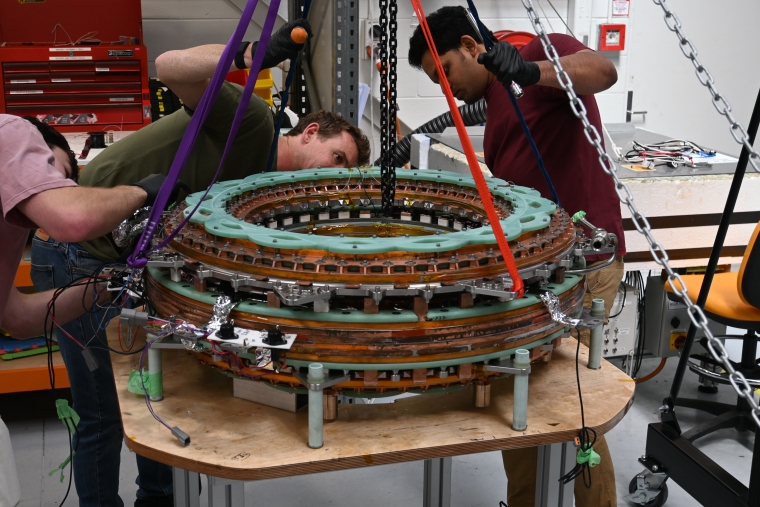
The researchers at OpenStar Technologies in Te Whanganui-a-Tara say they have achieved a crucial milestone when it comes to creating fusion energy, by making plasma suspended within a magnetic field in a vacuum chamber.
Fusing atoms at extremely high temperatures as happens in the Sun and stars holds the promise of providing nearly endless green energy. While mankind has been able to successfully split atoms (fission) since the 1940s in experimental and eventually, commercial reactors, fusion equivalents have been elusive and remain at the experimental stage.
This despite regular breakthrough announcements that claim to take us yet another step closer towards energy production through fusion.
At the heart of the matter is heating the plasma (ionised gas) to the temperature required for fusion to take place on Earth, which can be 50 million degrees Celsius for some approaches.
Not only does this use a large amount of energy but as OpenStar said: "creating and confining plasma is the key engineering feat to enable fusion, as no physical material can withstand contact with temperatures that high; it must be suspended within magnetic fields in a vacuum chamber."
This is much more difficult than it sounds but it is what the Māori-led OpenStar appears to have done successfully, using a prototype of its Levitated Dipole Reactor.
Source: Openstar
In the words of OpenStar's director of plasma science, Dr Darren Garnier:
“We made a plasma today, so for me it is like Christmas. We’re a fusion company now, not just a magnet company, or someone drawing schematics with only hopes and dreams.”
Garnier's Alma Mater is the Massachusetts Institute of Technology (MIT) in the United States, which is where the Levitated Dipole Experiment (LDX) operated between 2004 and 2011 in Collaboration with Columbia University.
OpenStar described its process as an elegant solution inspired by nature that uses superconductors housed within the [vacuum] chamber, and the magnetic field lines emanate outwards in a dipole shape. This confines the plasma around the magnet, in a similar fashion to the Earth's magnetosphere.
Crucial to creating the magnetic containment fields are High Temperature Superconductors. OpenStar said they permit electromagnets that produce very strong containing fields, yet with effectively no power consumption. Wellington's Robinson Research Institute produces innovative work around superconducting magnets, and they're used in other nuclear fusion efforts around the world.
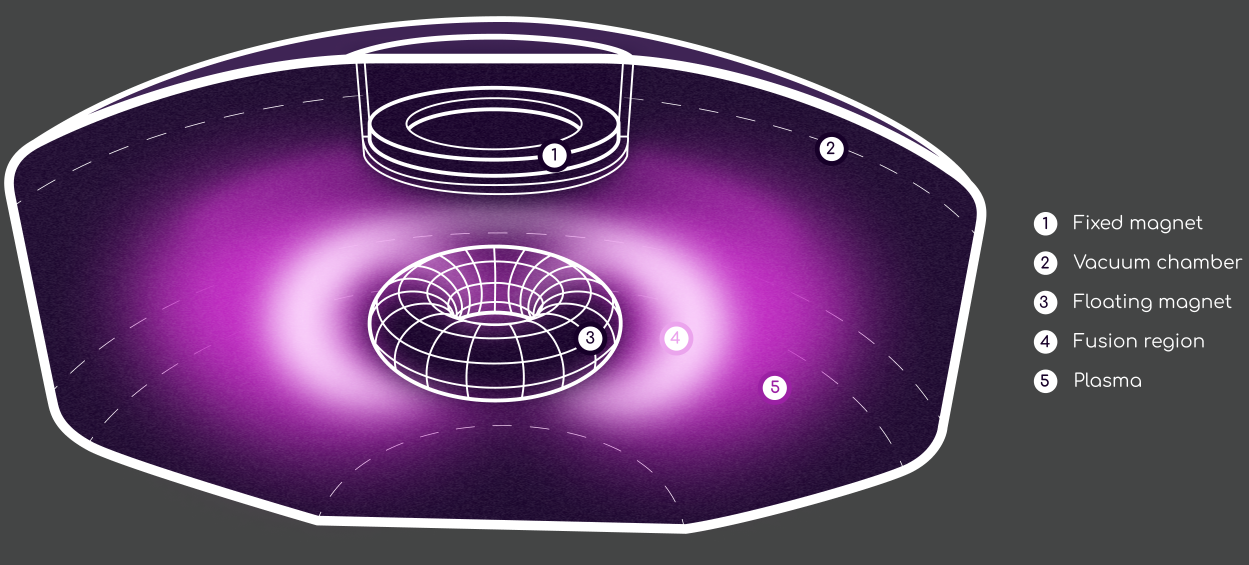
Although MIT and Columbia University thought the Levitated Dipole reactor was promising, official United States funding was diverted from their experiment in 2011, towards toroidal chambers with magnetic coils or tokamak systems to confine the plasma, which is a different approach, used by for example ITER in France. We'll see where OpenStar goes with its technology, if it gets us towards sustained fusion but company founder Dr Ratu Mataira said "this is New Zealand's bid to win the fusion race".
We welcome your comments below. If you are not already registered, please register to comment
Remember we welcome robust, respectful and insightful debate. We don't welcome abusive or defamatory comments and will de-register those repeatedly making such comments. Our current comment policy is here.