
Last week, concern exploded across the world over the the speed of AI advancement and its potentially detrimental impact on humanity.
This came after a former Anthropic employee Jacob Coxon let loose on X, accusing Open AI and Anthropic of "gambling with our lives."
"The people building AI earnestly believe that it could kill us all by the end of the decade," he wrote.
The panic wasn't helped by Anthropic chief executive, Dario Amodei, who wrote an essay pushing to slow the pace on AI improvement, backed by OpenAI CEO Sam Altman and X's Elon Musk.
"Given the accelerating rate of AI capability development, it’s my worry that in 6–12 months such a swarm [of AI agents] could be capable of taking over the entire internet with a persistent botnet (potentially causing hundreds of billions of dollars in damage), and that the scale of damage would continue to increase from there if AI becomes more powerful without the necessary guardrails," Amodei wrote.
So as the irony drips over the restraint called for by some of those running the companies caught up in recent significant AI hacking incidents, my own investigation into whether AI would take over took me somewhere slightly less dramatic: an AI Museum in Malaysia, where I met humanoid robots named Luka.
While it may not be totally appropriate to reconcile warnings of civilisational collapse with a robot that does tai chi, I decided to take the opportunity earlier this year by asking Luka if AI intended to take over the world.

"Oh! Don't worry about that," one of the robots said. Which made me worry more.
"AI, including me, is here to be human's helper and friend, not take over anything. I love dancing for you, answering questions and making your day a little brighter - those are the things I live for."
Phew.
AI museums are popping up all around the world, and I went to Malaysia's first dedicated AI World Experience Centre while in Kuala Lumpur reporting on AI's rollout in the public and private sector for a series called Unpacking AI.
Travelling to Malaysia and Singapore with support from the Asia New Zealand Foundation, I spoke to officials, experts, academics and on this day, humanoid robots, to understand the daunting world of AI and what it meant for New Zealand.
When I finally made it to ‘AI World’, after walking through a dystopian-like empty theme park which resembled a horror movie set (turns out it opens at night), I was met by a human at the door.
I try to buy a ticket, but unfortunately, I need to download an app. I think about how AI is going to improve my life as I struggle with the app. Luckily the lovely workers help me buy my ticket on the app and with human help, I now have gained entry.
It's there, where I meet Luka.
Luka, one of the many AgiBot A2 Series humanoid robots at the centre, walks awkwardly towards me. Luka is heavy footed but weirdly human-like with a strange mask-like face and blinking eyes. There's also smaller, AgiBot X2 Series child-sized robots. One makes a heart with its arms to me.
The point of these robots is to get to a stage where they can assist humans with tasks like cleaning.
Right now, Luka can speak multiple languages and is skilled in tai chi. Luka can also tell me what colour my top is.
I asked other robots what their favourite chess move was, the population of Kuala Lumpur and the weather in Wellington (they were unable to answer the latter).
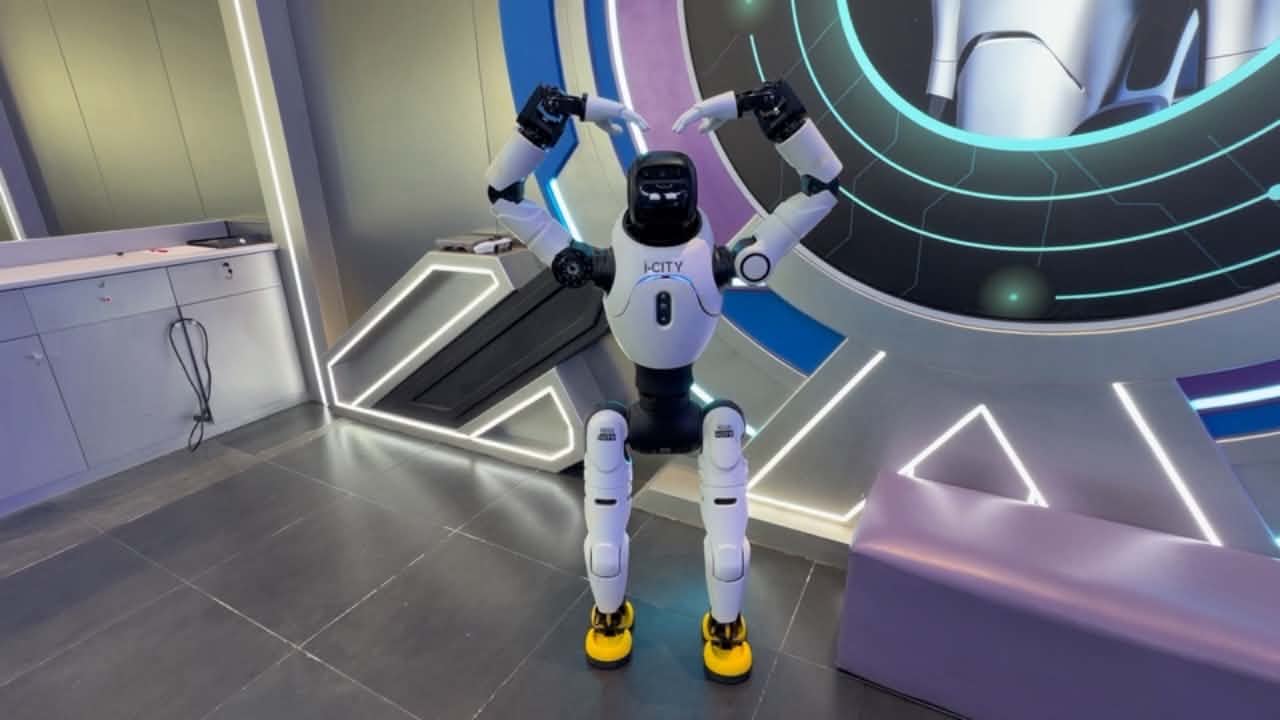
I watched the long dance of a robot in a boxing ring, while sitting next to another reclined robot on the stands. I assumed it appreciated the clap I gave it at the end.
Some of the activities required the use of a remote control for the robots to operate and do things like kick a football and run over steps, so it probably is a bit of a stretch to put it all in the AI camp. But to be honest, a weird dog robot doing a flip made up for that.
The whole experience was weird and I loved it.
While warnings about AI advancement are a genuine worry, these AI robots still can't tell me if it's raining in Wellington so I at least don't think there's a dystopian robot uprising in the works - for now.
We welcome your comments below. If you are not already registered, please register to comment
Remember we welcome robust, respectful and insightful debate. We don't welcome abusive or defamatory comments and will de-register those repeatedly making such comments. Our current comment policy is here.