
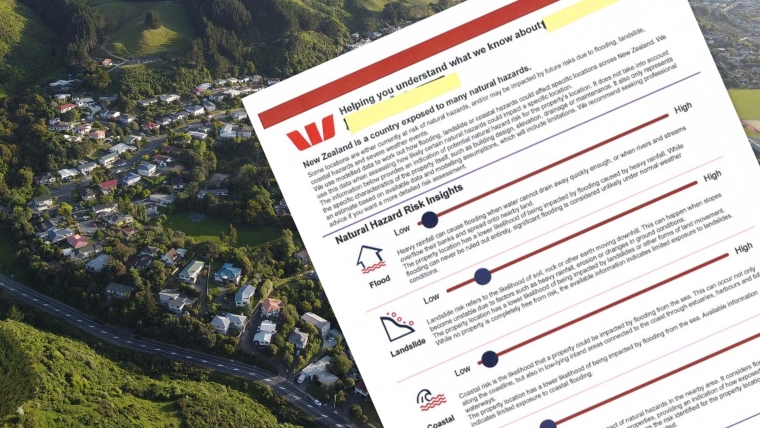
Would-be homebuyers wanting to take out a loan with Westpac NZ will now receive natural hazard risk information from the bank about the homes they’re looking to buy.
Westpac has invested in climate data, supplied by New Zealand-based environmental science and data analytics company ClimSystems powered by SLR Consulting, and will give home loan applicants a report on the same data the bank considers in its lending decisions.
Westpac’s head of consumer lending and insurance Jo McGregor said the Westpac Natural Hazard Risk Insights report would be available for any home lending for new residential properties. This would be available from Wednesday.
In an interview with interest.co.nz, McGregor said the bank had spent time investing in data that gives them a bit more indication of the natural hazards at a property level.
“From our perspective, it’s from the bank’s decision-making process around lending on longer time horizons. While there’s quite a lot of information out there, a lot of that comes from the perspective of say, an insurance company or a council … This was our opportunity to get our own data that’s really relevant to the decisions that we’re making.”
She said Westpac was keen for customers to have the same information they did when looking at buying a property.
“For a lot of customers, it’s the biggest financial decision that they’ll make.”

Information on individual properties
While the data gives an idea of the area around the property and the risks associated with that, McGregor said their information was at an individual property level.
“We don’t expect to decline any applications solely based on natural hazard insight. It would just be one of the pieces of information that we’re using to assess the security.”
Asked if people would be able to challenge the insights report, she said if they disagreed with the assessment and had their own information, they could share this with the bank.
Some mitigation measures may already have been undertaken at some properties, she said.
“The information we have is really [about] what’s the inherent risk on that property based on data, but we don’t necessarily have all the information about what improvements have been made.”
McGregor said: “If customers have got more information and they say, ‘hey, it looks like you've assessed this as quite medium, but the house doesn't sit on the edge of the hill. It's right in the middle with a couple of humps either side of it’, we'd be like ‘oh well … there's more to this than what the data is actually telling us, and that would sort of mitigate it …”
“So you wouldn't change the inherent risk for that property, but you'd actually say, ‘well, look, it's really well mitigated, so the residual risk at the end of all that is very very low.’”
McGregor said they could have further conversations with customers on the data but what the report does indicate is that people may want to do some of their own due diligence to understand if a property they’re looking at is potentially a little higher in terms of things like flood risk.
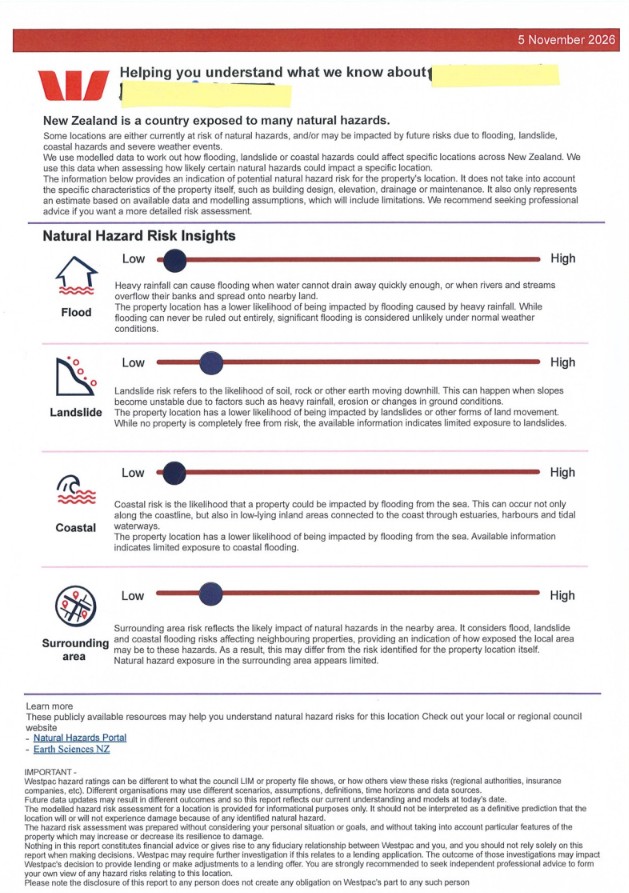
This involved things like looking at the LIM (Land Information Memorandum) report or hazard mapping more closely.
From the bank’s perspective, while it may not impact their lending decision, the risk may not be as low as a customer wants it to be, she said, and they might start thinking about how to make the property more resilient.
Asked how she saw this information working with insurance, McGregor said the information they were collecting was more from the bank’s perspective, and the fact they would be lending over the next 30 years as opposed to an insurance company which was looking at insuring for at least 12 months and the replacement value of the property.
“So it's a slightly different lens that the insurance companies will have on it. But obviously, the banking and the insurance do go hand in hand around making sure that we've got security and insurance over that security.”
'It may mean the amount we’re comfortable lending on an at-risk property is less than it may previously have been'
Sarah Hearn, Westpac NZ managing director of product, sustainability and marketing, said the bank wanted to make sure customers had relevant information available about a property they’re interested in, including the risk of that property experiencing damage from natural hazards like flooding or slips.
She said it wasn’t news to anyone that flooding and slips were happening more often in Aotearoa.
“We’re experiencing severe storms more frequently, and those storms can have a devastating impact on people’s homes and livelihoods.”
“We’re being careful and deliberate in the way we factor natural hazard risks into our lending decisions, with a focus on helping customers understand what it means for them," Hearn said.
“We are not moving to risk-based pricing and we don’t expect to be declining applications solely on the basis of this risk. However, in a small number of cases, it may mean the amount we’re comfortable lending on an at-risk property is less than it may previously have been.”
Providing people with the same information Westpac receives would help ensure they have the same information when making decisions, Hearn said.
We welcome your comments below. If you are not already registered, please register to comment
Remember we welcome robust, respectful and insightful debate. We don't welcome abusive or defamatory comments and will de-register those repeatedly making such comments. Our current comment policy is here.