

Long term international government bond benchmark interest rates have an outsized impact on New Zealand.
Sure, the OCR rules for very short term rates. But it is the longer maturities that set the yield benchmarks. These longer rates are how commercial property is valued, how corporate equities are assessed, and how currency relativities are set.
This is where we are at present:
| Govt bond yields | 2 yrs | 5 yrs | 10 yrs |
| % | % | % | |
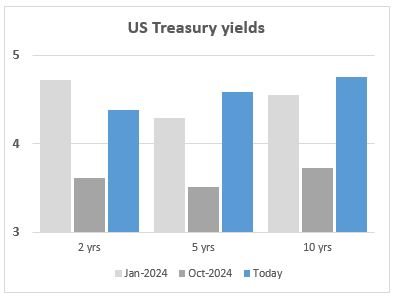
| US | 4.38 | 4.58 | 4.76 |
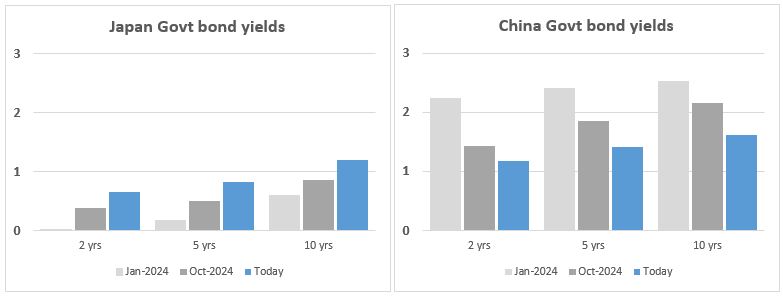
| Japan | 0.65 | 0.82 | 1.20 |
| China | 1.18 | 1.42 | 1.62 |
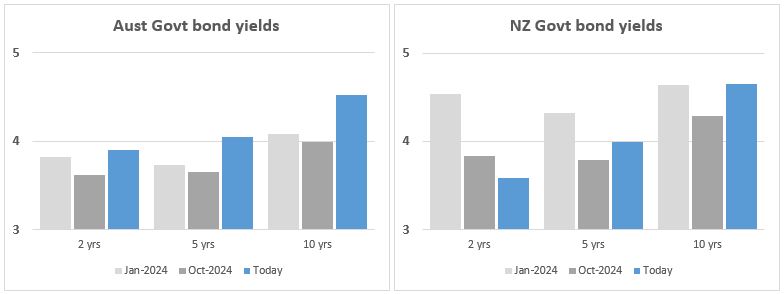
| Australia | 3.90 | 4.05 | 4.53 |
| New Zealand | 3.59 | 3.99 | 4.65 |
Things have changed rather quickly over the past three or so months.
This is where we were on October 1, 2024
| Govt bond yields | 2 yrs | 5 yrs | 10 yrs |
| % | % | % | |
| US | 3.61 | 3.51 | 3.73 |
| Japan | 0.39 | 0.50 | 0.86 |
| China | 1.43 | 1.86 | 2.16 |
| Australia | 3.62 | 3.65 | 3.99 |
| New Zealand | 3.83 | 3.79 | 4.29 |
And this is where we were at the start of 2024.
| Govt bond yields | 2 yrs | 5 yrs | 10 yrs |
| % | % | % | |
| US | 4.72 | 4.29 | 4.55 |
| Japan | 0.01 | 0.18 | 0.59 |
| China | 2.24 | 2.41 | 2.52 |
| Australia | 3.82 | 3.73 | 4.08 |
| New Zealand | 4.54 | 4.32 | 4.64 |
A number of things stand out here. Worth noting are ...
- the unwinding of the US inversions
- the speed of change up in the past 90 days of US rates, post-election
- NZ rates have moved from a premium to the US, to a discount to the US
- how far and fast the Chinese rates have fallen recently
- how far and how fast the Japanese rates have risen recently
- Australian rate have risen, but only modestly.
With rates moving this fast, it is bound to affect us. Even without the geopolitical pressures, these shifts are important from a Kiwi point of view because ...
- Australia owns 90% of our banking system, and the way they look at returns (through their yield perspective) impacts us. (If yields rise there more than here, it might push down the value of bank shares. And to mitigate that, bank boards will start looking for even bigger profits.)
- Japan and China are two of the world's major creditor nations. While we don't source much capital from them, Australia and the US does, and their situations are moving in opposite directions, and this too will affect the availability and pricing of the offshore borrowing we do.
- the US financial markets are where most of our foreign funds are directly sourced, or at least priced.
Interestingly, New Zealand benchmark bond yields are no longer at a premium to equivalent Australia rates across the shorter end of the tenors. And our relationship to the US has taken a major change. We are pivoting and even though our 10 year is back to where it was a year ago, it is now in a new rising trend.
Things are still on the move. It seems unlikely this is where these yields will be mid-2025 or the end of 2025.
The purpose of this review is to establish the benchmarks of where we start in 2025, and show how we got there from 2024.
Got a perspective on these shifts? Share it in the comment section below.
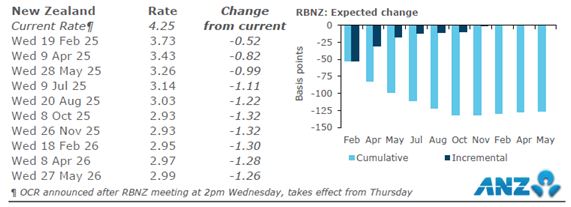
And for completeness, here are the current financial market pricing expectations for the OCR in 2025.
We welcome your comments below. If you are not already registered, please register to comment
Remember we welcome robust, respectful and insightful debate. We don't welcome abusive or defamatory comments and will de-register those repeatedly making such comments. Our current comment policy is here.