
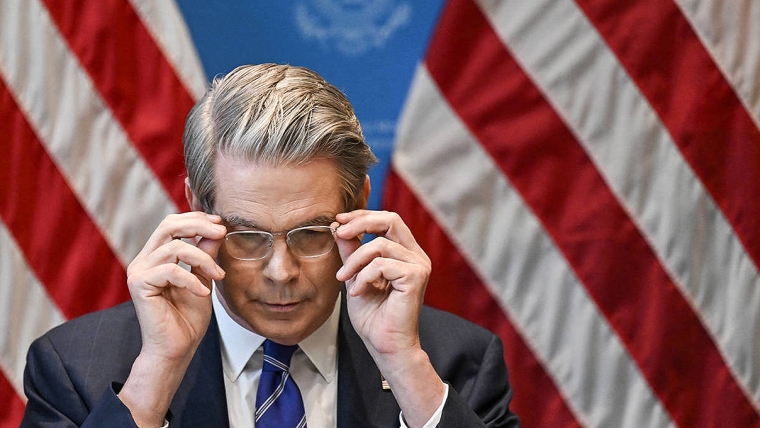
Intervening in financial markets is a fool’s game. And yet many seem incapable of internalizing that lesson. So it is with US Treasury Secretary Scott Bessent, as he seeks to manipulate currency and bond markets.
Bessent has the most consequential markets in his crosshairs. In targeting the foreign-exchange market, he is going after the world’s largest and most liquid financial market; according to the Bank for International Settlements’ latest triennial survey, over-the-counter foreign-exchange turnover reached $9.6 trillion per day in April 2025. Daily trading volume in Bessent’s other target, the $31.5 trillion US Treasury market (the world’s largest individual securities market), currently averages about $1.2 trillion.
Bessent somehow believes that he knows better than markets. He thinks that the Japanese yen should be stronger (and, by inference, the dollar weaker) and that long-term US interest rates should be lower. Accordingly, in partnership with Japan’s finance ministry, Bessent intervened to support a weakening yen on July 31. While the scale of the yen purchases was not disclosed, a photograph of Bessent’s to-do list suggests that the United States spent $5–10 billion, with Japan reportedly chipping in another $53 billion. A few weeks later, Bessent announced an increased buyback of long-dated US Treasuries that potentially works out to about $32 billion per quarter.
These are puny amounts relative to the trading volume in these vast markets. The combined yen intervention represents about 0.6% of daily foreign-exchange turnover (and less than 4% of daily net yen trading), while the support measures for long-dated bonds is equivalent to only about 0.1% of the market per quarter. Bessent has hinted that there could be more to come, but without meaningful policy changes by the US Federal Reserve or the Bank of Japan, the impact of tiny interventions in huge markets will likely be negligible.
There is a myth that, in the 1980s, coordinated currency intervention was decisive in addressing extreme swings in the value of the dollar, which was too strong in the mid-1980s and too weak a few years later. But the Plaza Accord, the agreement reached by the then-G5 in September 1985 to weaken the dollar, came fully seven months after the greenback peaked. The next joint intervention, the Louvre Accord, followed in February 1987, aimed at stabilizing international currency markets after the dollar’s subsequent plunge in 1985–86. But it came about a year and a half before the dollar started bottoming out in 1989–90.
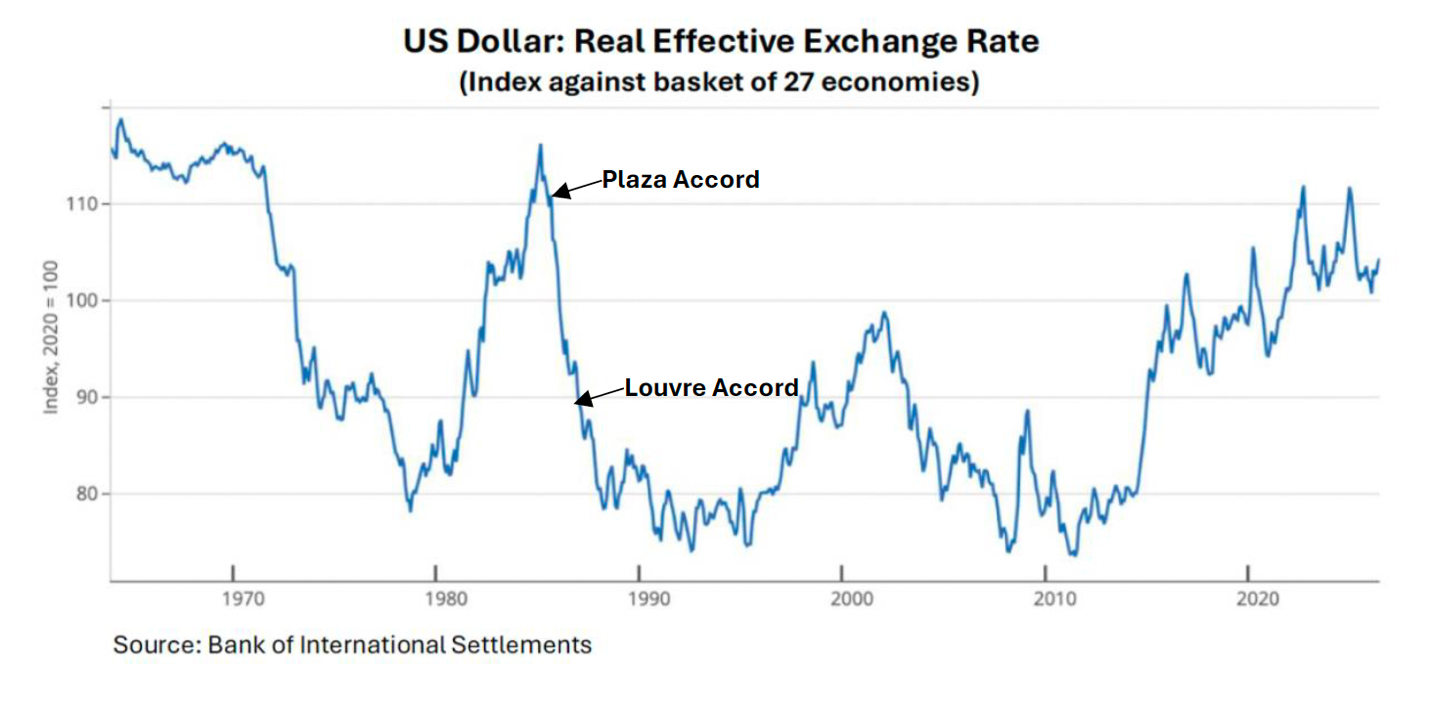
In other words, joint currency interventions by the major advanced economies did not match up well with major shifts in foreign-exchange markets. While the Plaza Accord piled onto a trend that was already underway, the Louvre Accord struggled to have any impact. Significantly, these actions did not break the back of currency speculators, as George Soros famously did when he bet against the British pound in 1992.
Bessent, who worked for Soros at the time of his famous attack on sterling and was part of the team that planned it, may be guilty of conflating today’s circumstances with those more than 30 years ago. Fond memories, however, often mislead today’s compasses.
As for Bessent’s intervention in the bond market, there is a slight twist. The Treasury has not only pledged to increase buybacks of long-dated bonds, but also has indicated a willingness to issue more short-term securities. This is not a formal “Operation Twist” like those orchestrated by the Fed in 1961 and 2011–12 as part of a conscious effort to flatten or tilt down the yield curve. Again, the best that can be said of the current operation is that it may be an attempt to signal a change in debt management that might lead to a reduction in longer-term financing costs.
The early returns in the currency and bond markets offer little encouragement that Bessent’s interventions have made much of a difference. Any momentary blips immediately following the measures have subsequently been reversed. The yen remains weak, and rates on long-term bonds are basically back to where they were before the buyback announcement. Meanwhile, the dollar has weakened, and gold prices—possibly a new safe haven—have risen sharply.
If Bessent is following former European Central Bank President Mario Draghi’s 2012 motto and doing “whatever it takes” (originally referring to the preservation of the euro), he clearly has a lot more “whatever” to do.
What strikes me about Bessent’s role in Donald Trump’s administration of sycophants is how dramatically he has changed from the man I first met in the mid-1990s. For a few years, Bessent was a regular attendee at Morgan Stanley’s fabled Lyford Cay investment conference. He moved on, and so did I. We reconnected at Yale, where in 2011 he invited me to speak at an undergraduate seminar on financial crises that he was teaching at one of the residential colleges.
Bessent’s character has been transformed in the political arena. A year ago, I questioned his willingness to support many of Trump’s most outrageous economic positions, on everything from tariffs and growth to the integrity of the US Bureau of Labor Statistics and the veracity of the Yale Budget Lab.
Trump’s mendacity reminds me of Zhao Gao, a famous eunuch of the early Qin Dynasty (221–206 BC). According to legend, Zhao was a ruthless master of factual distortion. He even convinced the emperor at the time, Qin Er Shi, and his court that a deer was a horse. The 2026 version of Bessent seems more than willing to embrace the deer as a horse. Markets don’t like fables.
*Stephen S. Roach, a faculty member at Yale University and former chairman of Morgan Stanley Asia, is the author of Unbalanced: The Codependency of America and China (Yale University Press, 2014) and Accidental Conflict: America, China, and the Clash of False Narratives (Yale University Press, 2022). Copyright: Project Syndicate, 2026, published here with permission.
We welcome your comments below. If you are not already registered, please register to comment
Remember we welcome robust, respectful and insightful debate. We don't welcome abusive or defamatory comments and will de-register those repeatedly making such comments. Our current comment policy is here.