
Here's our summary of key economic events overnight that affect New Zealand with news the US Fed has given its expected 'lift-off' signal.
The US Federal Reserve has confirmed it is changing its policy direction. They have signaled interest rate rises will likely start in March, their first since 2018, and they have accelerated plans to unwind their easy money policies for the US economy amid sharp-rising inflation.
Overall, this is pretty much what financial markets had priced in.
In immediate reaction, the UST 10yr yield has risen to 1.80%. The USD has firmed slightly. And the S&P500 has risen from what was already a strong day of gains.
In other news, US new home sales rose sharply in December to just over an +57,000 in the month, the fastest sales rate since September, but bringing the total actual new dwellings sold in 2021 to only 762,000 and -7.3% less than in 2020. But prices rose with the median up more than +16% to US$392,900 (NZ$585,000).
American mortgage interest rates moved up sharply again last week, back to pre-pandemic levels. And the level of mortgage applications fell at the same time, and quite sharply.
Surging imports, probably in response to supply chain difficulties because retail inventories are surging, have pushed the US trade deficit up to -US$101 bln in December on a seasonally-adjusted basis, a small increase from November. But on an 'actual' basis, the deficit went the other way, falling in December from November. Year-on-year, imports are up +19.6% and exports are up +20.3%, so minor 'progress' on their trade front in 2021.
In related news, the US is warning that the supply-chain crisis for semiconductor computer chips isn't getting resolved, and the only solution is a massive reshoring program to build most of their requirements at home.
In Canada, their central bank reviewed its policy positions, leaving its core rate unchanged at 0.25%. But they have set the stage for rate rises in March, probably mirroring the US Fed.
In China, they are having to face up to some failed ambitions in developing their semiconductor industry.
And China is looking at sharply reduced levels of foreign direct investment in 2022, promising new incentives as it contemplates a painful pullback.
In Australia, their rural sector is having another very strong season on the back of La Nina weather conditions and good rainfall. And there is a prospect that the next year will continue the good times, a very unusual three-peat on the 'good weather' front. Their rural sector could earn them AU$78 bln, mainly from unusually good crop yields. Very high shipping and fertiliser costs take some of the gloss off the trade, and Aussie agriculture is highly dependent on artificial fertilisers. But of course, rain is the key variable there.
In NSW, there were 21,030 new community cases reported yesterday, another increase from the prior day, now with 195,701 active locally-acquired cases, and 29 daily deaths again. There are now 2,943 in hospital there and a record high. In Victoria they reported 13,507 more new infections yesterday. There are now 139,562 active cases in that state - and there were 34 more deaths there. Queensland is reporting 13,551 new cases (now more than Victoria) and 9 more deaths. In South Australia, new cases have risen to 2401 yesterday with 13 more deaths. The ACT has 986 new cases and two deaths, and Tasmania 643 new cases. Overall in Australia, 52,613 new cases have been reported.
Deaths from Omicron in the US now exceed those for Delta. And the Aussie Omicron death toll is rising fast too.
The UST 10yr yield opened today at 1.78%, up another +3 bps from this time yesterday and then added another +2 bps on the Fed announcement. The UST 2-10 rate curve starts today unchanged at +75 bps. Their 1-5 curve is marginally flatter at +93 bps, while their 3m-10 year curve is marginally steeper at +174 bps. The Australian Govt ten year benchmark rate is sharply higher at 1.97% and a +2 bps rise. The China Govt ten year bond is +4 bps higher at 2.72%. The New Zealand Govt ten year is up +4 bps at 2.61%.
After the Fed's review, Wall Street is up with the S&P500 gaining +2.1% in early afternoon trade. Microsoft's earnings underpinned the mood. Overnight most European markets were up +2.2% although London only gained +1.4%. Yesterday, Tokyo ended -0.4% lower, Hong Kong +0.2% firmer and Shanghai gained +0.7%. The ASX was closed yesterday for Australia Day, but the NZX50 ended+0.5% higher.
The price of gold starts today at US$1832/oz and -US$16 lower than this time yesterday.
And oil prices start today up by another +US$2.50/bbl at just over US$87/bbl in the US, while the international Brent price is now just over US$89/bbl. At these levels, this commodity is at it highest since 2014. Ukraine tensions aren't helping of course.
The Kiwi dollar will open today marginally firmer at 66.9 US. Against the Australian dollar we are fractionally lower at 93.3 AUc. Against the euro we are a little firmer at 59.3 euro cents. That means our TWI-5 starts today at 71.4 and marginally higher overall.
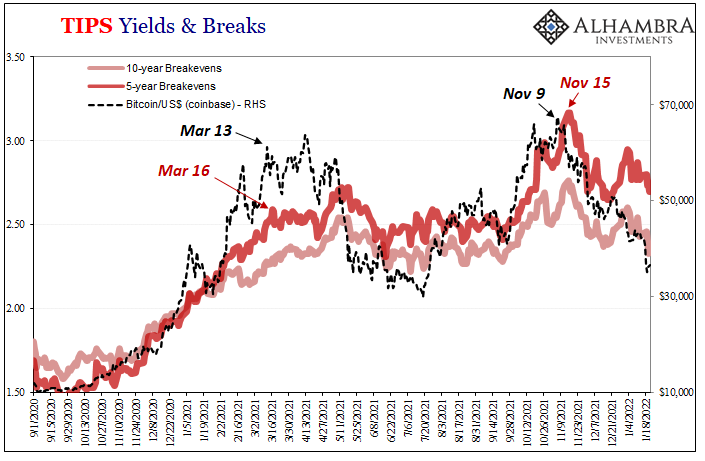
The bitcoin price has recovered today, back up to US$38,293 and a further +3.4% rise. Volatility over the past 24 hours has been moderate at +/- 2.8%.
The easiest place to stay up with event risk today is by following our Economic Calendar here ».
We welcome your comments below. If you are not already registered, please register to comment
Remember we welcome robust, respectful and insightful debate. We don't welcome abusive or defamatory comments and will de-register those repeatedly making such comments. Our current comment policy is here.