
By Alison Brook*
Inflation in many developed countries has risen to levels not seen in several decades. With it has come calls for central banks to aggressively tighten monetary policy. In New Zealand, the Reserve Bank hiked interest rates in both October and November – with predictions of up to seven further rises over the course of 2022. However, if the past is any guide, rapidly rising interest rates are a blunt instrument to cool an overheated economy.
The latest OECD survey of New Zealand confirmed the economy is showing signs of overheating due to government support measures to counteract the effect of the pandemic. While the government stimulus enabled the country to quickly recover to pre-COVID levels, it also had the effect of driving up household debt to 169% of disposable income and house prices to unsustainable levels. The OECD warned that if the government did not move to open borders and rein in spending, interest rates may have to be raised to levels that risked sending the country into a hard economic landing.
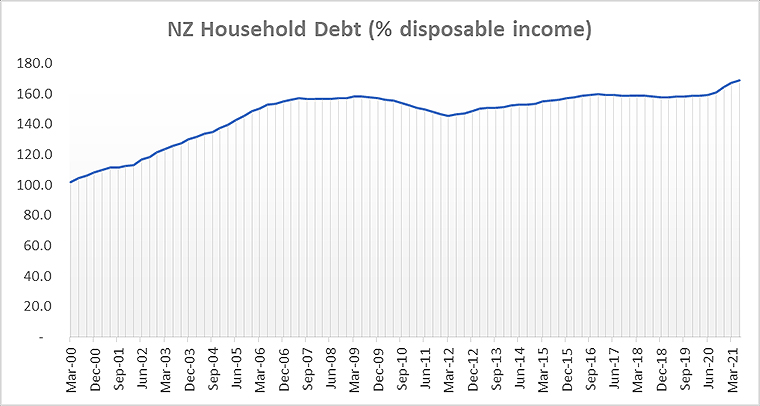
Data source: Reserve Bank of New Zealand
A different kind of inflation
While there are calls to raise rates quickly to quell inflation, a new report from BlackRock Investment warns that this may be misdiagnosing the underlying cause of inflation. Unlike the 1980s, the post-pandemic inflation surge is not being triggered by increases in demand but rather by severe supply constraints which have increased the cost of production.
Inflation only started to take off for some advanced economies when they opened after pandemic lockdowns. Not only was it difficult to get the global supply chain engine started up again, but supply capacity (people and capital) was also in the wrong place at the wrong time. BlackRock argues that when demand drives inflation, increasing rates can stabilise inflation and growth. However, where inflation is caused by supply constraints a very different approach is needed. If central banks move too quickly to dampen inflation, they risk killing off fledgling demand.
The New York Fed has also acknowledged domestic monetary policy may have a “limited effect” on supply-side global inflation.
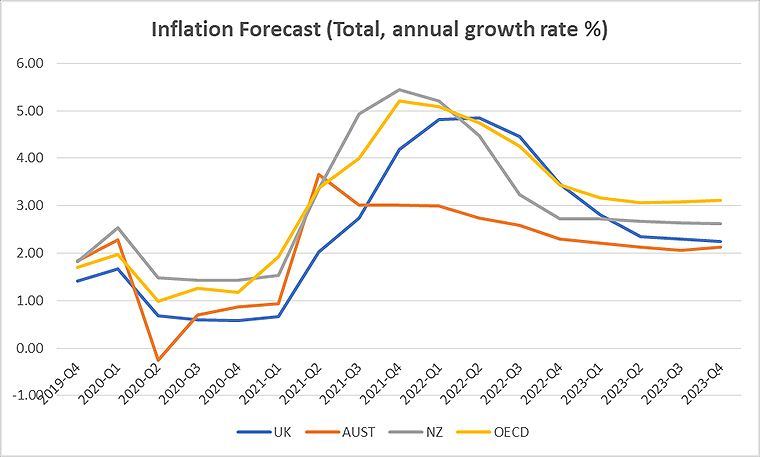
Source: OECD Economic Outlook: Statistics and Projections
Consumption shift from services to goods
In addition to supply constraints, during the pandemic lockdowns, consumers dramatically shifted their spending away from services to goods. Where households had previously spent their discretionary savings on eating out and travel, they redirected their spending onto things like renovations and buying digital equipment for working from home. This massive shift in purchasing behaviour, coupled with border closures, led to shortages, and ultimately inflationary pressure.
The Bank of International Settlements also points to two further factors that are exacerbating the supply bottlenecks. First, the fact that manufactured goods tend to be more dependent on the smooth operation of supply chains, and secondly the “bullwhip effect” of participants along the supply chain hoarding components due to fears of future shortages.
Long term disinflationary forces
Alex Joiner, chief economist at IFM investors argues that the impact of supply-side factors has been underestimated long before the pandemic. In the decades leading up to the pandemic central banks attempted to combat disinflationary supply-side factors like globalization, technology, and demographics by aggressively lowering interest rates. While it has had a massive effect on asset price inflation it has been less effective in sustainably stimulating demand. Joiner writes it “reinforces that monetary policy has been over-relied upon for far too long, to manage too much in the economy with too few tools.”
Whatever the final course central banks take over the next year BlackRock warns that ongoing supply uncertainties mean we should expect further volatility ahead.
It is still unclear for the New Zealand economy where the balance of inflationary forces lies. However, slamming on the brakes could do real damage for many economies and households dependent on cheap liquidity and still reeling from the lingering effects of the pandemic.
*Alison Brook is from the Knowledge Exchange Hub at the Massey University campus at Albany, Auckland. She is on the GDPLive team. This article is a post from the GDPLive blog, and is here with permission. The New Zealand GDPLive resource can also be accessed here.
We welcome your comments below. If you are not already registered, please register to comment
Remember we welcome robust, respectful and insightful debate. We don't welcome abusive or defamatory comments and will de-register those repeatedly making such comments. Our current comment policy is here.