
Here's our summary of key economic events over the weekend that affect New Zealand, with news global inflation pressures seem to be easing off sharply.
First, the benchmark for world food commodity prices dropped sharply in July, with major cereal and vegetable oil prices recording double-digit percentage falls. But meat prices held, and the dairy price fall was modest in the circumstances, both still very close to their all-time record highs. But the retreats for cereals are impressive and will certainly ease global inflation pressure. The overall index fell -8.6% in July from June even if it is still +13% higher than a year ago. Along with the sharp falls in crude oil prices recently, perhaps Team Transitory will have its day yet.
Chinese exports rose +18% in July from year-ago levels, a bit better than expected but very similar to the June result. Imports rose only +2.3% and less than expected suggesting their domestic demand is soft, especially as they fell from June. If it wasn't for the US economy firing on all cylinders and drawing in imports from all over, China's trade result wouldn't have held up. In fact, the surplus they reported was a record high.
They had a trade surplus of +US$41.5 bln in July with the US, a deficit of -US$6.9 bln with Australia, and a deficit of -US$0.4 bln with New Zealand, according to their Customs data. All these three data items are 'larger'; that is, a bigger surplus with the US, bigger deficits with Australia and New Zealand.
In China, all eyes are on signs their moribund property markets are recovering. Cement production remains unusually low, but there are signs high stocks are falling, drawn down as some projects get back underway. But there is no sign that iron ore prices are rising from a demand rise. And at the same time, there is no sign China has yet succeeded in driving down the iron ore price as part of it new bulk-buying program.
The Japanese have reported something of a surprise with household spending rising quite sharply in June to be +3.5% higher than a year ago, up +1.5% from May alone. No analyst saw that jump coming. These are 'real' gains, after adjusting for inflation. True it is only one month and that doesn't make it a trend. But quite a string of Japanese data has been positive recently, so this household data may have legs and underpin the inflation rise the Bank of Japan has been seeking for decades. Separately, they reported better than expected incomes growth as well.
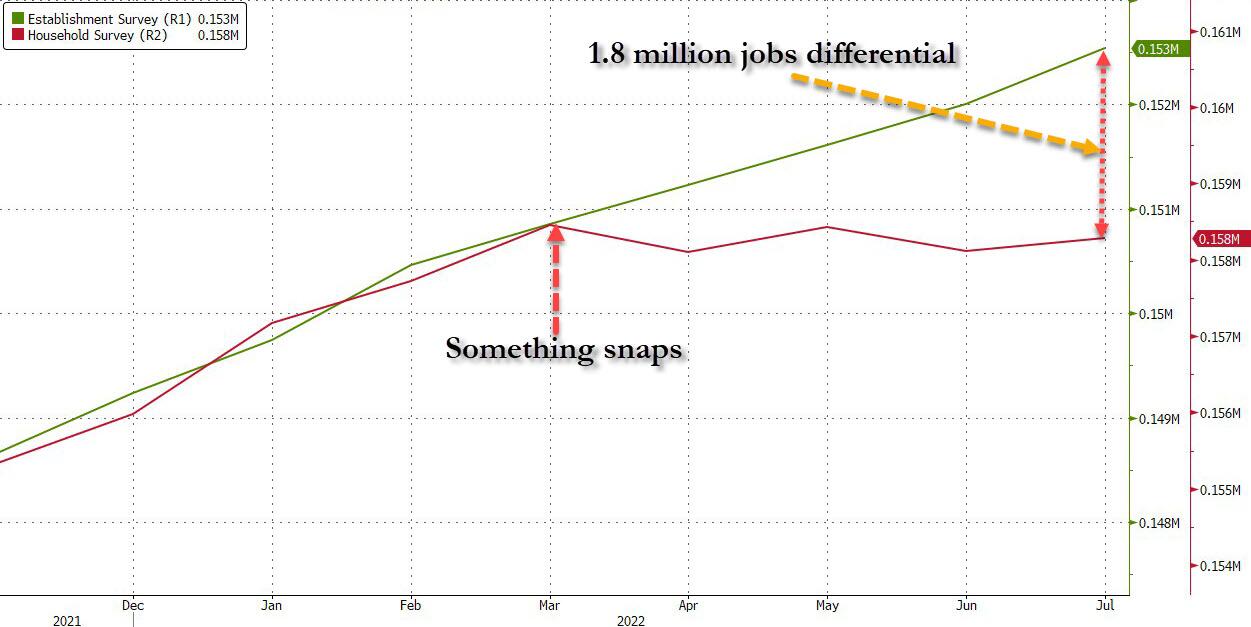
Over the weekend in the US, their non-farm payrolls report for July has heaped pressure on the Fed with a much larger than expected rise. Their labour market remains hot with employers adding +528,000 jobs in the month, double what analysts had expected. This is not data that suggests the US is in recession. July is normally a month when overall payrolls shrink as firms go into their summer shutdown mode. But this year that hasn't happened with the employed labour force now over 152 mln workers, and a hugely impressive +5.8 mln gain from a year ago (or if you like seasonally adjusted data, +6.1 mln more). Apart from the 2021 recovery from 2020 there has never been a July quite like this one. The rise in the number of women being hired is impressing analysts too.
The US jobless rate fell to 3.5% matching the pre-pandemic level, and their best since 1969. Their participation rate didn't change much however.
Meanwhile, American consumer debt rose much more than expected, in fact up +US$40 bln in June from May, that was almost double the +US$25 bln expected, and the May rise was revised up. The June rise was the second biggest jump ever.
The Canadians also released jobs data for July and that wasn't anywhere near as impressive; in fact they reported the summer decline that didn't happen in the US. They lost -31,000 jobs in July on top of the -43,000 they lost in June. (A +20,000 gain was expected.) The July losses were split between full-time and part-time jobs, but in the context of their overall 20.6 mln labour force, it didn't change their jobless rate at 4.9%.
Singaporean retail sales fell in June from May, and that undermined their good year-on-year gains. Apart from fuel sales which were boosted by inflation, the falls were widespread and somewhat unusual for them. If the Chinese posturing on Taiwan is extended, that probably won't help economies like Singapore.
In India, their central bank reviewed their policy rate on Friday. It was 4.9% and markets had expected a +35 bps rise to 5.25%. But the RBI pushed through a full +50 bps hike to 5.4%. It's a sharper than expected rise because they too have inflation concerns, and they need to shield their exchange rate which has come under pressure since war broke out in Europe.
Turkey has reported an 80% annual inflation rate for July (well, 79.6% to be exact). Nothing the Turkish president seem to actually work for him. Now he is talking with the Russians on a new economic pact. We will see how that works out. Its the weak and the weak, and a sign of desperation.
The UST 10yr yield starts today at 2.83%, jerked higher by +16 bps on the US jobs data. The UST 2-10 rate curve is more inverted today, now at -40 bps but their 1-5 curve is less negative at -31 bps. Their 30 day-10yr curve is now at +66 bps and much steeper than this time Friday. The Australian ten year bond is unchanged at 3.26%. The China Govt ten year bond is little-changed at 2.75% and still near its low for the year. And the New Zealand Govt ten year will start today down at 3.33%. A week ago it was at 3.72% so a rather large -39 bps cumulative retreat since then.
Warren Buffett’s company reported a -US$44 bln loss in the second quarter as the paper value of its investments plummeted, but Berkshire Hathaway’s many operating companies performed well suggesting the overall economy they operate in is weathering the pressure from inflation and rising interest rates. The stock prices of three of Berkshire’s biggest investments - Apple, American Express and Bank of America - all fell significantly during the second quarter. But those stocks have all rebounded since the start of July, meaning Berkshire’s portfolio is already worth more than it was at the end of June. And Berkshire’s Q2 earnings were up a remarkable +39% from year-ago levels to $9.3 bln.
The price of gold will open today at US$1776/oz which is up +US$2 /oz from this time Saturday. A week ago it was US$1765/oz, so a +US$11 gain since then.
And oil prices start down a mere -50 USc from Saturday at just on US$88/bbl in the US, while the international Brent price is now just on US$94/bbl. A week ago these prices were US$98 and US$104/bbl respectively, so basically a drop on -US$10/bbl in that time. That is a drop of -22% from early June, and basically back to prices in effect before the Russian invasion of Ukraine.
The Kiwi dollar will open today at 62.4 USc which is -½c lower than this time last week. Against the Australian dollar we are marginally firmer at 90.4 AUc. Against the euro we are firmer too at 61.4 euro cents. That all means our TWI-5 starts today at just on 71. It has been in a very tight range at about this level for three weeks now.
The bitcoin price has moved marginally higher from this time Saturday, up +1.8% to US$23,251. Volatility over the past 24 hours has been low at just over +/-0.9%.

The easiest place to stay up with event risk today is by following our Economic Calendar here ».
We welcome your comments below. If you are not already registered, please register to comment
Remember we welcome robust, respectful and insightful debate. We don't welcome abusive or defamatory comments and will de-register those repeatedly making such comments. Our current comment policy is here.