

A new report commissioned by business lobby group Business New Zealand slams NZ’s restrictions on Foreign Direct Investment (FDI).
The report, by the New Zealand Institute of Economic Research (NZIER), finds the restrictions, along with high corporate taxes and insufficient research and development, are obstacles to investment here.
It also says the most efficient companies get less support in NZ than they should.
The report aims to look at the impact of investment conditions on the NZ economy as a whole. On the question of overseas investment, the NZIER is blunt.
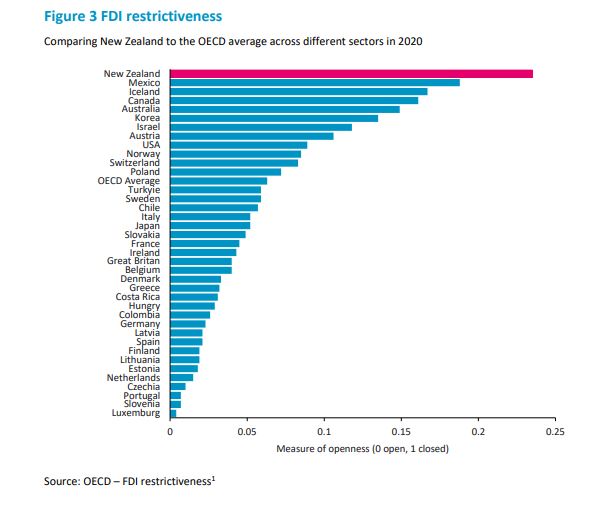
“New Zealand has the most restrictive FDI policy in the OECD,” the NZIER study says.
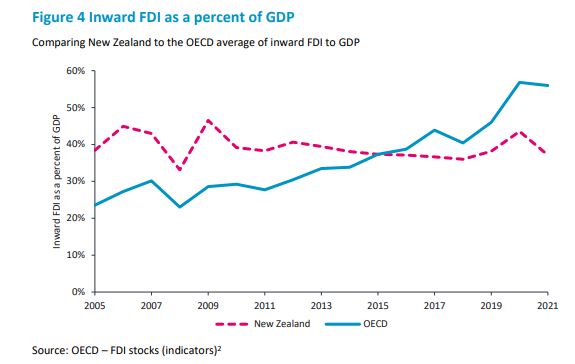
“New Zealand’s inward FDI as a percent of GDP has remained relatively constant (since 2005) whereas the OECD average has been increasing.”
The NZIER report quotes OECD studies that show FDI in NZ is generally lower than other counties anyway, and this shortfall is a barrier to both trade and the diffusion of technology and knowledge.
It says the benefits of investment need to be promoted and require “alignment with government objectives with clear policy tools and measures to achieve this.”
The NZIER document also has strong words to say about NZ’s corporate tax rates.
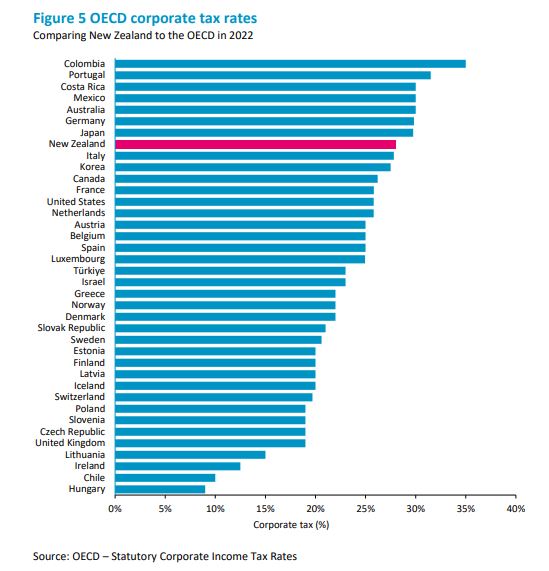
Not only are they higher than in most comparable countries, but they are out of kilter with income tax, and this has contributed to more investment in property and housing.
“The most recent OECD survey of New Zealand recommended reducing corporate taxes as a percentage of GDP from 5.1% to the OECD average of 3.1%,” the NZIER says.
“The joint aims of this tax cut would be to increase business investment and enhance the attractiveness of New Zealand for international investment.”
Offset lower corporate tax with a CGT
The report added the fiscal impact of lower corporate taxes could be offset by a capital gains tax. (Business NZ CEO Kirk Hope was one of three members of the Tax Working Group in 2019 with a minority view against implementing a comprehensive capital gains tax system).
The report has several good things to say about NZ alongside its criticism, saying this country is largely corruption free.
In addition, measures of human capital such as education and training are largely in line with the OECD average. However NZ workers earn less than the OECD average and work slightly longer hours.
In addition, NZ’s geographical isolation puts a burden on infrastructure and this problem is exacerbated by thin capital markets.
The report has a lot to say about so-called “frontier firms”. These are companies with the highest level of productivity in a country. They don't just help overcome NZ’s geographical isolation, but also provide an example to help small firms to catch up.
In NZ, frontier firms make up 8% of the time worked on business activities, but provide 29% of the value-added output. Yet they still lag well behind their overseas counterparts, with productivity levels half those of frontier firms in five Northern European countries.
The NZIER report brings this problem back to a lack of investment.
“International literature has suggested that limited access to capital can hinder firms' ability to invest in research and development, upgrade technology, and expand their operations,” the study says.
And it goes on to say that attracting more high quality FDI would help to fix this.
The report notes NZ has strong and reliable public institutions and robust competition policies. But it also says NZ has many problems as well and bringing investment levels closer to developed world norms would help fix many of them.
We welcome your comments below. If you are not already registered, please register to comment
Remember we welcome robust, respectful and insightful debate. We don't welcome abusive or defamatory comments and will de-register those repeatedly making such comments. Our current comment policy is here.