sign up log in
Want to go ad-free? Find out how, here.

Cheap Chinese EVs could soon shake up NZ’s used car market. Kenny Ching asks if we are ready

Business / opinion
Cheap Chinese EVs could soon shake up NZ’s used car market. Kenny Ching asks if we are ready
ev
Getty Images.

By Kenny Ching*

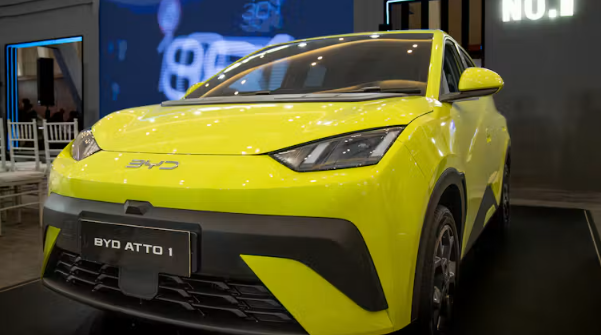
BYD’s electric Atto 1 looks much like any other modern city car. It has a five-star safety rating, a touchscreen-equipped interior and, by most accounts, is surprisingly refined to drive.

Little about it screams “cheap car” – except its roughly NZ$30,000 price tag.

That puts Chinese electric vehicles into interesting territory. They are no longer competing only with new Toyotas, Teslas and other EVs, but with the used petrol cars that still make up most vehicles on New Zealand’s roads.

To date, much of the conversation about widespread EV adoption has centred on emissions, charging infrastructure and incentives for motorists to make the switch.

But cheaper new EVs could have consequences well beyond EV uptake: they could push down the value of New Zealand’s petrol-powered fleet and disrupt the businesses built around it.

Our recent research into technological change helps explain why. As new technologies take hold, they can change which assets, skills and businesses remain valuable – potentially weakening those built around the technologies they replace.

How cheap EVs could change the price ladder

Falling EV prices have attracted attention before.

Tesla’s price cuts in 2021, combined with the since-scrapped Clean Car Discount, pushed an entry-level Model 3 below $60,000. Further cuts in 2023 briefly brought its post-rebate price towards $55,000.

Chinese manufacturers are now taking that price competition much further down the market.

That’s important because new and used cars are not separate markets, but inter-connected ones. If a three-year-old petrol car costs $27,000 while a comparable new car costs $40,000, buying used may make sense.

But if a credible new EV costs as little as $30,000, that calculation changes.

The used car has not suddenly become worse, but its price comes under pressure, potentially affecting older cars below it. A cheap new car can therefore compress the used-car price ladder.

For decades, New Zealand has effectively been importing Japan’s depreciation. Japanese consumers buy cars new and absorb their early loss in value. New Zealand then imports them years later at prices local households can afford.

In 2023, used imports made up 42% of New Zealand’s existing light-vehicle fleet. In 2025, almost 97% of used passenger-car imports came from Japan.

If China can produce capable new vehicles for only a modest premium over older Japanese imports, New Zealanders may become less reliant on another country’s depreciation for affordable cars.

That would represent a structural change in our vehicle market, rather than simply another shift in market share between brands.

Ripple effects for the automotive industry

Research shows new technologies don’t just replace old products, but also change the businesses and skills that surround them.

The internal-combustion car supports an enormous ecosystem: petrol stations, mechanics, lubricant suppliers, engine and transmission repairers, parts distributors, dealers and wreckers.

EVs require a different mix of services and skills around charging, batteries, power electronics and software.

According to MITO’s 2025 automotive industry report, New Zealand’s wider automotive sector employs more than 68,000 people across about 15,000 businesses and contributes roughly $8 billion to GDP. Automotive repair and maintenance alone employs about 23,400 people.

EVs will not make those jobs disappear. They still need tyres, suspension, collision repairs and electronic servicing.

But they do not require oil changes, exhaust systems, spark plugs or many traditional engine and transmission repairs. As the fleet changes, so will the work required to keep it moving.

Falling petrol-car values could reinforce that shift. If cheaper new cars put downward pressure on an older vehicle’s value, expensive repairs become harder to justify.

That could accelerate the retirement of some vehicles, further affecting demand for parts, fuel and servicing.

Why the electric transition is an economic one

For consumers, much of this could be good news. Cheaper vehicles and lower running costs represent genuine economic gains.

But the gains and costs do not necessarily occur in the same places.

New Zealand manufactures essentially no mass-market passenger cars. Much of the value from producing the new technology therefore accrues overseas, while many of the businesses that could be affected – dealerships, repair shops, parts suppliers and fuel retailers – are local.

China already supplied 73% of New Zealand’s fully electric vehicle imports in the year to June 2026.

This is where policy discussion needs to broaden. The shift to EVs is an economic transition as well as an environmental one, with research increasingly examining how technological change can redistribute jobs, skills and economic value even when society as a whole benefits.

For New Zealand, that means watching more than EV registrations. Used-car values, scrappage, repair businesses and automotive employment could show how the transition is affecting the wider economy. Training will also need to evolve towards electrical, electronic and software skills.

None of this means New Zealand faces an imminent collapse of its automotive industry. The fleet turns over slowly and petrol cars will remain on our roads for decades.

But as cheaper EVs change what we buy and drive, the businesses and skills supporting our vehicle fleet will need to change with them.The Conversation


*Kenny Ching, Senior Lecturer, Business School, University of Auckland, Waipapa Taumata Rau.

This article is republished from The Conversation under a Creative Commons license. Read the original article.

We welcome your comments below. If you are not already registered, please register to comment

Remember we welcome robust, respectful and insightful debate. We don't welcome abusive or defamatory comments and will de-register those repeatedly making such comments. Our current comment policy is here.

12 Comments

When I was car shopping last year I got a front-row seat to the power of incentives with how different salespeople and mechanics tried to twist themselves into a donut when talking about EVs. Funniest one was the Nissan dude who tried to appeal to my masculinity and anti-woke sentiment. 

This is a good article. What it hasn't talked about is:

a) Battery SOF life is waaaaaaaay beyond what it was when people used to laugh at the early Nissan Leafs. 

b) So what about a wave of even cheaper second hand Chinese EV imports?

Up
2

Does China have the Jpanese system of disincentivising the ownership cars older than 3 years? 

Up
2

I don't think so. Good point.

Up
1

Steering wheel is on the wrong side isn't it?

Up
4

Cars are becoming disposable items. They now contain so much tech that they will no longer be worth repairing when things break. Parts also become more expensive as it’s no longer a case of replacing a bulb if your indicator light stops working, it’s the whole unit. How recyclable are they with the amount of plastic in them. 

Up
0

This is my concern with Chinese EV's specifically. Toyota Hybrids you can remove the battery pack, remove and test each cell and replace any ones underperforming for currently ~$30 per cell. That;s pretty cheap in my books. I've recently seen a few youtube tidbits around Chinese EV manufacturers having the entire battery pack as a solid unit so individual cells cannot be replace, requiring the owner to purchase a brand new pack in its entirety. This is done by design to save costs for the manufacturer and also guarantee future income for repairs for their vehicles.
 

Not sure specifically which manufacturers have this practice, but on principle I'd pay a bit extra to have a vehicle that is repairable at not too much of a cost down the lifetime of it, thus allowing me to keep it for longer.

Up
2

A more relevant question is whether Chinese EVs will last as long as used Japanese vehicles? They may require scrapping.

Up
1

"surprisingly refined to drive."  Has he driven it? Tried to use the AC on a hot day?

This article is full of false dichotomies.   The choice is not between a new atto1 for 30K or a 3 year old petrol family wagon for $27K.  If im in the market for a tiny car then other option i'm looking at is the 3 year old suzuki swift for $10K

Up
3

From a car guy's point of view, EVs are still not terribly good at being cars suitable for NZ. 

Some, like Kia's EV3, are getting closer, and might be a good choice if you didn't live on NZ's roads or don't venture too far from home.

I'm car shopping at the moment and cars are mostly pretty tedious, or even horrible, to drive unless you spend a lot.

EVs are not terribly practical for here - many are too low slung for our large number of metalled roads, which is why so many RAV4s and Subaru Outbacks get sold, and are over-packed with complex and annoying technology that tries to hide the fundamentally under-cooked basic engineering. There is hope with EVs like Slate - but the likelihood of getting something this sensible here is remote. We don't even import something as rational as Dacias.

We drive so much becasue our public transport, particularly outside the cities, is poor. If I'm driving to the far end of the island with 100Kg of tools, I don't want to spend hours at chargers and people look at you sideways if you try and check in a drop saw on public transport. We also tow more than most other nations becasue delivery here costs a lot: I live on a hill where I can see my local mitre10, less then 2kM away, but the minimum delivery fee is north of $80.

Our charging network is sparse, meaning you end up in some odd, out of the way places while you wait. Bring a book, sandwiches and coffee.

Up
1

Have you lived with an EV, Golem, day in and day out?

I have, four years and counting, coming up on 120k kms shortly.

Just dropped half a tonne of steel to the metal recyclers this morning, which was carried in the trailer towed by my EV sedan.

We have travelled the length and breadth of the country in ours more than once; I need to pee and eat and drink more often than the car needs to be charged, so waiting while charging is something I haven't particularly experienced.  I do mostly (>95%) charge at home: leaving home with a full 'tank' every day is great.

I have had two financial 'ahah! freedom' moments in my life: paying off my mortgage was one, switching to all EVs was the other.  For us, it's been transformational.

Up
2

I think our motivations and needs are very different :-). 

I've looked at a few, but they don't meet my needs, living in Otago. What I'm trying to work out is how to replace a 4WD Hiace van that got written off by a kid who drove through a stop sign and T-boned me. 

My long distance stuff - like the 800 kM drive to the ferry or Nelson, or the 500kM day return to Wanaka - are done in a modern warm hatchback that's too low slung to be happy on shingle. I also tend to take the scenic routes where chargers are few. 

I'd like to replace both with one, and plan to use hire services for a ute or van for heavy local stuff. The van was very good at coping with full sheets of building materials and I often used it as a sleeper van when visiting friends in some remotish places. 

I need something with the ground clearance to cope with things like the Dansey's or Hakataramea roads, and some light fording on roads that are a bit notional. 

Most EVs have too little ground clearance because they have pursued underbody laminar flow aerodynamics at the expense of that kind of practicality. I'm kind of hoping Slate come here eventually, but given we don't import anything as rational and simple as Dacia, I'm not holding my breath. 

I'd also like to be able to stick a rooftop tent on top for when I get really remote. Or I'm out the back of Wanaka helping friends build a house. 

I've driven a few EVs and PHEVs and they were uniformly uninvolving or lumbering to drive, far too complex and plagued with poorly calibrated gadgets. 

Things like a Tesla or a VW id or BMW iX series or a Kia EV6 are plush and phenomenally quick, but they're not involving drives or utilitarian - and many of them are extremely spendy without actually being that well made. 

The most fun, quirky EV I've driven was the Kia PV5 van - but it's got only 140mm of ground clearance. As an aside, the thing that made me grin the most over the last few years was a Citroen C4 Cactus - but the seating position killed my back. 

As far as I can tell, any EV I've seen would meet - maybe - 70% of my wants and needs, and the other 30% is all the fun bits. 

Up
0

Toyota is currently the most popular car brand in the US by both new-vehicle sales and positive public opinion.

And Toyota’s hybrids are very popular, especially the Camry and RAV4. Its fully electric vehicles have a smaller following, although the bZ has become a meaningful competitor in the electric-SUV market. Toyota accounts for approximately 44% of US hybrid registrations.

https://finance.yahoo.com/energy/articles/over-60-toyotas-sold-q3-17380…

Up
0