

BNZ has posted a 7.8% drop in half-year profit due to accounting movements in its offshore debt holdings, and as its net interest margin fell 12 basis points.
The bank's net profit after tax for the six months to March 31 fell $35 million, or 7.8%, to $416 million from $451 million in the six months to March 31 last year. A key factor in the lower profit was $95 million of losses from fair value movements and hedging. (see more on this at the foot of this article*).
Net interest income rose $25 million, or 3.1%, to $823 million, other operating income was up $1 million, or 0.4%, to $280 million, meaning net operating income rose $26 million, or 2.4%, to $1.103 billion.
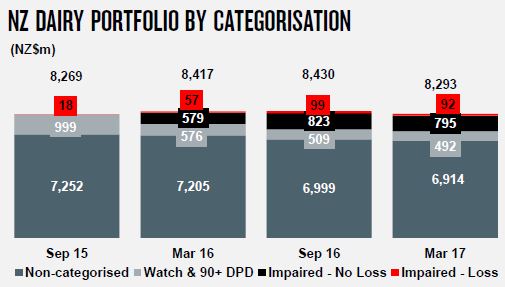
Operating expenses increased $3 million, or 0.7%, to $433 million. Charges for bad and doubtful debts dropped $44 million, or 52.4%, to $40 million helped by an improved outlook for the dairy farming sector.
In the six months from September 30 to March 31, customer deposits rose $2.5 billion, or 5%, to $53 billion. Over the same time period gross loans grew $2.1 billion, or 2.8%, to $76.2 billion.
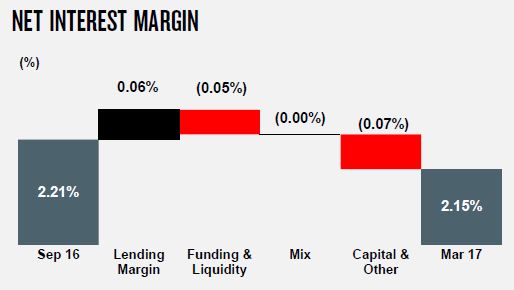
Year-on-year, BNZ's net interest margin dropped 12 basis points to 2.15%, and was down six basis points half-on-half.
CEO predicts increased pressure on lending margins will 'influence lending rates'
BNZ CEO Anthony Healy said the strength of the NZ economy is providing both benefits and challenges, reflected in sound credit quality and lower bad and doubtful debts, but with increasing margin compression as lending growth continues to exceed deposit growth across the banking system.
"We anticipate there will be increased pressure on lending margins in the coming months which will influence interest rates. Essentially, while funding costs have fallen they haven’t fallen by as much as our lending rates, which means our margins have reduced. Today there are more people looking to borrow, so banks are paying more to win customers deposits so this will lead to higher lending costs being passed through to borrowers," Healy said.
Healy elaborated on these comments in an interview with interest.co.nz.
"When you've got a country that spends more than it earns, so we run a current account deficit, it has to be funded primarily through the banking system. And as credit growth has remained strong but deposit growth has almost halved in the last six months, that puts more pressure on the deposit market. Banks are obviously competing for their share of a smaller pie of deposits. So that pushes up the cost of deposits and that then filters its way through the cost of funds, and therefore over time to lending rates," Healy said.
"Over the past six to 12 months banks' margins have been compressed quite a bit because of that. So I would expect over time, you will see lending rates increase because the cost of funds is increasing."
7k Android Pay users
Meanwhile, BNZ says that since it launched Android Pay on December 1 last year, it has registered 7,000 customers and processed 49,000 Android Pay transactions.
Parent National Australia Bank (NAB) increased interim cash earnings by 2.3% to A$3.29 billion. NAB's fully franked interim dividend was unchanged at A99 cents per share, and its return on equity fell 30 basis points to 14%.
| BNZ performance measures | March 2017 | September 2016 | March 2016 |
| Cash earnings on average assets | 1.16% | 1.20% | 1.14% |
| Net interest margin | 2.15% | 2.21% | 2.27% |
| Cost to income ratio | 39.3% | 39.6% | 39.9% |
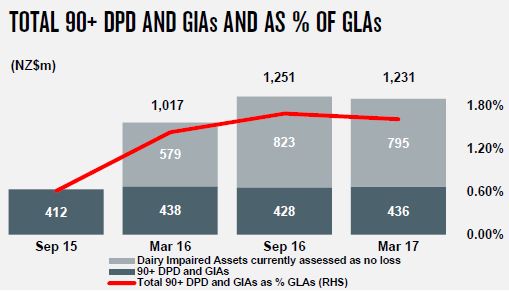
*The chart above shows 90+ days past due and gross impaired assets as a percentage of gross loans and advances.
*Unrealised fair value gains or losses on economic hedges that do not qualify for hedge accounting and hedge ineffectiveness causes volatility in statutory profit, BNZ says, which is excluded from cash earnings as it is income neutral over the full term of transactions. This arises from fair value movements relating to trading derivatives for risk management purposes; fair value movements relating to assets, liabilities and derivatives designated in hedge relationships, and fair value movements relating to assets and liabilities designated at fair value. BNZ's half-year cash earnings, which is not a statutory financial measure, is not presented in accordance with NZ Generally Accepted Accounting Principles, nor audited, rose $40 million, or 9%, to $484 million.
BNZ's press release is here and here's parent NAB's press release.
We welcome your comments below. If you are not already registered, please register to comment
Remember we welcome robust, respectful and insightful debate. We don't welcome abusive or defamatory comments and will de-register those repeatedly making such comments. Our current comment policy is here.