
Parliamentary Commissioner for the Environment Jan Wright has sent a clear message to politicians at the top of government with her final report: Leadership is needed on climate change.
New Zealand’s climate change targets should be enshrined in law, giving the message that it is an inter-generational issue that needs to be tackled with cross-party support, Wright says.
New legislation, similar to the UK’s Climate Change Act, should require the setting of carbon budgets that would act as stepping stones towards New Zealand’s various targets signed under agreements like Paris, Wright says. Denmark, Finland, France, Ireland, Mexico, Norway, Scotland, Sweden, and Switzerland also have similar legislation.
Speaking in Wellington Thursday after launching the final report from her time in the role, Wright said political leadership was needed right from the top of government, citing the influence Margaret Thatcher and then Tony Blair had on the creation of the UK legislation.
Meanwhile, she also flagged an idea for how to partially include agriculture under New Zealand's Emissions Trading Scheme (ETS), by “very easily” bringing nitrogen fertiliser under the scheme. “To bring agriculture as a whole into the ETS would be quite difficult…and perhaps not achieve much; just a lot of noise."
Labour and the Green Party came out in support of the proposal. Federated Farmers said the report had their "qualified support," but said decisions needed to be apolitical. The Feds' climate change spokesperson, Andrew Hoggard, referrenced recent adverse weather events and said more needed to be done to improve resilience to the changing climate.
Dairy NZ said having formal carbon budgets would create certainty for the dairy industry. "We recognise the dairy sector’s responsibility to contribute to reduction targets, but we are currently operating within an environment that provides no clear pathway for dairy to move towards a low emission future," CEO Tim Mackle said.
“The approach recommended by Dr Jan Wright provides a transparent process which would provide greater certainty to dairy. The setting of carbon budgets for five year periods would will allow the dairy sector and farmers to plan over the longer term how they will reduce their emissions. However, this is a complex challenge which requires a well thought out approach," he said.
Legislation needed
Wright says the legislation should also establish a high-powered independent expert group that would crunch the numbers and provide objective advice.
“Climate change is the ultimate intergenerational issue,” Wright said. “It’s a huge challenge. And not just for the current Government, but also for the Governments that succeed them into the future, be they blue, red, green, or any other colour.”
“There is an opportunity here for the next Parliament to build on recent developments and take a historic step forward that will be credited for generations to come,” she says. Wright called for cross-party agreement on the issue.
Wright on Thursday released a report on New Zealand’s progress to meeting its climate goals. Under the Paris Agreement, we’ve promised to reduce carbon emissions to 30% below 2005 levels by 2030.
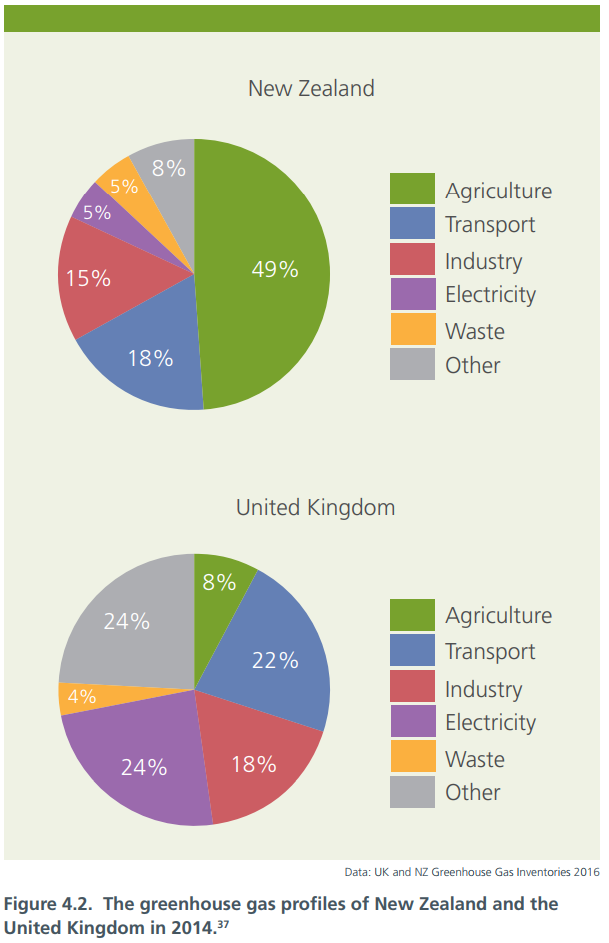
The Paris Agreement gives New Zealand a ‘carbon budget’ from 2021 to 2030 of 594 MtCO2e worth of emissions – just under 60 Mt per year over that period for which 40 Mt a year will be taken up by agriculture emissions. Current projections show we’re set to emit 814Mt over that period. See Alex Tarrant’s article here on problems facing New Zealand’s reductions and offsetting track here, due to a reliance on an international carbon market opening up that New Zealand polluters can tap.
In the report, Wright echoed comments from Climate Change Minister Paula Bennett on Wednesday that there was no guarantee New Zealand would gain access to international carbon credits.
How have we been doing?
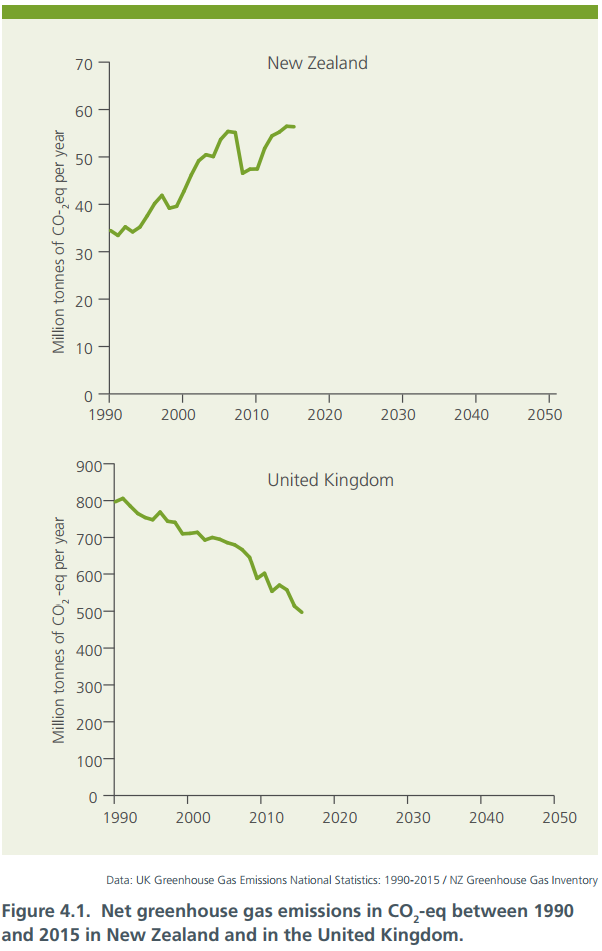
Since 1990, New Zealand's emissions had risen "very significantly," the report says. Considerable variation from year to year was down to reasons such as the Global Financial Crisis, lower cattle and sheep numbers during droughts, tree harvesting cycles, cold winters, and dry years.
Wright noted the graph below appears to indicate that New Zealand would meet its Paris target without reliance on offshore credits if net emissions levelled out.
"But it is not so simple. In the 1990s, there was a spike in new forest planting. These trees, sometimes referred to as the ‘wall of wood’, will be harvested during the 2020s, and much of the carbon dioxide stored in the wood will begin to return to the atmosphere," she said.
"Moreover, there is no direct link between New Zealand climate policy and reaching the Paris target. There are no guarantees that the curve will begin to bend or that there will be access to international carbon credits."
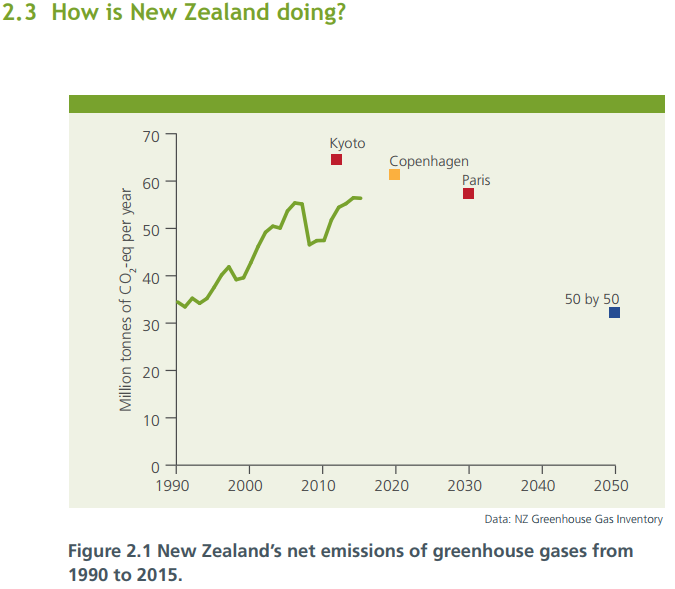
The chart above details various climate change commitments governments have signed up to. Three have been set following United Nations conferences – a 2012 target at Kyoto in 1997, a 2020 target at Copenhagen in 2009, and a 2030 target at Paris in 2015. A fourth target – the ‘50 by 50’ target – was gazetted by the Government in 2011, the report sets out.
Agriculture
Watch Wright talking about how New Zealand could partially bring agriculture under the ETS in the video below. She says nitrogen fertiliser could be an easy way to bring the sector partially under the scheme.
There were also changes ahead for the industry which might mean pastoral agriculture is not as dominant an industry as it is now, Wright said. “I’m speaking to the Red Meat conference next Monday…and you can see in their programme that they’re quite concerned…about the prospect on synthetic protein coming over the horizon, and the effect that will have on New Zealand.”
This could also be the case with synthetic milk, she said. “The same thing that happened to wool with nylon. “We’re not going to be able to feed the world on protein from animals. So this looks like a change that’s going to come. It could happen faster than we think. So I do think our agriculture’s going to face changes, regardless…you can’t look at an economy and say that’s the way it’s always going to be.”
We welcome your comments below. If you are not already registered, please register to comment
Remember we welcome robust, respectful and insightful debate. We don't welcome abusive or defamatory comments and will de-register those repeatedly making such comments. Our current comment policy is here.