

By David Skilling*
This is my last note for 2023. Thanks for reading, I hope that you have found these notes useful. I look forward to continuing the conversation early in the New Year.
If this has been forwarded to you, please do subscribe to receive my weekly insights on global economic & geopolitical dynamics.
The small world note from two weeks ago offered a summary view on the economic and political dynamics that will shape 2024. Mike O’Sullivan and I argued that 2024 would be characterised as a ‘scramble for supremacy’, as economic and political competition intensifies across and within economies. From strategic competition between geopolitical rivals; to growing competition between 'friends'; domestic political competition in a big election year (notably the US); competition between monetary & fiscal policy in a high debt, high rates world; and growing competition between labour and capital.
The 2024 outlook, and my weekly notes, provide a sense of the risks that we have our eye on: from the intersection of high rates and high debt to the potential for escalation in the Middle East and the looming US Presidential elections. It will be another consequential year.
But the global economic and political environment is characterised by deep uncertainty. In a more fluid global economic and geopolitical environment, tail risk events become much more likely: few picked the Russian invasion of Ukraine in 2022 or the scale of the Hamas attacks on Israel in 2023. The changing global environment fattens the tails of the probability distribution function, with outlier events increasingly likely.
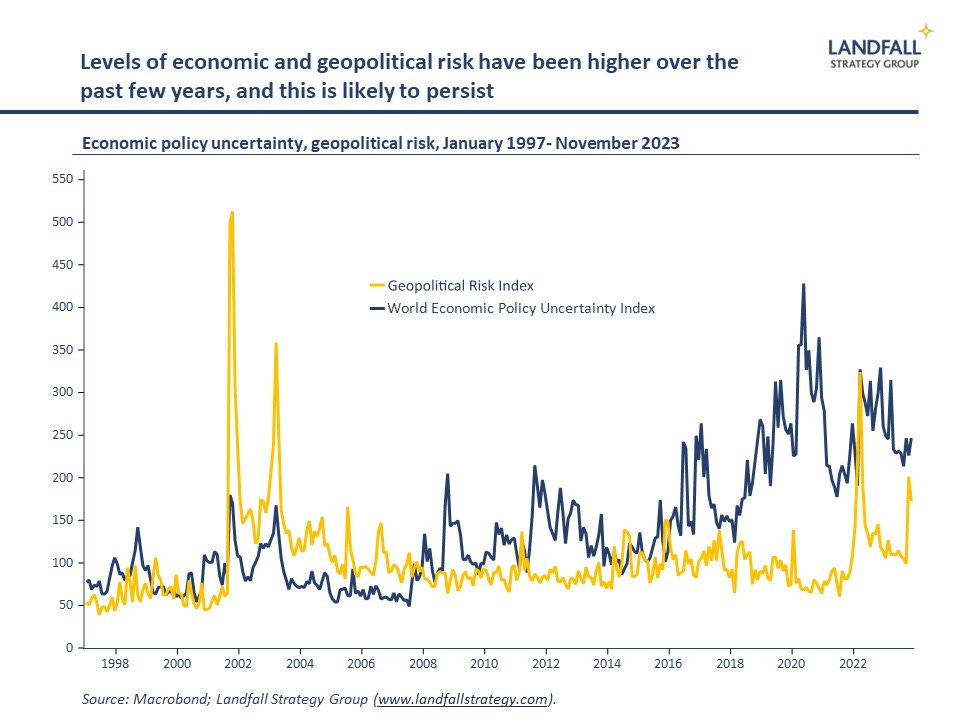
This means that governments, firms, and investors should prepare for the unexpected in the year ahead. Predictions are challenging at the best of times, and these are not the best of times. So our 2024 outlook concludes with some ‘wildcards’. These wildcards are not predictions, but (in our view) plausible events that are worth considering. We also identify several risks that we don’t think merit too much concern.
Wild cards
Autocratic regime change: The regimes in China and Russia look stable enough, but these regimes are opaque and are under significant economic and political stress. And history shows that regime change is often a surprise; 2024 will be the 35th anniversary of the fall of the Berlin Wall. These regimes may look stable, but both Mr Putin and Mr Xi are working hard to keep domestic politics under control. Senior officials are being replaced with remarkable frequency in China – the Foreign and Defence Ministers over the past few months, as well as multiple military officers. Regime change is possible, with implications that would shake the world.
A viable third party US Presidential candidate emerges: The unpopularity of a likely-convicted Mr Trump and an older Mr Biden creates more space than for some time for a third party candidate to emerge. Of course, the barriers to entry are very high in the US system, and the election is less than a year away. But nothing is usual in US politics, and there is a high level of dissatisfaction along with polarisation. This time might be different, and a late surprise candidate is possible – probably through the centre.
Technology breakthroughs: AI has garnered most of the headlines this year since OpenAI released ChatGPT in November 2022, and AI will likely continue to continue to surprise in 2024 as it develops exponentially. Technology surprises in 2024 may come elsewhere: two areas we have our eye on are rapid developments in nuclear fusion (given the amount of private capital flowing) and quantum. Both are a distance away from commercial deployment, but the timelines may be reduced.
Mass climate change event: 2023 is expected to be the warmest year on record. But the world seems to be getting accustomed to record temperatures on a daily basis. The risk is growing of a climate change event that directly kills tens of thousands of people in a G20 country, perhaps reinforced by El Nino. This would reshape the global debate. Although progress is being made in reducing emissions intensity, policy settings are increasingly prioritising economic objectives over the green transition (COP28 made progress, but not enough).
Cyber shock: The coronavirus was a major global shock from 2020, but a cyber virus could also be a first order global shock. There have been recent events, from Russia’s attacks on Ukraine to the massive disruption from DP World in Australia in November. The risk of a cyber-attack on a broader scale, e.g. impacting financial institutions worldwide, should not be discounted.
Things not to worry (too much) about
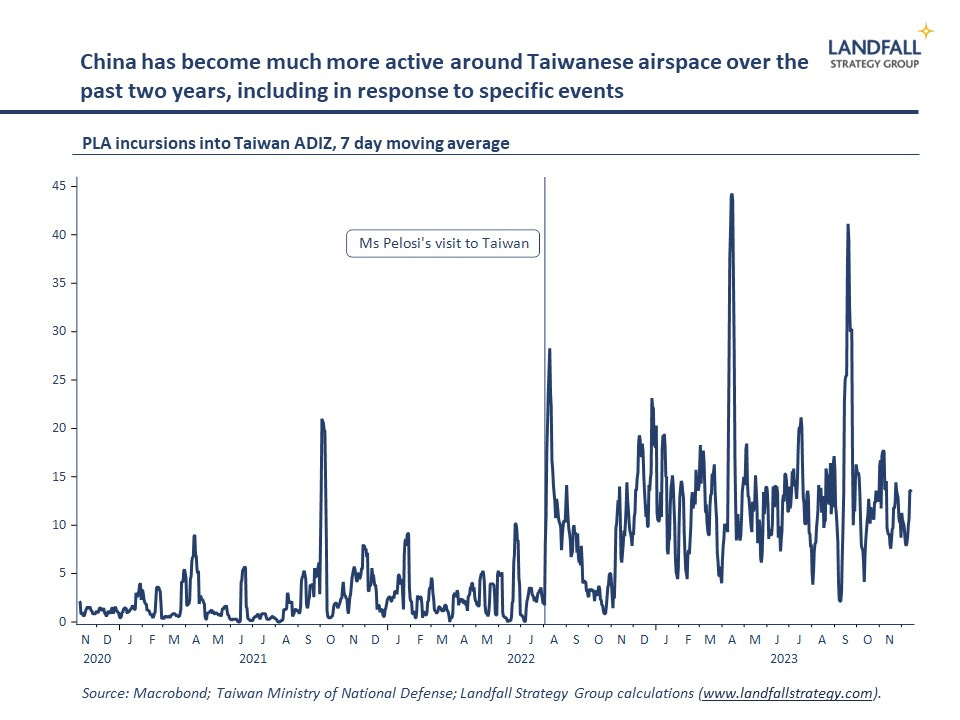
Taiwan invasion. We continue to believe that an invasion of Taiwan is unlikely to occur in 2024 (or for the next few years): it is risky militarily, there would be very substantial costs imposed on China, and there are many alternatives to squeeze Taiwan short of war. And military failure would be fatal to Mr Xi’s leadership. A distracted, stretched US may raise the risks of Chinese adventurism (note recent action in the South China Sea around the Philippines), and Taiwan remains a central issue for Mr Xi and the CCP, but the near-term risk still seems low. However, we expect ongoing provocation by China (fighter jet incursions), particularly around the elections in Taiwan in January.
China economic crisis: China’s economy is slowing structurally, in addition to a range of near-term headwinds: notably, the challenges facing the real estate sector, the high levels of debt across the economy, and negative FDI inflows. However, the Chinese government has a broad range of policy levers that it can deploy to stave off a crisis – and there are pockets of growth in the Chinese economy: note that China has recently become the world’s largest car exporter. Slowing growth is much more likely than an economic or financial crisis. It is Chinese politics more than economics that is the bigger risk.
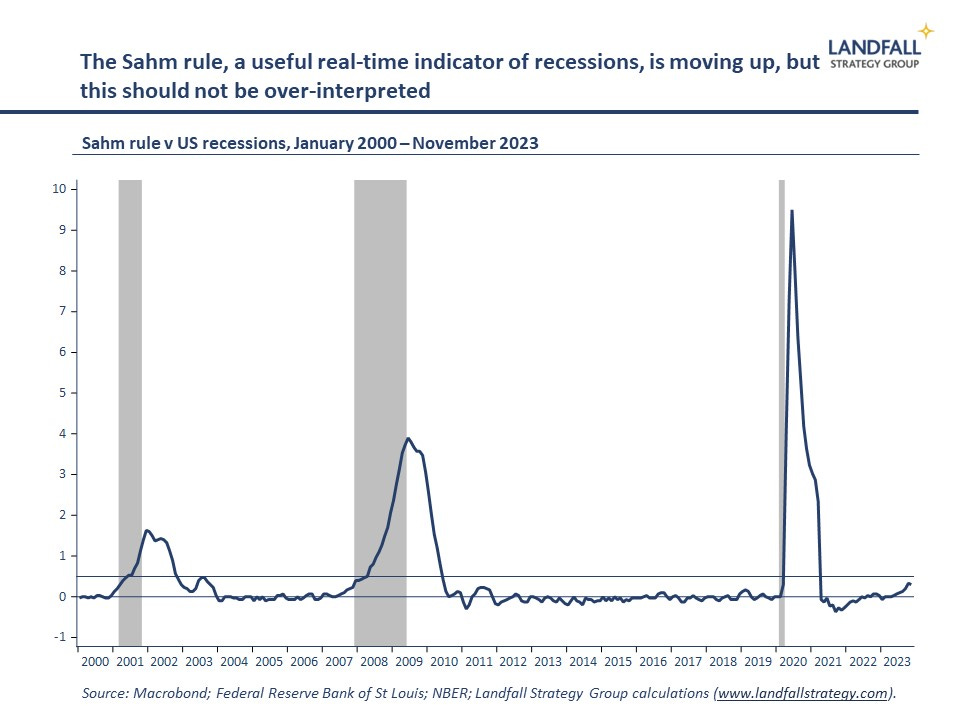
Recession: Calls for a recession in the US have been made consistently over the past year. We continue to think this unlikely, particularly in election year in the US when macro policy is likely to remain accommodating. Even the creator of the Sahm rule is unpersuaded that the indicator is accurately warning of a US recession. A recession in Europe is more likely, but this will not be severe.
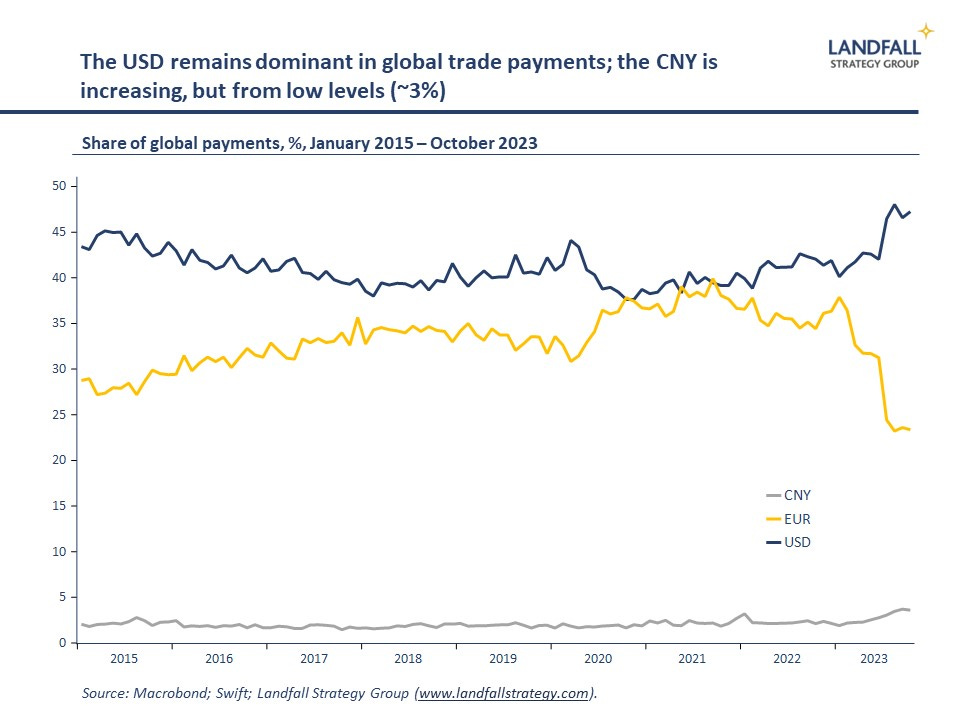
De-dollarisation: Initiatives like BRICS+ and announcements of more transactions being denominated in CNY attract headlines, but a replacement of the USD remains exceedingly unlikely. There will be some diversification, but no currency offers the same advantages that the USD does. Any transition will take decades not years.
VC funding: In the last two years the technology/venture capital industry has suffered as the easy supply of funding has dried up. Venture valuations have been cut down and in segments like fintech, are undergoing a brutal consolidation. However, we think however that the VC sector is bottoming out, and funding is beginning to return. 2024 may be the year when venture funding returns, including into deep-tech.
Implications
So what to do in periods of deep uncertainty, with an increasing frequency and intensity of political and economic shocks? Firms, investors, and governments need to be able to adapt and respond quickly to these shocks. Resilience and agility will be sources of competitive advantage in a more turbulent environment. And although organisations cannot live in a permanent crouch, there is a need to deliberately manage exposures: ‘Only the paranoid survive’ as Andy Grove famously said.
Organisations should invest in building resilience to shocks (e.g. managing leverage) and diversifying risk exposures (markets, supply chains). And scenario planning will become a more important input into capital allocation and strategy development, so that institutions can better understand and position for potential exposures. Brace for another turbulent year.
Thanks for reading small world. This week’s note is free for all to read. If you would like to receive insights on global economic & geopolitical dynamics in your inbox every week, do consider becoming a free or paid subscriber. Group & institutional subscriptions are also available: please contact me to discuss options (more information is available here).
*David Skilling ((@dskilling) is director at economic advisory firm Landfall Strategy Group. The original is here. You can subscribe to receive David Skilling’s notes by email here.
We welcome your comments below. If you are not already registered, please register to comment
Remember we welcome robust, respectful and insightful debate. We don't welcome abusive or defamatory comments and will de-register those repeatedly making such comments. Our current comment policy is here.