

Here's our summary of key economic events overnight that affect New Zealand, with news investors are rediscovering their appetite for equity investments, a signal they see the future positively.
But first we should note that it is another long holiday weekend in the US. Monday in the US (Tuesday NZT) will be President's Day and markets, both bond and equity markets, will be closed.
The next release of a survey on consumer sentiment has it rising and confirming earlier surveys. The University of Michigan version rose slightly to a fresh high since July 2021 even if it was marginally below market forecasts.
US residential building consents slipped in January from December, but were +8.6% higher than a year ago.
But American housing starts slumped almost -15% in January to an annualised rate of 1.331 mln, lower than year-ago levels and the lowest since August and missing market forecasts by a lot. It is the biggest fall since April 2020.
Inflation is clearly not beaten yet even if it is down. US producer prices were up +0.3% in January from December, the biggest month-on-month increase in five months, following a -0.1% decline in December. Analysts expected a rise of +0.1%. Cost of services rose +0.6% m/m, the largest increase since July. But that all means producer prices are only a modest +0.9% higher than a year ago. It is the recent pickup that worries markets.
Petrol prices are a component of both CPI and PPI changes. Today their average nationwide price is US$3.284/gal (NZ$1.42/L, not a miscalculation). That is -4.0% lower than a year ago. But complaining about "high gasoline prices" is still built into their partisan conversations.
On Wall Street, with the December company results three quarters released by now, they show a modest +3.2% lift from a year ago. Against expectations however the story is more positive; 75% of S&P 500 companies have reported a positive EPS 'surprise' and 65% of S&P 500 companies have reported a positive revenue 'surprise'. This reminds us that late 2023 expectations were low - and unnecessarily so it turns out.
Money that shifted out of equities into money market funds is now moving back. Global equity funds racked up significant inflows in the week to February 14 as investor optimism returned for this stock market rally, despite lingering uncertainties over the Federal Reserve's rate cut plans. It is a global thing, including Australia.
In China, financial markets return on Monday after the Chinese New Year break. Authorities will be ready to cover any weaknesses, and investors are likely to take advantage. The 'Beijing put' is going to save many investors. But it might work for Beijing who seem to be engineering a substantial rise in the proportion of SOE control of overall GDP. Private ownership and control of large enterprises is now not seen in the country's best interests by Beijing.
Singapore's exports rose notably in January from December and were up almost +17% from a year ago. Analysts were expecting a more modest +5% rise.
As widely expected, the Russian Central Bank held its policy rate unchanged at 16%, a pause to the +850 bps hiking campaign that started in July 2023. (At the same time as the bank's press conference, which local media played in full, unusually, Alexi Navalny was killed in his Arctic prison. And no mention was made of that.)
International nickel prices are remaining "very low" at levels first reached in 2003. At these levels, miners are giving up, especially as the low-cost source is Indonesia who can survive at these levels. But Australia doesn't want mine shutdowns as it needs a viable local industry to power its green transition. So yesterday Australia classified nickel as a “critical mineral”, opening the way for the crisis-hit industry to access billions of dollars in cheap Federal government loans.
Meanwhile, global electricity production from fossil fuels continued to decline in 2023 (-2.8% year-on-year), largely due to reduced production from coal fired power plants (-8.8% y-o-y). Specifically, the reduction in production from the United States (-8.7% y-o-y), Germany (-26.7% y-o-y), Poland (-18.7% y-o-y), Japan (-7.7% y-o-y) drove the overall trend of this decrease in coal-fired electricity generation. Coal prices are now back to levels first seen in 2011. Conversely, net electricity production from renewable energy remained higher than the same period last year (+6.0% y-o-y), a trend that has been consistent since July 2023, driven by higher production from wind (+5.1% y-o-y) and solar power (+10.9%). Electricity production from nuclear power increased by 6.0% y-o-y, as production in France rebounded from the low levels of 2022.
The UST 10yr yield starts today at 4.30% and up +6 bps from yesterday, up +11 bps from a week ago. The key 2-10 yield curve inversion is a deeper at -37 bps. Their 1-5 curve inversion is shallower at -70 bps. And their 3 mth-10yr curve inversion has moved back to -108 bps. The Australian 10 year bond yield is now at 4.232% and up +4 bps from yesterday. The China 10 year bond rate is unchanged at 2.45% while they are on holiday. The NZ Government 10 year bond rate is up +5 bps at 4.92%. A week ago it was at 4.91% so little net change.
In Wall Street's Friday pre-long-weekend trading session, the S&P500 is little-changed and up a mere +0.2% over the week. Overnight European markets were varied. London took off, up +1.5% on the days to close up +1.8% for the week. Paris rose +0.3% overnight to be up +1.3% for the week. Frankfurt was up +0.4% on the day, up +0.8% for the week. Yesterday Tokyo ended its Friday session up +0.9% to be +4.3% higher over the week, and the star of the show. Hong Kong ended up +2.5% toi be +2.2% higher over the week. Shanghai remains closed. Singapore rose +1.4% yesterday to end its week up +2.4%. The ASX200 closed its Friday trade up +0.7% to enable a weekly +0.2% gain. The NZX50 also rose +0.7% on Friday but ended the week down -1.2%.
The Fear & Greed index is still at the "extreme greed" level where it was a week ago.
The price of gold will start today up +US$9/oz from yesterday at US$2010/oz. But that is -US$13/oz lower from this time last week.
Oil prices are up +50 USc at just on US$78.50/bbl in the US while the international Brent price is up similarly to US$83/bbl. Both prices are up about +US$2 over the last week.
The Kiwi dollar starts today at just on 61.2 USc and up +20 bps from this time yesterday. A week ago it was at 61.4 USc. Against the Aussie we are still at 93.7 AUc. Against the euro we are still at 57.8 euro cents. That all means our TWI-5 starts today at just under 70.6 and little-changed. A week ago it was at 70.9.
The bitcoin price starts today at US$52,006 down -0.4% from this time yesterday. But it is up a net +9.2% from this time last week. Volatility over the past 24 hours has been modest at just on +/- 1.5%.
Daily exchange rates
Select chart tabs
The easiest place to stay up with event risk is by following our Economic Calendar here ».
33 Comments
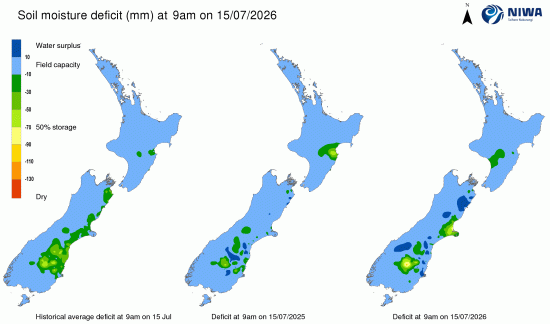
Looking at the moisture map.. The north island is going from one extreme to the other.... Farmers will be hurting. Again.
Where we are the map's turned orange and there's been no rain in the last while or going forward in the 10 day forecast. But the water tables still quite high and there's still some green in the paddocks plus plenty of rough pasture. I'm happy enough for this time of year.
Even in Auckland it’s been very hot and dry but grass still fairly green, must still be some moisture underneath.
Money that shifted out of equities into money market funds is now moving back.
“Cash on the sidelines” can certainly change ownership, but it can’t go “into” the stock market, or the bond market, or anywhere else, without coming right back out in someone else’s hands. Once a security is issued, that security has to be held by someone, at every moment in time, exactly in the form it was issued in, until that security is retired.
"Alexi Navalny was killed in his Arctic prison. And no mention was made of that."
In other news, Admiral Viktor Sokolov, who was killed in a cruise missile attack on the Sevastapol Black Sea naval headquarters back in September last year, has finally been removed from his position as commander of the Black Sea fleet. Obviously decomposing isn't an impediment to being a decision maker in Russia? Until now anyhow.
https://www.kyivpost.com/post/28112#:~:text=Russian%20Armed%20Forces-,'….
An American citizen journalist died in Ukrainian custody... and his name has not been mentioned from the White House press podium, nor his case investigated.
But it remains that Gonzalo Lira's death on Jan.24 - following an eight-month imprisonment on charges of ”justifying Russia's military actions in Ukraine” - is not 'useful' to the Biden administration. Yet Biden during his speech was very quick to pivot from Navalny's plight to the need for Congress to push through his funding package for Ukraine. Link
You are nothing if not predictible Audaxes. Gonzalo Lira was not a Journalist.
Here's an in depth exposee of the nasty little Russian asset you are propagandizing. Just another Andrew Tate wannabe.
Good Morning from #Germany, where individual banks are heavily involved in US commercial real estate (CRE). Acc to Moody's, Aareal Bank & Deutsche Pfandbriefbank have the largest exposure compared w/their capital levels. The shares of Deutsche Pfandbriefbank, which is the most shorted in Germany, have recently lost a quarter of their value. In case of Deutsche Bank, there is a gap between banks' exposure to US specialized lending and exposure to banks' US CRE book as DB engages to a material extent in other asset-based or project lending that would also qualify as specialised lending, acc to Moody's. https://moodys.com/research/Banks-Europe-Most-EU-banks-have-limited-direct-exposure-to-Sector-Comment--PBC_1397441 Link
Gee Whanganui River / National Park looks impressive. Has anyone visited?
No. But an on river trip has been on the hit list since I walked a lot of the bank 50 years ago.
You can now book guided on river multi day trips.
Remember back in the 1980s did a jet boat trip from Pipiriki a fair way up the river. The guy I worked for then was looking around a farm property for sale up there. Kahura I think was its' name? I remember it well because it was such a beautiful place. The farm shearing shed sat at the top of the cliffs and the wool was winched down to a river barge. The river was the only way out. From the river you couldn't see the land above had been cleared.
It's awesome. You can hire canoes and sell guide 5 days or 3. Very chilled and beautiful scenery. On the 2nd day we got dumped on by torrential downpour but you just huddled under our ponchos on the canoe and let the current take us. The next day the river had risen by over a metre and we flew along the last section in half the estimated time. Still one of the coolest trips we've done in NZ. Not as good as Abel Tasman by kayak but cool none the less.
Nickel seemingly hardly worth a nickel. Yet Australians will pay $billions to mine it, for no market. Extremely good example of the self defeating distortional affect of subsidies, money that inevitably simply disappears down its own vortex and undermines the viability of the relative industry. PM Muldoon demonstrated exactly that outcome in NZ with SMPs and other mindless agricultural subsidies.
Will be interesting to watch this. Maybe the old supply and demand. Mine it, stash it and if half the mines shut down who knows what will happen to the price in 12 months.
Guess you can create a nickel mountain just as the EEC in the 80s created frozen beef mountains. In the end that eventually provided plenty of cheap protein to such as the USSR and similar.
We slag off Australia but we are blowing $30 billion on climate homeopathy. At least nickel has some practical uses other than enriching carbon traders.
Hilarious, this new attempted attack line, "climate homoeopathy". Expect to see it being run with for a while, should we?
Wow ! Thanks for the link, it's incredible !
3 hundred and sixty million dollars penalty. Thats gonna hurt
That's a penalty for artificially inflating the value of his assets.. if this was applied to Luxon, shouldn't he receive a fine too?
Its for ripping off others, investors, state govts and banks
https://youtu.be/h0n2iy6cXOg?si=p5t5c-82sVDv63m4
Describes the property ponzi with trump at the centre of it
In Malaysia you pay 11% into your retirement fund and the employers pays 6%.
Image what 17% percent would do within the KiwiSaver format Using Kiwisaver as replacement of super would give immediate savings of super costs, building until you could get rid of National Super altogether.
https://www.oecd-ilibrary.org/sites/9b4a70b1-en/index.html?itemId=/cont…
That would have worked if we'd started decades ago. Starting now would mean too much burden on workers as they pay for boomers super plus try and save for their own.
"The worst decision by a New Zealand politician, ever"
https://www.stuff.co.nz/business/money/300327451/the-worst-decision-by-…
http://www.nzlii.org/nz/legis/hist_act/nzsa19741974n41317/
We elect the pollies so you can't blame everything on them. NZ elected jacinda and her cronies, at least half of of the nz voters are dumb f**ks. Those born after '72 DPB no doubt
Don't agree sparrow. The way it is going workers can not have Super at all when they need it, nor any Kiwisaver much.
Q. When is the best time to plant a fruit tree? A. Twenty years ago.
Q When is the second best time to plant a fruit tree? A. Now.
What if you can’t afford any fruit trees because you have to pay for everyone else to eat fruit?
Your negative commentary style Jimbo leads to dead fruit trees and no fruit. Fight over the cake but never bake one. It's a lefty thing.
(Loving the mixed metaphors today)
Good metaphor KH. Everyone is waiting for someone else to bake the cake. On the other hand it's hard to bake a cake when others have already grabbed all the ingredients. That's a right wing thing. The best cakes are those freely available to people in need and made by those who can for their own consumption.
It’s easy to see why NZ has one of the lowest levels of corruption in the world…oh, wait…
https://www.nzherald.co.nz/nz/christchurch-property-developer-dave-henderson-pushes-for-day-in-court/KTM4BEORXFCRBCS6C74XBAEOZA/
Suggest you research that person a bit more kiwikidsnz.
Fletchers again
https://www.stuff.co.nz/business/350181308/insiders-view-what-went-wron…
"If you ask me (and I was), the seeds of demise lie in the ideological decision by Mark Adamson and his acolytes to neuter middle management by dictating central control of all people-related and finance matters..."
I've seen this same business school dogma play out elsewhere, with the same results.
We welcome your comments below. If you are not already registered, please register to comment
Remember we welcome robust, respectful and insightful debate. We don't welcome abusive or defamatory comments and will de-register those repeatedly making such comments. Our current comment policy is here.