

Here's our summary of key economic events overnight that affect New Zealand, with news of more evidence inflation is sticky and that rate cut prospects are fading.
The American PCE inflation index came in at 2.7% for the year to March, back to levels they last had in November. It has now risen, modest as it might seem to us, for the past three months. Their 'core' rate has held at 2.8%. The financial market takeaway is that American inflation is uncomfortably sticky and that the Federal Reserve is right to be cautious about signaling a cut in its benchmark policy rates. (Again, it seems the Fed has called this correctly, and market analysts got ahead of themselves.)
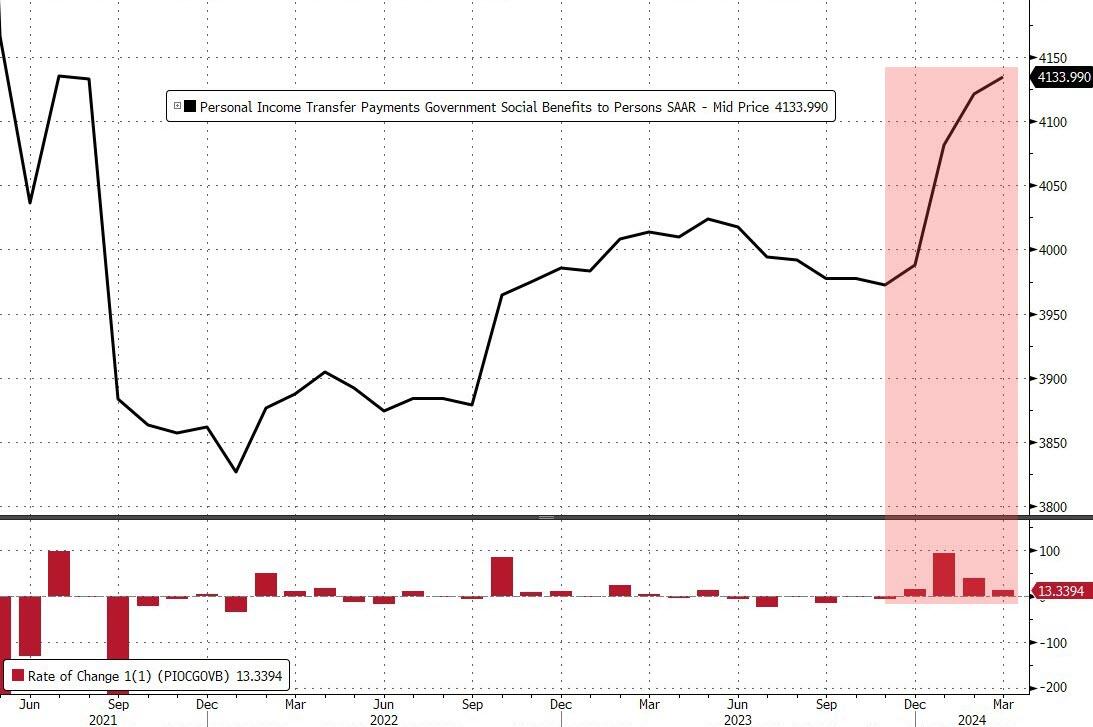
The same data shows American consumers spending normally with personal consumption spending +2.7% higher than a year ago while disposable personal incomes were only up +1.4%.
Although the final April University of Michigan sentiment survey results slipped slightly from the initial release, they essentially maintained the optimism gains that started in January and this index is still +21% higher than year ago levels.
Separately, the USDA is noting that one in five samples it took in a national milk survey showed the presence of the H5N1 bird-flu virus. That is indicating the infection in American dairy herds is much more widespread than previously assumed. But they also said there is no cause for alarm. "To date, the retail milk studies have shown no results that would change our assessment that the commercial milk supply is safe", they said. That is mainly because it is now clear that pasteurisation kills the virus in milk. American dairy farmers however might be noticing a dip in milk output from infected cows.
The Bank of Japan kept its policy unchanged on Friday, as expectations mount for central bank action to deter further selling of the embattled yen. It will guide overnight call rates between 0 and 0.1% with market actions, a new policy target adopted after the negative rate policy was ended on March 19. But the yen has continued to fall, primarily against the USD but even against the NZD. At today's 93.8 Yen to the NZD, that is now it's 'lowest' since May 1986, thirty-eight years ago. Against the USD, the yen has sunk to 158 to the USD, its 'lowest' since March 1986. Markets are betting that Tokyo is going to have to intervene very soon. While Japanese exports are suddenly much more competitive, a depreciation like this (-15% in the past year) could bring an inflationary shock with it.
And it is not only the Japanese who have a currency problem. The recent volatility of the yuan, depressed profits and unexpected shifts in external demand are combining to make some Chinese exporters less sure about their business prospects – and more likely to park their assets in anything but the yuan. The yuan's value has recovered somewhat since October but exports haven't, and business holders of the CNY are sensing a potential official depreciation is imminent.
Markets are also sensing a new official rate cut is imminent in China, and Chinese government 10 year bond yields dropped sharply today.
And staying in China, there are reports that property market sentiment is improving, and that has property-based equities rising sharply on the Hong Kong stock exchange - but oddly, not yet on the Shanghai exchange. One to watch.
And in a new stimulatory action, China is offering trade-in subsidies for new car buyers. ICE car owners can get a ¥10,000 subsidy (NZ$2325) to buy a new NEV, or they can get ¥7000 (NZ$1625) for a new ICE car with engines of 2 liters and smaller. The world's largest car market is about to get larger and have its profitability problems 'solved'.
In Australia there is headline talk that the "market bets the RBA will raise rates by August". The only problem is that this isn't actually what market pricing shows. A few outlier analysts are making the "raise by August" noise, but actual pricing shows no such thing. It shows no pricing of a rate hike (or cut) in 2024 and a partial pricing in of a -25 bps rate cut in mid 2025. But the headlines look interesting anyway.
The copper price rose another net +1.7% for the week, but that was enough to take it higher than its 2011 peak (remember spate of the copper thefts at that time?), but it still hasn't quite topped its all-time high in February 2022 although it is now close.
And a new food item is rising in price fast, olive oil. In Europe it is up +50% in a year. Production is being stunted by changes in climate in the regions that traditionally generate the main volumes. Expect other regions to step up plantings and production (and that might include New Zealand).
The UST 10yr yield is now at 4.67% and down -3 bps from this time yesterday, but up +4 bps for the week. The key 2-10 yield curve inversion is now at -32 bps. And their 1-5 curve inversion is marginally deeper at -52 bps. Their 3 mth-10yr curve inversion is now at -71 bps and also deeper. The Australian 10 year bond yield is now at 4.54% and down -3 bps. The China 10 year bond rate has taken a dramatic dive down to 2.21%, down a very unusual -7 bps. The NZ Government 10 year bond rate is now at 5.08% and up a sharp +10 bps from yesterday. A week ago it was at 4.92% so a net rise of +16 bps.
Wall Street is higher today with the S&P500 up +1.0% taking the weekly gain to +2.3%. Overnight European markets all rose. bookmarked by Frankfurt's +1.4% rise and London's trailing +0.7% gain.. Yesterday, Tokyo ended its Friday session up +0.8% for a weekly rise of +1.9%. Hong Kong ended up +2.1% for a spectacular weekly jump of +7.6%. And Shanghai rose +1.2% for no gain for the week. Singapore ended down -0.2% on the day. The ASX200 ended its Friday session down a sharp -1.4% for a modest weekly gain of +0.2%. The NZX50 fell -1.2% on Friday to limit the weekly gain to +0.4%.
The Fear & Greed index is still in the "fear" range as it was last week.
The price of gold will start today a little firmer, up +US$7 from this time yesterday at US$2340/oz. A week ago this price was US$2394/oz, so it has dropped -US$54 over the past seven days.
Oil prices are little-changed from yesterday at just under US$83.50/bbl in the US while the international Brent price is now just on US$88/bbl. A week ago these prices were US$82.50/bbl and US$86.50/bbl, so about +$1.50 up since then.
The Kiwi dollar starts today unchanged at just under 59.5 USc. For the week it has risen +½c. Against the Aussie we are softer at 91 AUc. Against the euro we are a little firmer at 55.6 euro cents. That all means our TWI-5 starts today just under 69.2 and also little-changed from yesterday but up +40 bps for the week.
The bitcoin price starts today at US$64,034 and down -1.1% from this time yesterday and for the whole week, down a ne of only -0.4%. Volatility over the past 24 hours has remained modest at just on +/- 1.5%.
Daily exchange rates
Select chart tabs
The easiest place to stay up with event risk is by following our Economic Calendar here ».
We welcome your comments below. If you are not already registered, please register to comment
Remember we welcome robust, respectful and insightful debate. We don't welcome abusive or defamatory comments and will de-register those repeatedly making such comments. Our current comment policy is here.